hankyoreh
Links to other country sites 다른 나라 사이트 링크
Defense Ministry decides not to classify N. Korea as its ‘main enemy’
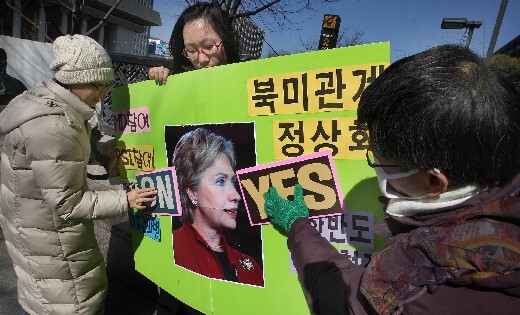
The Ministry of National Defense made the determination not to refer to North Korea as the “main enemy” but as a “direct and serious threat” in its 2008 Defense White Paper.
“It was determined that North Korea would be listed as a ‘direct and serious threat’ in the 2008 Defense White Paper that will be issued on February 20,” an authority at the ministry said Tuesday. In so doing, the ministry expressed its intention not to repeat a previous designation of North Korea as the country’s “main enemy,” in spite of repeated demands from conservatives since the launching of the Lee Myung-bak administration last year.
This approach by the Defense Ministry is a simple issue of expression regarding whether or not to call North Korea the country’s main enemy, and it is known to have reflected an understanding that this is separate from a readiness posture or the recognition of a realistic threat.
Previously, when Defense Minister Lee Sang-hee was asked at a general meeting of the parliamentary Defense Committee last September if the expression “main enemy” would be used again in the White Paper, he responded, “I don’t think it’s right for our society to lapse into the internal conflict that North Korea desires by using the expression ‘main enemy’ again.”
The expression “direct and serious threat” used in the 2008 White Paper represents a “composite” of the 2004 and 2006 Defense White Papers from the Roh Moo-hyun presidency. In the 2004 White Paper, North Korea was listed as a “direct military threat,” and in the 2006 White Paper, it was called a “serious threat.” Defense White Papers are released every two years.
The expression “main enemy” was first used in the 1995 Defense White Paper. This followed a statement made by North Korean representative Park Yong-su at the eighth inter-Korean working-level talks held at Panmunjom in March 1994, when he said, “If war breaks out, Seoul will become a sea of fire.” There are no other examples worldwide of nations being specified as “enemies” in Defense White Papers, and the expression was removed from the 2004 White Paper in consideration of the special nature of inter-Korean relations, combining exchange and cooperation with military antagonism.
Please direct questions or comments to [englishhani@hani.co.kr]
Editorial・opinion
![[Guest essay] The real reason Korea’s new right wants to dub Rhee a founding father](https://flexible.img.hani.co.kr/flexible/normal/500/300/imgdb/original/2024/0423/8317138574257878.jpg "[Guest essay] The real reason Korea’s new right wants to dub Rhee a founding father") [Guest essay] The real reason Korea’s new right wants to dub Rhee a founding father
[Guest essay] The real reason Korea’s new right wants to dub Rhee a founding father![[Column] ‘Choson’: Is it time we start referring to N. Korea in its own terms?](https://flexible.img.hani.co.kr/flexible/normal/500/300/imgdb/original/2024/0423/3617138579390322.jpg "[Column] ‘Choson’: Is it time we start referring to N. Korea in its own terms?") [Column] ‘Choson’: Is it time we start referring to N. Korea in its own terms?
[Column] ‘Choson’: Is it time we start referring to N. Korea in its own terms?- [Editorial] Japan’s rewriting of history with Korea has gone too far
- [Column] The president’s questionable capacity for dialogue
- [Column] Are chaebol firms just pizza pies for families to divvy up as they please?
- [Column] Has Korea, too, crossed the Rubicon on China?
- [Correspondent’s column] In Japan’s alliance with US, echoes of its past alliances with UK
- [Editorial] Does Yoon think the Korean public is wrong?
- [Editorial] As it bolsters its alliance with US, Japan must be accountable for past
- [Guest essay] Amending the Constitution is Yoon’s key to leaving office in public’s good graces
Most viewed articles
- 1[Guest essay] The real reason Korea’s new right wants to dub Rhee a founding father
- 2Terry Anderson, AP reporter who informed world of massacre in Gwangju, dies at 76
- 3Why Korea shouldn’t welcome Japan’s newly beefed up defense cooperation with US
- 4[Column] ‘Choson’: Is it time we start referring to N. Korea in its own terms?
- 5Senior doctors cut hours, prepare to resign as government refuses to scrap medical reform plan
- 6Opposition calls Yoon’s chief of staff appointment a ‘slap in the face’
- 7[Column] The clock is ticking for Korea’s first lady
- 8New AI-based translation tools make their way into everyday life in Korea
- 9[Editorial] Japan’s rewriting of history with Korea has gone too far
- 10[Column] Are chaebol firms just pizza pies for families to divvy up as they please?