hankyoreh
Links to other country sites 다른 나라 사이트 링크
Is Morgan Stanley being overly pessimistic about semiconductors?
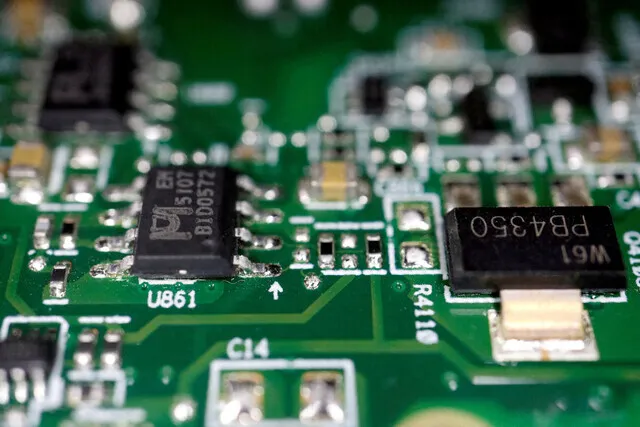
Optimists and pessimists are debating the mid-term prospects of the memory semiconductor industry.
Some observers expect Korean chipmakers Samsung Electronics and SK Hynix to keep posting record sales at least until early 2025. But others predict that memory semiconductor prices will plummet within a few months.
For now, the market is siding with the pessimists, led by investment bank Morgan Stanley. SK Hynix’s stock closed the day Thursday at 152,800 won, down 6.1% from the previous day of trading. In this article, we will examine a range of indicators to see whether pessimism will remain dominant.
① DRAM prices: When will they fall, and by how much?
Disagreement between the optimists and pessimists focuses on when DRAM prices will start to fall, and how great that fall will be. Morgan Stanley’s projection for DRAM’s average selling price is a 7.7% decrease in 2025 and a 25.0% decrease in 2026. According to the bank’s analysis, sluggish sales of smartphones and PCs and uncertainty about demand for AI will drive a downturn in DRAM prices early next year, bringing on a bear market.
In contrast, several securities firms in Korea and other countries don’t expect to see a modest fall in DRAM prices until the second half of next year.
In a report released on Sept. 10, Meritz Securities analyst Kim Sun-woo predicted that the average selling price for SK Hynix’s DRAM would not post a year-over-year decline until the fourth quarter of 2025 (-1%). Given aggressive expansion by Taiwan-based TSMC, which provides packaging for SK Hynix’s high-bandwidth memory chips, Kim surmised that the Korean company would continue to reap benefits from high-bandwidth memory.
② Have exports of Korean chips already peaked?
The main indicator behind Morgan Stanley’s analysis is the growth rate of Korea’s semiconductor exports. The bank noted in its report that chip exports had posted 50% year-over-year growth in July. That was down from the peak of 67%, the bank said, indicating that growth is softening.
One problem here is that Morgan Stanley apparently disregarded the base effect. Since bottoming out in February 2023 at US$6.11 billion, Korea’s semiconductor exports have been steadily rising along with a recovery in the market, reaching US$11.07 billion in December.
The reason the year-over-year growth rate has fallen recently is less because of an export slowdown than because of a substantial base effect. In fact, semiconductor exports in August reached US$11.89 billion, setting a record for the month. That backs up questions raised in some sectors about the logic behind Morgan Stanley’s analysis.
③ Will the semiconductor market face an oversupply?
The conclusions Morgan Stanley has drawn from sluggish performance in the IT sector deserve to be scrutinized.
Market research firm TrendForce predicted this month that global smartphone output in the fourth quarter would be 5% lower than in the year before. Apple has also been struggling with rumors about poor sales of the iPhone 16.
According to Morgan Stanley, prolonged stagnation in demand for smartphones and computers (except for AI servers) is depressing the semiconductor market.
But importantly, such factors don’t lead to a severe decline in the semiconductor market. The primary reason for pendulum swings between booms and busts in the industry is an imbalance between supply and demand. That is to say, aggressive facility expansion in times of strong demand leads to oversupply during times of weak demand, driving prices sharply downward.
A crucial factor here is that the memory industry has held off on investment given concerns about weak demand for IT. Samsung Electronics’ facility investment in the first half of the year in its Device Solutions division, which includes semiconductors, amounted to around 19.6 trillion won, which was 16% less than the previous year.
Furthermore, a new factory in Cheongju that’s being built by SK Hynix won’t be completed until the end of 2025.
“Since demand for memory semiconductors has been stagnant for so long, companies have been conservative in their investments,” observed Kim Yang-paeng, a senior analyst at the Korea Institute for Industrial Economics and Trade.
By Lee Jae-yeon, staff reporter
Please direct questions or comments to [english@hani.co.kr]

Editorial・opinion
![[Editorial] Head of USFK continues to cross the line with inappropriate political remarks](https://flexible.img.hani.co.kr/flexible/normal/500/300/imgdb/original/2026/0528/4817799568931091.jpg "[Editorial] Head of USFK continues to cross the line with inappropriate political remarks") [Editorial] Head of USFK continues to cross the line with inappropriate political remarks
[Editorial] Head of USFK continues to cross the line with inappropriate political remarks![[Editorial] A disgraced former president like Park Geun-hye has no place on the campaign trail](https://flexible.img.hani.co.kr/flexible/normal/500/300/imgdb/original/2026/0526/2117797859381587.jpg "[Editorial] A disgraced former president like Park Geun-hye has no place on the campaign trail") [Editorial] A disgraced former president like Park Geun-hye has no place on the campaign trail
[Editorial] A disgraced former president like Park Geun-hye has no place on the campaign trail- [Editorial] Korea’s online hate problem calls for platform regulation and anti-discrimination law
- [Reporter’s notebook] Trump’s primary purge of ‘traitors’ won’t win him anything
- [Guest essay] Moscow-Pyongyang ties are rewriting security in NE Asia
- [Reporter’s notebook] Trump’s primary purge of ‘traitors’ won’t win him anything
- [Column] An incompetent ally is worse than no ally at all
- [Editorial] Samsung’s tentative bonus deal highlights need for profit-sharing rules
- [Editorial] Crisis averted at Samsung, but society must continue chip profit-sharing debate
- [Editorial] Seoul and Tokyo should focus on pragmatic cooperation, not countering China
Most viewed articles
- 1K-pop wins big at AMAs, with BTS taking home artist of the year
- 2Gwangju groups call for Shinsegae chief to resign after ‘insincere’ apology for ‘Tank Day’ promo
- 3[Editorial] Head of USFK continues to cross the line with inappropriate political remarks
- 4[Editorial] Samsung’s tentative bonus deal highlights need for profit-sharing rules
- 5[Editorial] Crisis averted at Samsung, but society must continue chip profit-sharing debate
- 6KFTC eyes criminal proceedings against Coupang founder over alleged false filings
- 7[Reporter’s notebook] Trump’s primary purge of ‘traitors’ won’t win him anything
- 8After decades of secrecy, South Korea goes public with nuclear submarine project
- 9Lee calls sovereign defense ‘fundamental’ amid rift with US over OPCON transfer timing
- 10[Guest essay] Moscow-Pyongyang ties are rewriting security in NE Asia