hankyoreh
Links to other country sites 다른 나라 사이트 링크
Trump eyes Korea for reciprocal tariffs, using LNG and shipbuilding as leverage
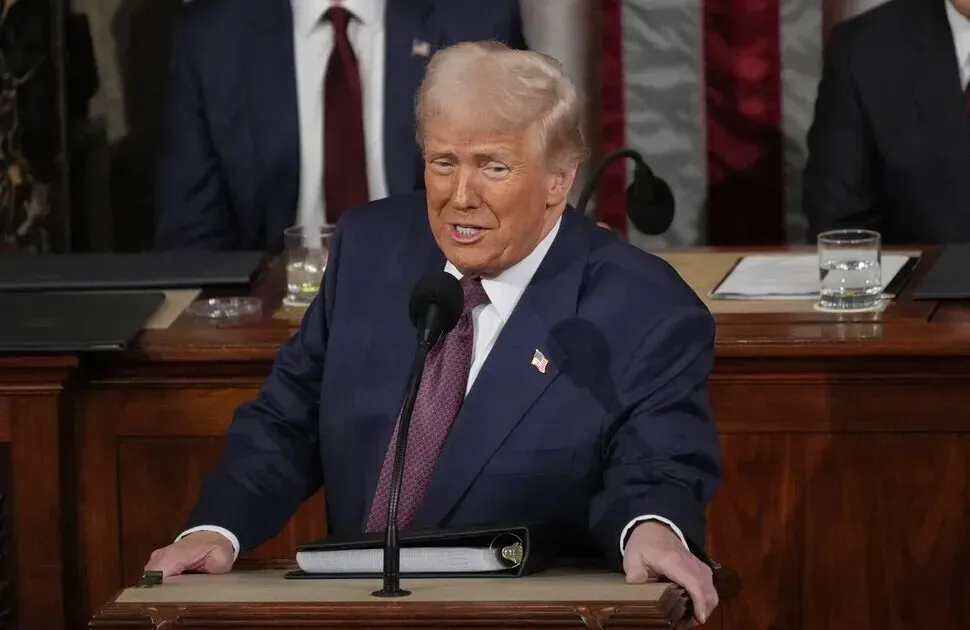
In a speech to both houses of Congress on Tuesday, US President Donald Trump mentioned actions that could have a direct impact on the Korean economy.
Trump claimed that Korea’s tariffs, on average, are four times higher than those of the US, suggesting that Korea could be hit by the reciprocal tariffs that are supposed to take effect at the beginning of April.
Trump’s determination to revoke the CHIPS and Science Act is another potential pitfall for Korean chipmakers that made big investments in the US during the Biden administration.
Trump also signaled cooperation with other countries on developing a natural gas pipeline in Alaska and reviving the US’ shipbuilding industry. Some think that cooperation in the energy and shipbuilding sectors could help Korea convince the US to ease off on trade.
“South Korea’s average tariff is four times higher [than the US’],” Trump said in his address.
The idea behind reciprocal tariffs is to tax another country’s imports at the same level as their own tariffs.
Trump’s direct mention of Korea in this context makes it more likely that Korea will be included in the reciprocal tariffs Trump is planning to roll out on April 2.
Under the free trade agreement that took effect in 2012, around 98% of goods traded between Korea and the US are tariff-free. But Trump means to calculate non-tariff factors including value-added tax (VAT), industrial subsidies and exchange rates into his decision about whether to implement reciprocal tariffs.
Trump compounded the pressure by repeatedly suggesting the possibility of abolishing the CHIPS Act. His idea is to use tariffs as a weapon to encourage investment in place of the semiconductor law’s approach of encouraging companies to build factories in the US by providing US$52.7 billion in support.
“Your CHIPS Act is a horrible, horrible thing,” Trump asserted, citing the example of the Taiwanese semiconductor company TSMC, which recently agreed to invest an additional US$100 billion in the US.
It remains unclear whether abolition of the CHIPS Act would be approved by the US Congress. It is also uncertain whether Trump’s remarks were referring to subsidies that have already been contractually set in place.
Before the completion of its term, the Joe Biden administration signed subsidy payment contracts with key companies last year. Samsung Electronics and SK Hynix are also officially set to respectively receive US$4.645 billion and US$458 million if they follow through with their promised investments.
An official with the South Korean Ministry of Trade, Industry and Energy stressed that the semiconductor subsidies were based on “contracts established between the government and companies.”
“We will need to additionally gauge how things progress going forward,” they added.
Also on Tuesday, Trump pledged to “resurrect the American shipbuilding industry” — another point that the South Korean government may refer to as leverage.
Last year, China accounted for 71% of global shipbuilding orders, while Korea held 17% of the market and Japan 5%. The rate for the US was just 0.1%.
The number of shipyards in the US, which stood at over 400 in the past, has since dwindled to 21. In contrast, China has been using its shipbuilding industry as a basis for beefing up its navy, with 234 warships to the US’ 219 — posing a threat to US dominance of the seas.
Since the US is not in a position to establish the necessary capabilities in the short term, one realistic option available to it is cooperation with South Korea, which outperforms it in terms of current competitiveness. Seoul may be in a position to emphasize the potential for cooperating with the US in areas such as maintenance, repair and overhaul (MRO) services for US warships along with new building and orders for liquefied natural gas (LNG) carriers and icebreakers.
Trump further mentioned the possibility of South Korea as a potential “partner” in investing in an Alaskan natural gas pipeline project. Seoul is currently giving the matter careful consideration.
Minister of Trade, Industry and Energy Ahn Duk-geun stressed Tuesday that there was “no reason for South Korea to go on board with an infeasible project.”
Ahn went on to say that Seoul would “decide on a position after examining the specific content and situation.”
For now, the South Korean government is weighing the possibility of increasing its imports of LNG from the US. Trump previously used the increased adoption of US-produced crude oil and gas as a bargaining chip during his first term.
By Jun Seul-gi, staff reporter; Park Jong-o, staff reporter; Lee Jae-yeon, staff reporter
Please direct questions or comments to [english@hani.co.kr]

Editorial・opinion
![[Editorial] Head of USFK continues to cross the line with inappropriate political remarks](https://flexible.img.hani.co.kr/flexible/normal/500/300/imgdb/original/2026/0528/4817799568931091.jpg "[Editorial] Head of USFK continues to cross the line with inappropriate political remarks") [Editorial] Head of USFK continues to cross the line with inappropriate political remarks
[Editorial] Head of USFK continues to cross the line with inappropriate political remarks![[Editorial] A disgraced former president like Park Geun-hye has no place on the campaign trail](https://flexible.img.hani.co.kr/flexible/normal/500/300/imgdb/original/2026/0526/2117797859381587.jpg "[Editorial] A disgraced former president like Park Geun-hye has no place on the campaign trail") [Editorial] A disgraced former president like Park Geun-hye has no place on the campaign trail
[Editorial] A disgraced former president like Park Geun-hye has no place on the campaign trail- [Editorial] Korea’s online hate problem calls for platform regulation and anti-discrimination law
- [Reporter’s notebook] Trump’s primary purge of ‘traitors’ won’t win him anything
- [Guest essay] Moscow-Pyongyang ties are rewriting security in NE Asia
- [Reporter’s notebook] Trump’s primary purge of ‘traitors’ won’t win him anything
- [Column] An incompetent ally is worse than no ally at all
- [Editorial] Samsung’s tentative bonus deal highlights need for profit-sharing rules
- [Editorial] Crisis averted at Samsung, but society must continue chip profit-sharing debate
- [Editorial] Seoul and Tokyo should focus on pragmatic cooperation, not countering China
Most viewed articles
- 1K-pop wins big at AMAs, with BTS taking home artist of the year
- 2[Editorial] Head of USFK continues to cross the line with inappropriate political remarks
- 3KFTC eyes criminal proceedings against Coupang founder over alleged false filings
- 4[Editorial] Samsung’s tentative bonus deal highlights need for profit-sharing rules
- 5[Editorial] Crisis averted at Samsung, but society must continue chip profit-sharing debate
- 6[Reporter’s notebook] Trump’s primary purge of ‘traitors’ won’t win him anything
- 7Ambassador denies Iranian involvement after Korea concludes ship was hit by Iran-linked missiles
- 8Lee pulls off pragmatic diplomacy balancing act between strongmen Trump and Xi
- 9Seoul stops short of naming Iran as attacker in strike on ship in Hormuz
- 10[Guest essay] Moscow-Pyongyang ties are rewriting security in NE Asia