hankyoreh
Links to other country sites 다른 나라 사이트 링크
Trump’s 100% chip tariff could be detrimental to Korean exports
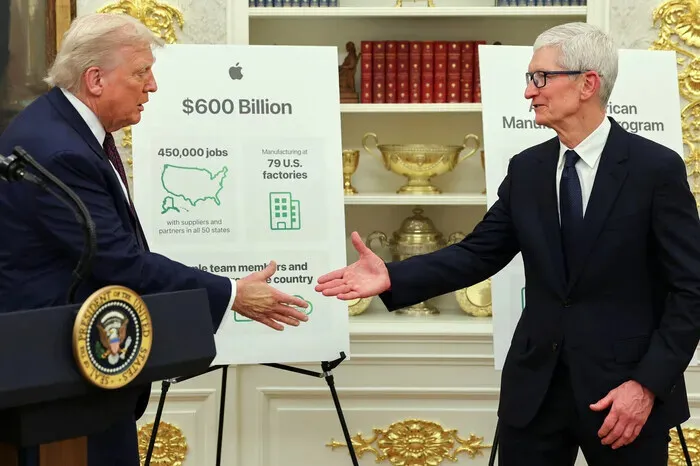
US President Donald Trump’s announcement that he will impose a 100% tariff on all imported semiconductors has sent jitters through the South Korean government and business community once more. That’s because, despite the Information Technology Agreement stipulating no tariffs among member nations, including the US and South Korea, tariffs even higher than those on automobiles (15% for South Korea) and steel and aluminum (50%) are looming over semiconductors.
Observers say that the US is cracking the whip on countries that have served as US chip suppliers so far in order to bring production to the home front.
On Wednesday, Trump, alongside Apple CEO Tim Cook, announced at the White House that Apple will be investing an additional US$100 billion in the US.
“We’ll be putting a tariff of approximately 100% on chips and semiconductors. But if you’re building in the United States of America, there’s no charge,” Trump said.
“If you’ve made a commitment to build or if you’re in the process of building, as many are, there is no tariff,” he added
Trump also warned countries not to go back on their word.
“If, for some reason, you say you’re building and you don’t build, then we go back and we add it up, it accumulates, and we charge you at a later date, you have to pay, and that’s a guarantee.”
Trump had indicated multiple times that he’d levy a semiconductor tariff, but this was the first time he publicly announced one.
Trump’s tariff comments came directly after an announcement of Apple’s plan to invest US$100 billion in the US over the next four years. Trump did not mention the specifics regarding how much of the manufacturing process needs to happen within the US in order to be exempt from the tariffs.
Semiconductors make up Korea’s second-largest export category to the US, following automobiles. According to the Korea International Trade Association, chip exports to the US amounted to US$10.7 billion last year.
Before Trump’s announcement, the South Korean administration announced that it had secured a deal with the US to receive “most-favored-nation” benefits on semiconductors and pharmaceutical products. Since the US has made a deal with the EU to levy tariffs of only 15% on semiconductors, it’s possible that South Korea could get a similar deal. The White House is expected to announce its official tariff policy next week.
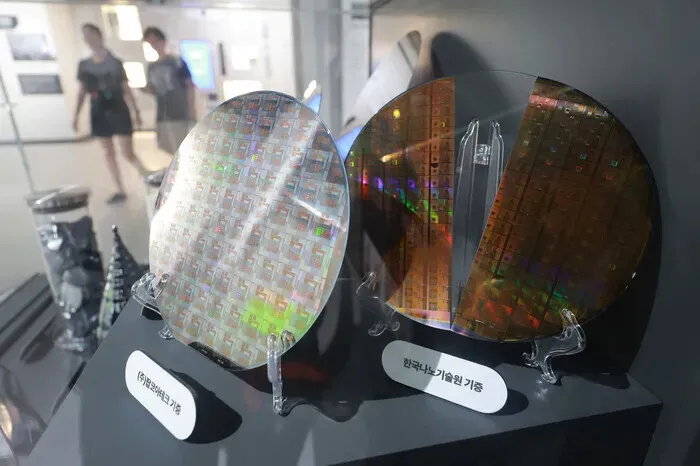
Industry insiders are viewing the move as part of Trump’s strategy to bring the semiconductor supply chain to the US. In the current supply chain, US firms take care of the design, which has high added value, and manufacturers in South Korea, Taiwan and other Asian countries take care of manufacturing and production.
The Biden administration offered a “carrot” in the form of large-scale subsidies to firms that produced in the US, but Trump has chosen the “stick” in the form of tariffs on chips produced outside the US.
The impact that such tariffs will have on Korean firms is not trifling. Semiconductors are the largest category of exports to the US, following automobiles. Among the semiconductors produced in Korea last year, 7.5% were exported to the US. Compared to chips exported to China (32.8%), Hong Kong (18.4%), Taiwan (15.2%) and Vietnam (12.7%), the proportion of chips exported to the US is relatively low. The US places fifth in the ranking of countries to which Korea exports chips.
However, the tariffs increase the price of chips sold in the US. Firms that purchase Korean chips, reprocess them, and resell them to the US will also face increased costs, meaning there’s no ruling out the possibility of buyers pressuring Korean firms to lower their prices.
Companies now face the dilemma of moving production facilities to the US to avoid the tariffs. However, the process of investing in and building local production sites in the US takes years before factories can actually begin operations.
In addition to Apple, many semiconductor firms have pledged to expand their production in the US. Taiwan’s TSMC has pledged to invest US$165 billion in the US, while Nvidia is planning on investing US$500 billion in AI infrastructure over the next four years.
South Korea’s Lee Jae-myung administration is, for now, betting on the most-favored-nation benefits it was promised. The administration says it was promised “not unfavorable conditions” compared to other countries when it came to product categories like semiconductors and pharmaceuticals during recent trade negotiations with the US. The administration, therefore, expects it will not receive anything higher than the 15% levied on the EU.
South Korea’s top trade envoy Yeo Han-koo said during a radio interview on Thursday, “If the tariff on semiconductors is set at 15% for most-favored-nation conditions, then we will also get 15%.”
“Whether the official tariff [on semiconductors] is 100% or 200%, it won’t matter to us,” he stressed.
However, there are concerns about uncertainty based on Trump’s tendency to freewheel deals as circumstances change. One government official said, “We will need to wait until an official administrative order is issued to see exactly how things will proceed.”
Some within the industry say it is unlikely that such tariffs will become a reality. Semiconductors are essential for smartphones, automobiles, and electronics — the bread and butter of industry. Big US tech firms have gone all in on AI, and are therefore the largest consumers of chips, so a high tariff on semiconductors will significantly impact the US economy. Also, semiconductor production involves several stages of microproduction, including production, design, and packaging, before the final product is issued. Some therefore argue that a universal tariff will not be as damaging as people think.
The high bandwidth memory (HBM) chips produced by SK Hynix, for instance, are part of the Nvidia AI acceleration phase package produced by TSMC. They go through processing at a data center server production site in Mexico before the final product is issued to the US market. The production process’s division of labor is highly complex, making it difficult to categorize under a single tariff.
Kim Yang-paeng, a senior research specialist for the Korea Institute for Industrial Economics and Trade, said, “Micron Technology, an American producer of computer memory, does not produce its chips locally. Therefore, Korean firms are not the only ones who will be hurt by the tariffs.”
“Chip firms that export to the US will call on Korean components makers to lower their prices, or the overall chip market may shrink,” he added.
By Park Jong-o, staff reporter; Lee Bon-young, staff reporter; Kim Won-chul, Washington correspondent
Please direct questions or comments to [english@hani.co.kr]

Editorial・opinion
![[Editorial] Head of USFK continues to cross the line with inappropriate political remarks](https://flexible.img.hani.co.kr/flexible/normal/500/300/imgdb/original/2026/0528/4817799568931091.jpg "[Editorial] Head of USFK continues to cross the line with inappropriate political remarks") [Editorial] Head of USFK continues to cross the line with inappropriate political remarks
[Editorial] Head of USFK continues to cross the line with inappropriate political remarks![[Editorial] A disgraced former president like Park Geun-hye has no place on the campaign trail](https://flexible.img.hani.co.kr/flexible/normal/500/300/imgdb/original/2026/0526/2117797859381587.jpg "[Editorial] A disgraced former president like Park Geun-hye has no place on the campaign trail") [Editorial] A disgraced former president like Park Geun-hye has no place on the campaign trail
[Editorial] A disgraced former president like Park Geun-hye has no place on the campaign trail- [Editorial] Korea’s online hate problem calls for platform regulation and anti-discrimination law
- [Reporter’s notebook] Trump’s primary purge of ‘traitors’ won’t win him anything
- [Guest essay] Moscow-Pyongyang ties are rewriting security in NE Asia
- [Reporter’s notebook] Trump’s primary purge of ‘traitors’ won’t win him anything
- [Column] An incompetent ally is worse than no ally at all
- [Editorial] Samsung’s tentative bonus deal highlights need for profit-sharing rules
- [Editorial] Crisis averted at Samsung, but society must continue chip profit-sharing debate
- [Editorial] Seoul and Tokyo should focus on pragmatic cooperation, not countering China
Most viewed articles
- 1K-pop wins big at AMAs, with BTS taking home artist of the year
- 2[Editorial] Head of USFK continues to cross the line with inappropriate political remarks
- 3KFTC eyes criminal proceedings against Coupang founder over alleged false filings
- 4[Editorial] Samsung’s tentative bonus deal highlights need for profit-sharing rules
- 5[Editorial] Crisis averted at Samsung, but society must continue chip profit-sharing debate
- 6[Reporter’s notebook] Trump’s primary purge of ‘traitors’ won’t win him anything
- 7Ambassador denies Iranian involvement after Korea concludes ship was hit by Iran-linked missiles
- 8Lee pulls off pragmatic diplomacy balancing act between strongmen Trump and Xi
- 9Seoul stops short of naming Iran as attacker in strike on ship in Hormuz
- 10[Guest essay] Moscow-Pyongyang ties are rewriting security in NE Asia