hankyoreh
Links to other country sites 다른 나라 사이트 링크
Buried and lost for a millennium, Korean temple’s Bodhisattva dazzles once more
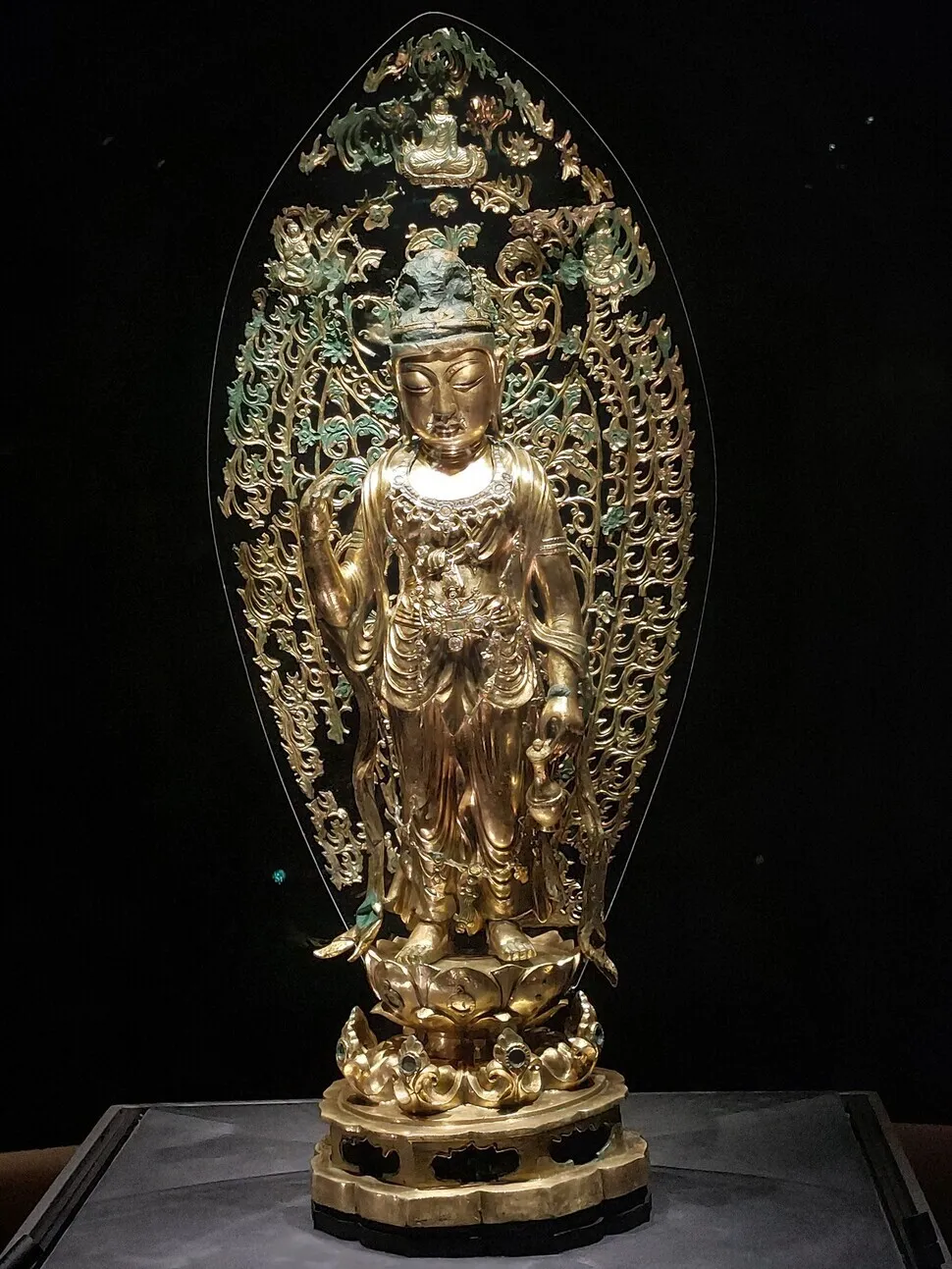
The dazzling gilt-bronze statue of the Bodhisattva lay buried in the ground in a remote area of the Korean countryside.
This standing statue of Avalokiteśvara (pronounced Gwaneum in Korean) was produced with extreme care by the craftsmen of Gyeongju in the eighth and ninth centuries CE, in the Unified Silla Period.
But the statue’s destiny was a dark one. After being transferred to a temple in the mountains of Yangyang, in Gangwon Province, the statue was buried in a landslide that swallowed the entire temple.
Fate did not release the statue from its grip until the 21st century. Nine years ago, the statue turned up, almost miraculously, under an archaeologist’s spade. It took five years of painstaking work removing greenish rust and dirt before the statue could return to the light.
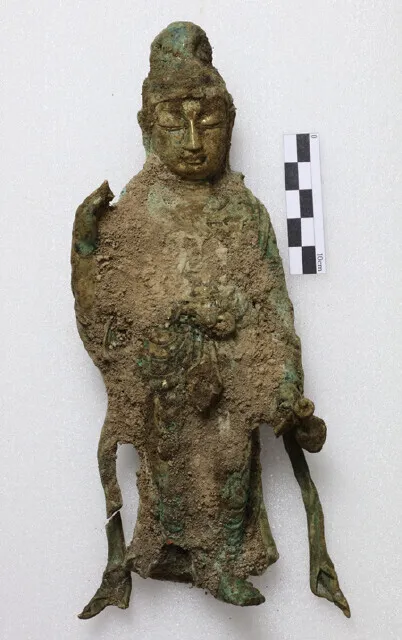
This is the gripping tale behind the gilt-bronze standing statue of Avalokiteśvara excavated at the Seollim Temple site in Yangyang. The statue has been displayed at a special exhibition called the “Reclaimed Light from the Unified Silla Period” at the Chuncheon National Museum since May.
After being excavated in 2015, the statue underwent a lengthy restoration period that has made it one of the most stunning ancient Buddha statues on the Korean Peninsula.
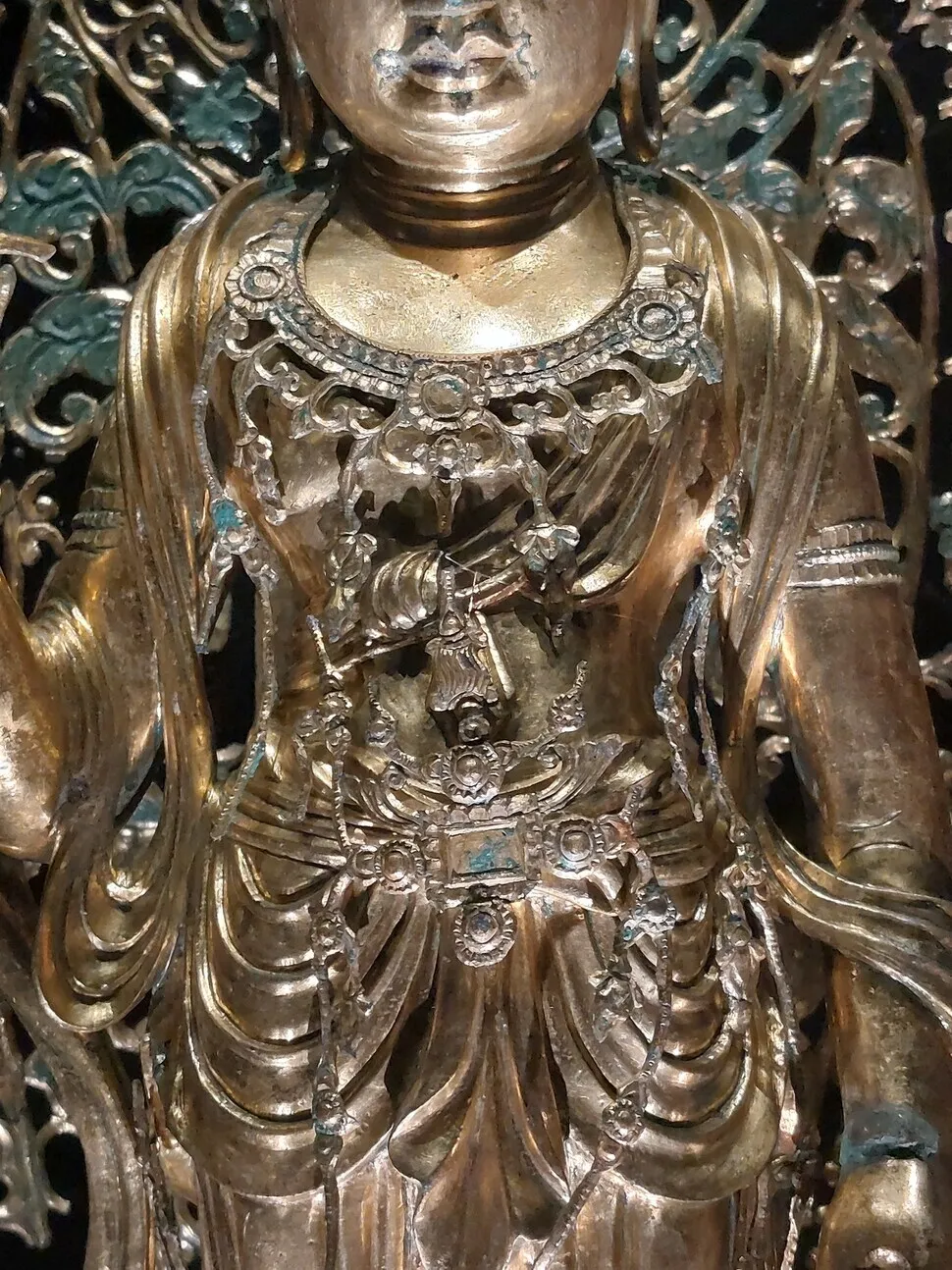
Including the seat and the aura behind it, the gilt-bronze standing statue of Avalokiteśvara is 66.7 cm (26.2 in) tall. The statue is not only the largest of the non-monolithic gilt-bronze statues from the Unified Silla period with a known place of excavation, but also retains its seat, aura, and various ornaments. It’s also the only Buddha statue in the country that shows traces of coloration with pigments and ink on the hair, lips and beard.
Following its restoration at the Cultural Heritage Conservation Science Center in 2021, the statue was first displayed to the public at the Central Buddhist Museum last year. While the current exhibition is not the statue’s first public appearance, it’s more noteworthy than last year’s exhibition.
Preservation experts at the Chuncheon National Museum collaborated to restore details on the aura behind the statue and some of the decorative beads. In addition, the statue’s display case rotates, allowing viewers to admire every detail of the statue.
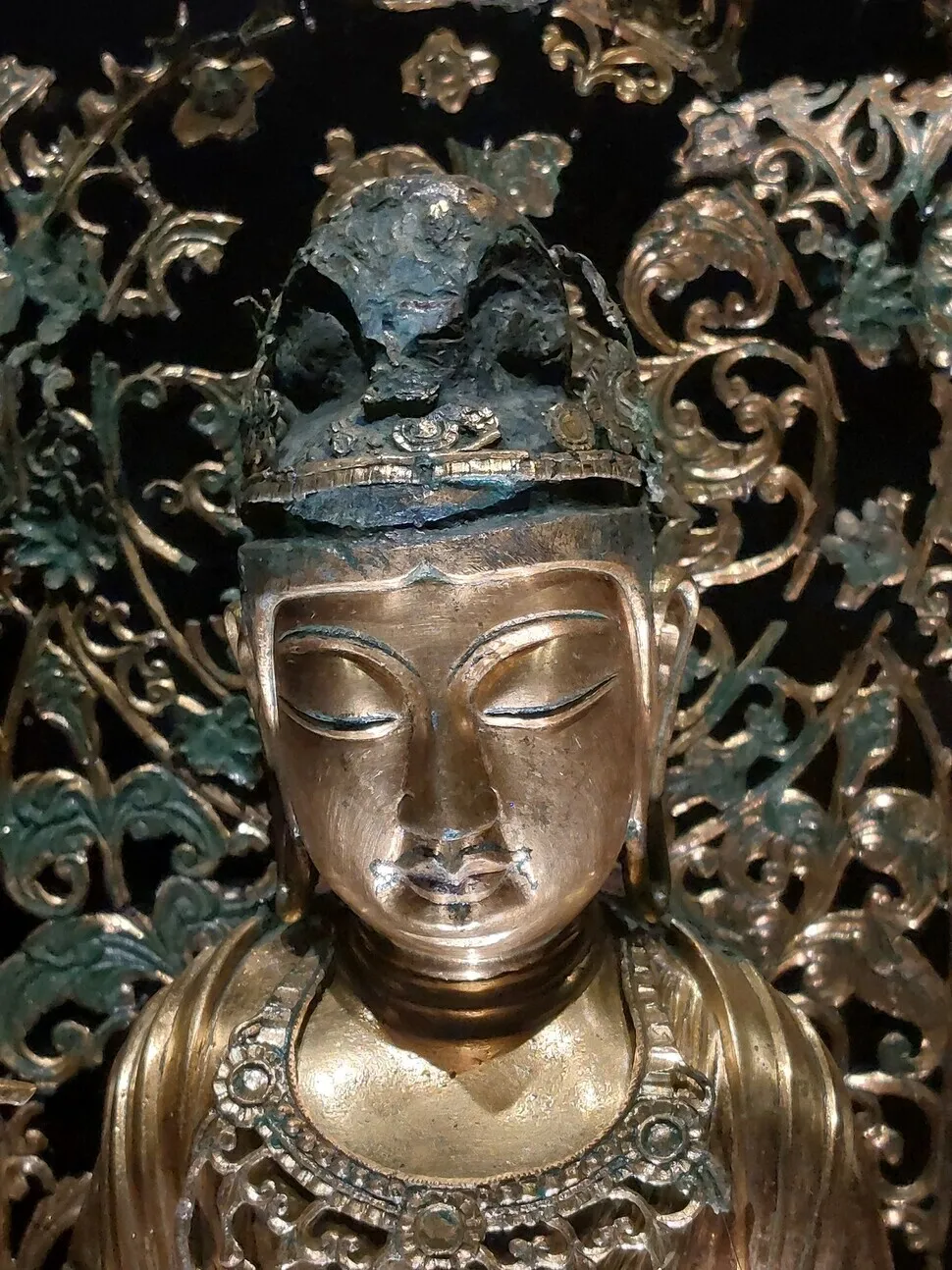
The Seollim Temple’s statue is considered the most decoratively gorgeous and outstanding of any ancient Buddhist statue in Korea.
Perhaps the best way to decorate a statue is to layer several areas with jewelry to maximize the visual effect. That’s the approach that was put to excellent use in the statue excavated from the Seollim Temple site. The patterns of flames and vines on the aura were made with openwork that exquisitely harmonizes with the splendor of the body.
Viewers’ eyes are drawn to the neck, chest and stomach of the Avalokiteśvara statue. Above the gentle folds of the clothing is a necklace of baubles shaped like flower blossoms. Below that, by the belly, is a square ornament of exquisite construction that represents the height of decorative extravagance. Aiding the viewing experience is a museum light that grows brighter and dimmer in intervals, like the tolling of a bell.
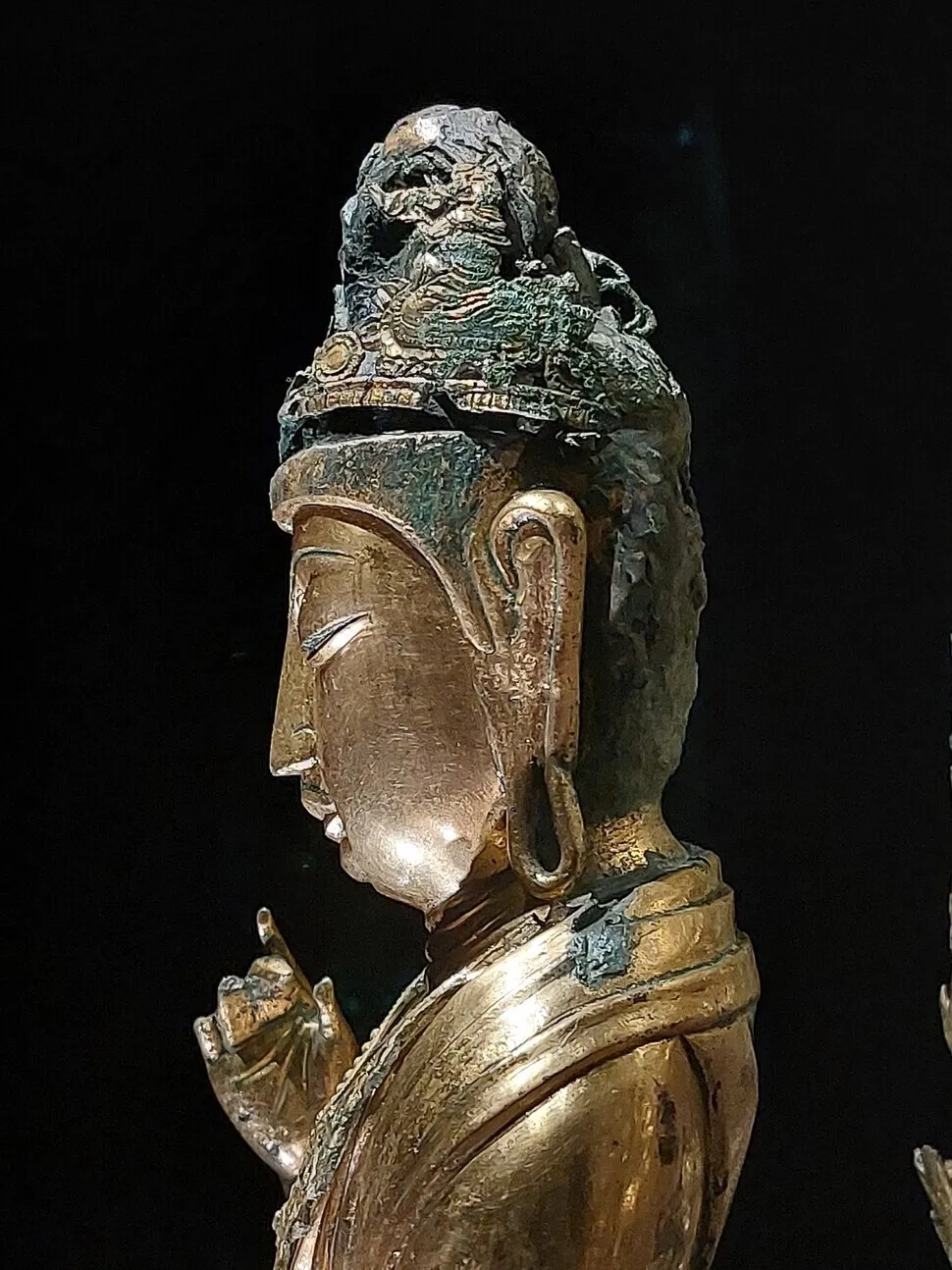
An interesting comparison can be drawn between this statue and the Baekje-era gilt-bronze Avalokiteśvara statue that was returned to Japan after being exhibited at the Ho-Am Art Museum in Yongin, Gyeonggi Province, in the first half of the year. Both the statues can be regarded as masterpieces reflecting the Buddhist belief, artistry and technique of the two kingdoms of Silla and Baekje. But the ingenuity and childlike expression of the Baekje statue contrasts with the gravity, serenity, and benevolence of the Silla statue from the Seollim Temple site, which was made 200 years later.
Those distinctive characteristics of Buddhist statues of the Silla dynasty strike a contrast with Buddhist statues of the Tang and Song dynasties of China, which are solemn yet show secularization in bodily features, and Buddhist statues of the contemporaneous Heian period of Japan, which have frightening facial expressions that are supposed to drive away demons.
This exhibition, which runs through July 28, shows how the Buddhist artistry of the Unified Silla period developed and matured in its representation of figures while carrying on the tradition of gold craftsmanship evident in crowns and other jewelry found in Silla burial mounds of the fifth and sixth centuries.
By Roh Hyung-suk, senior staff writer
Please direct questions or comments to [english@hani.co.kr]

Editorial・opinion
![[Editorial] PPP leader’s trip to US is a stunt without substance](https://flexible.img.hani.co.kr/flexible/normal/500/300/imgdb/original/2026/0417/4317764157621763.jpg "[Editorial] PPP leader’s trip to US is a stunt without substance") [Editorial] PPP leader’s trip to US is a stunt without substance
[Editorial] PPP leader’s trip to US is a stunt without substance![[Editorial] Remembering Sewol tragedy is how we prevent another](https://flexible.img.hani.co.kr/flexible/normal/500/300/imgdb/original/2026/0416/6617763295917051.jpg "[Editorial] Remembering Sewol tragedy is how we prevent another") [Editorial] Remembering Sewol tragedy is how we prevent another
[Editorial] Remembering Sewol tragedy is how we prevent another- [Editorial] Close communication with incoming US ambassador will be key for alliance
- [Editorial] World must stand against any and all tolls in Strait of Hormuz
- [Correspondent’s column] Trump’s real red line isn’t Iran’s nuclear program
- [Column] Who’s calling whom a rogue state?
- [Column] Xi Jinping exploits growing rift in Transatlantic alliance
- [Column] Trump’s war boomerangs on US hegemony and alliances
- [Column] Negotiating with bombs
- [Column] What the debate over Atlas and robots in factories missed
Most viewed articles
- 1South Korea positions itself for greater influence after end of Iran war
- 2Korean A-bomb victims head to UN to tell their stories and seek accountability
- 3[Interview] Key to stewardship code is sustainable value, not box-ticking, says expert
- 4World is ‘being ravaged by a handful of tyrants ’ pope says in dig at Trump
- 5Trump hints second round of talks with Iran could take place over weekend
- 6[Editorial] PPP leader’s trip to US is a stunt without substance
- 7Trump hints at renewed talks with Iran, but nuclear enrichment remains a sticking point
- 8Lee becomes first sitting president to attend Sewol memorial ceremony
- 9Pushed into a corner, Sewol memorial fights to keep memory alive
- 10Sewol survivors say their mistake was making it off the ferry alive