hankyoreh
Links to other country sites 다른 나라 사이트 링크
[Interview] Are China and Russia fake friends?
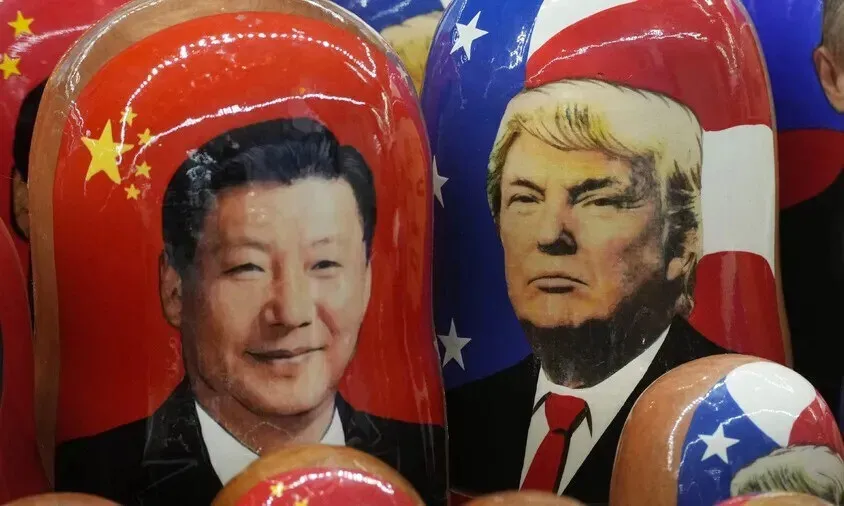
“It is a constant in a turbulent world rather than a variable in geopolitical games.”
This is how Wang Yi, China’s top diplomat, described the relationship between China and Russia during a press conference held last month on the sidelines of the National People’s Congress in Beijing. It was a signal of confidence on China’s part at a time when the US is ratcheting up its pressure to suppress the East Asian state’s rise and US President Donald Trump is pursuing closer ties with Moscow.
Both China and Russia have taken to calling one another their “equal” in friendship and emphasizing the mature, resilient and stable fraternity between their two nations. On April 1 (local time), Russian President Vladimir Putin received Wang and conveyed a message looking forward to Chinese President Xi Jinping’s upcoming visit to Moscow slated for May, saying the Chinese leader would be Russia’s “main guest” at the commemoration of the 80th anniversary of the end of WWII.
But while the two world powers outwardly project an image of a solid relationship, a peek beneath the surface finds fissures and instability. Sören Urbansky, a professor of history at Germany’s Ruhr University Bochum, says that it’s important to look at the relationship between China and Russia from a historical viewpoint.
“On the surface, both sides portray their relationship as very friendly — as allies, almost, you may say. But in fact, it’s just a strategic partnership,” Urbansky says. While they may currently enjoy a mutually beneficial relationship, that doesn’t mean the two will “automatically be friends forever. There are lots of areas where their interests are not congruent, but actually opposing,” the professor contends.
Along with Martin Wagner of the Berlin Free University’s Institute for East European Studies, Urbansky coauthored the book “China and Russia: A Brief History of a Long Relationship,” which was published in February. In the book, the authors outline how the relationship between Russia and China has repeated the cycle of cooperation, competition and distrust since the 17th century, when they first forged diplomatic ties.
The Hankyoreh spoke to Urbansky over Zoom on March 31 to understand what’s going on beneath the surface of Beijing-Moscow relations. His book with Wagner is slated for publication in Korea this October.

The following interview has been edited for length and clarity.
Hankyoreh: The prevailing view is that China and Russia will continue to have cozy relations going forward. Do you think that’s the case?
Urbansky: What’s important to understand is the growing imbalance in the relationship. China is clearly the dominant partner, while Russia is increasingly the junior one. And true friendship usually requires equality.
On the surface, both sides present themselves as equals — Xi Jinping hosts Putin with all the expected ceremony. But behind closed doors, China likely uses its leverage to push its interests. The imbalance is deepening.
Putin likely hoped a swift victory in Ukraine would strengthen his position with China. That didn’t happen. The war has only made the relationship more asymmetrical — and I’m not sure how long that dynamic will serve both sides equally.
Hankyoreh: What would you say have been the turning points for China-Russia relations since the 2010s?
Urbansky: The first early turning point was Russia’s annexation of Crimea in 2014. The ruble lost value — including against the yuan — shifting the economic balance. Cross-border dynamics changed too: where Russians once traveled more to China, now more Chinese go to Russia.
Trade between the two countries has grown significantly since then. Russia, under sanctions, became more willing to sell high-tech military equipment to China. Joint military exercises also intensified — first on land, now including air and sea.
Another important moment was China’s launch of the Belt and Road Initiative in 2013. Initially, Russia was hesitant and even promoted its own alternative, the Eurasian Economic Union. While Russia later joined the BRI, China never joined the EEU — another sign of the imbalance.
Hankyoreh: In your book with Martin Wagner, you argue that China appears to be simultaneously seeking both closeness and distance in its relationship with Russia. What is the intention behind this dual approach?
Urbansky: Officially, China maintains a position of neutrality. It abstains from UN votes, and it hasn’t recognized any of Russia’s annexed territories since 2008. But in practice, it’s leaning toward Russia — offering support without full commitment.
That’s because China also depends heavily on countries opposed to Russia: the US, Germany, Japan, South Korea and others. It doesn’t want to jeopardize those economic and political relationships.
China is also benefiting from the current global order — institutions like the WTO, WHO and UN — and uses them to its advantage. Russia, by contrast, has tried to disrupt that very order. So while both countries may share some goals, they pursue them in very different ways.

Hankyoreh: Some say that Trump’s cozying up with Putin is a tactic for checking China. Do you see that to be the case?
Urbansky: This is often called a “reverse Kissinger” moment, referring to Nixon and Kissinger’s outreach to China in 1971-1972. But the comparison doesn’t hold. Back then, China and the Soviet Union were already in open conflict. Today, China and Russia are strategic partners, not rivals. If Trump hopes to split them, it won’t be easy. Putin won’t risk his relationship with China to improve ties with the US. He wants both — better relations with Washington while keeping Beijing close, especially given Russia’s economic dependence on China.
Hankyoreh: What should Europe’s strategy be when dealing with the China-Russia relationship? China has sent signals of appeasement at the Munich Security Conference, calling Europe a partner.
Urbansky: After WWII, the US built the world order. Now, it’s distancing itself from that role, which benefits China and Russia. But China’s aggressive export subventions, its handling of COVID and its pro-Russian neutrality in Ukraine have made it a rival in European eyes. China is now trying to rebuild trust, especially with uncertainties surrounding the US trade policy. Still, Europe sees China’s political system as fundamentally incompatible. So while China may not be a truly constructive partner, Europe may have few alternatives if the US becomes increasingly adversarial. China might not be ideal — but it could be the least bad option.
Hankyoreh: What sort of risks do you think China-Russia relations carry, then?
Urbansky: Their strategic goals don’t always align. For example, if a Trump administration pulls US troops from Europe, it helps Russia but threatens China, since those forces might shift to East Asia — not in China’s interest. Their geopolitical agendas often diverge.
China and Russia compete in regions like Central Asia. Russia sees it as its sphere of influence, but China is now the top trading partner of all five Central Asian states and has even established a military presence in Tajikistan. Similarly, in the Arctic, Russia claims exclusive control, while China asserts its interests as a “near-Arctic” state. So while they are strategic partners, friction points remain.
Hankyoreh: To what degree does North Korea represent a risk factor in China-Russia relations? And what sort of impact will stronger Beijing-Moscow ties have on North Korea?
Urbansky: North Korea recently sent troops to support Russia in Ukraine. In return, it likely received advanced military technology, including rocket systems. This shifts the balance — North Korea is no longer solely dependent on China.
A stronger North Korean military doesn’t increase regional stability. It raises tensions in Northeast Asia, which China wants to avoid. North Korea often complicates things for both China and Russia due to its unpredictability. Still, Pyongyang wouldn’t benefit from a rift between Moscow and Beijing — it would force them to choose sides, which they’d rather avoid.
By Jang Ye-ji, Berlin correspondent
Please direct questions or comments to [english@hani.co.kr]

Editorial・opinion
![[Column] US and Korea: From an alliance of values to an alliance of extortion](https://flexible.img.hani.co.kr/flexible/normal/500/300/imgdb/original/2026/1004/4617910764257894.jpg "[Column] US and Korea: From an alliance of values to an alliance of extortion") [Column] US and Korea: From an alliance of values to an alliance of extortion
[Column] US and Korea: From an alliance of values to an alliance of extortion![[Editorial] Top priority in North Korean POW case should be human rights, not politics](https://flexible.img.hani.co.kr/flexible/normal/500/300/imgdb/original/2026/0928/6117905733887763.jpg "[Editorial] Top priority in North Korean POW case should be human rights, not politics") [Editorial] Top priority in North Korean POW case should be human rights, not politics
[Editorial] Top priority in North Korean POW case should be human rights, not politics- [Column] Fixing the blurred border between South and North Korea
- [Editorial] Shark sighting in Busan is a warning from nature
- [Column] Is AI about to destroy humanity?
- [Column] Harari’s 2030s: A new age of repressive desublimation
- [Guest essay] This Chuseok, think of the seasonal workers who plant and pick your food
- [Editorial] To build back public confidence, Lee must address issues affecting everyday Koreans
- [Column] Korea-Japan cooperation still has a long way to go
- Trump has taken a wrecking ball to America’s democratic institutions
Most viewed articles
- 1WaPo: Seoul supplied more shells to Ukraine than all of Europe
- 2[Column] US and Korea: From an alliance of values to an alliance of extortion
- 3[Column] Is “Afghan Girl” doing well?
- 4[Photo] Gaya earthenware pottery discovered in South Gyeongsang Province
- 5BTS wins 4 awards at Billboard Music Awards
- 6How to interpret North Korea’s response to explosions in the DMZ
- 7Abe hints at no settlement payment unless comfort woman statue is removed
- 8Real-life heroes of “A Taxi Driver” pass away without having reunited
- 9Former bodyguard’s dark tale of marriage to Samsung royalty
- 10Korea’s educational fervor stops short of gym class, with no PE for young learners