hankyoreh
Links to other country sites 다른 나라 사이트 링크
Lee and Lula: The parallel lives of two former child laborers-turned-world leaders
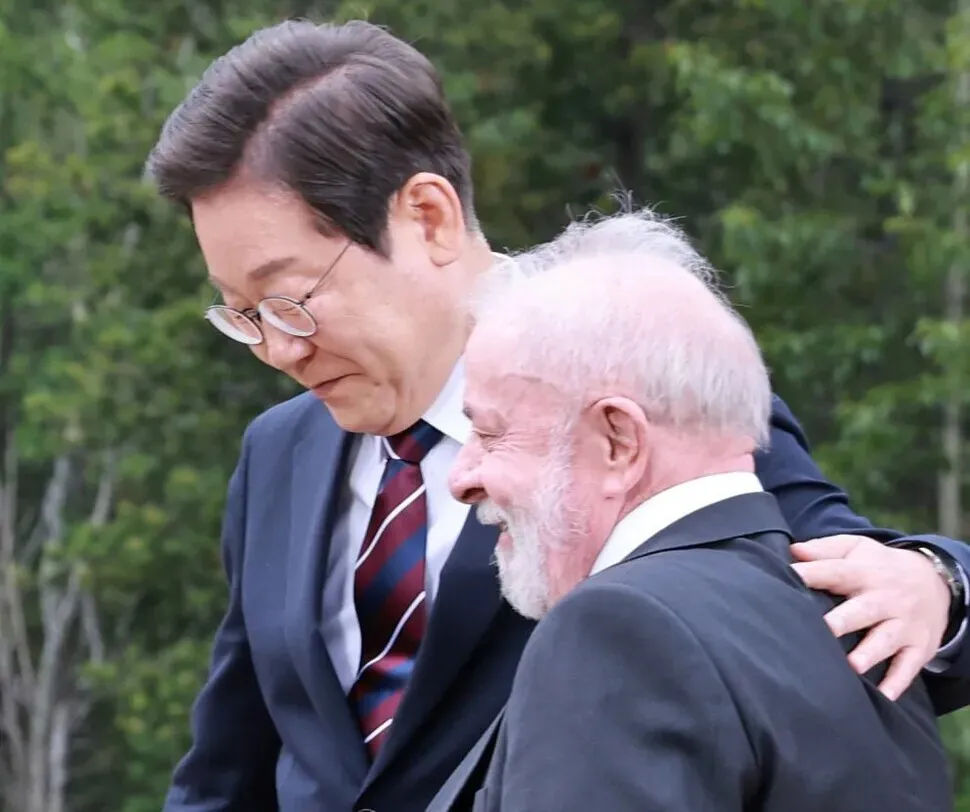
Two presidents, two continents, and two strangely similar lives.
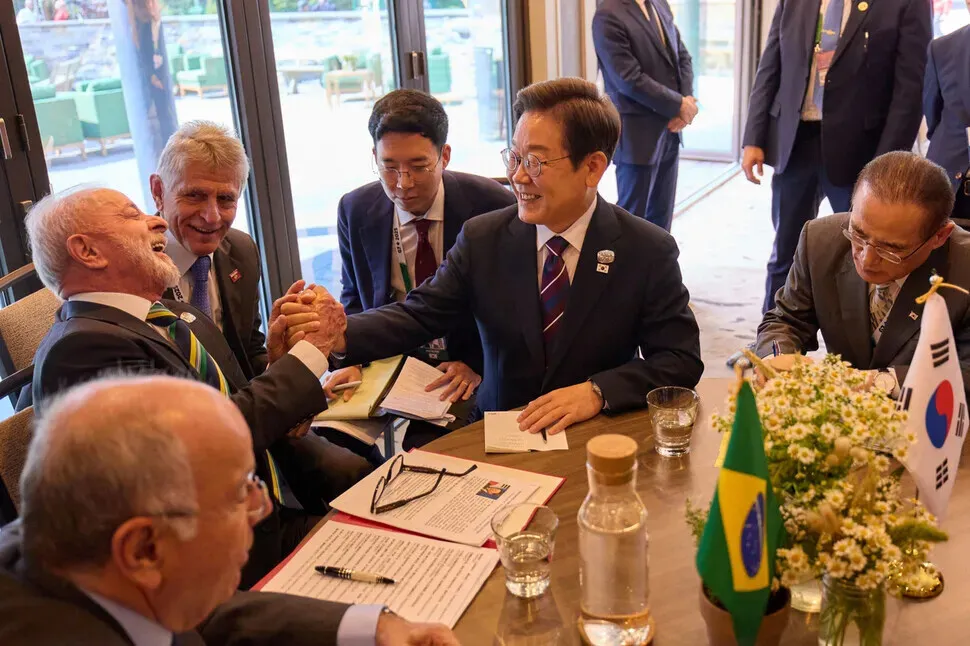
Korean President Lee Jae-myung and Brazilian President Luiz Inácio Lula da Silva held a bilateral meeting in Kananaskis, Alberta, on Tuesday while attending the Group of Seven summit hosted by Canada. This was the first summit that leaders from the two countries have held in 10 years.
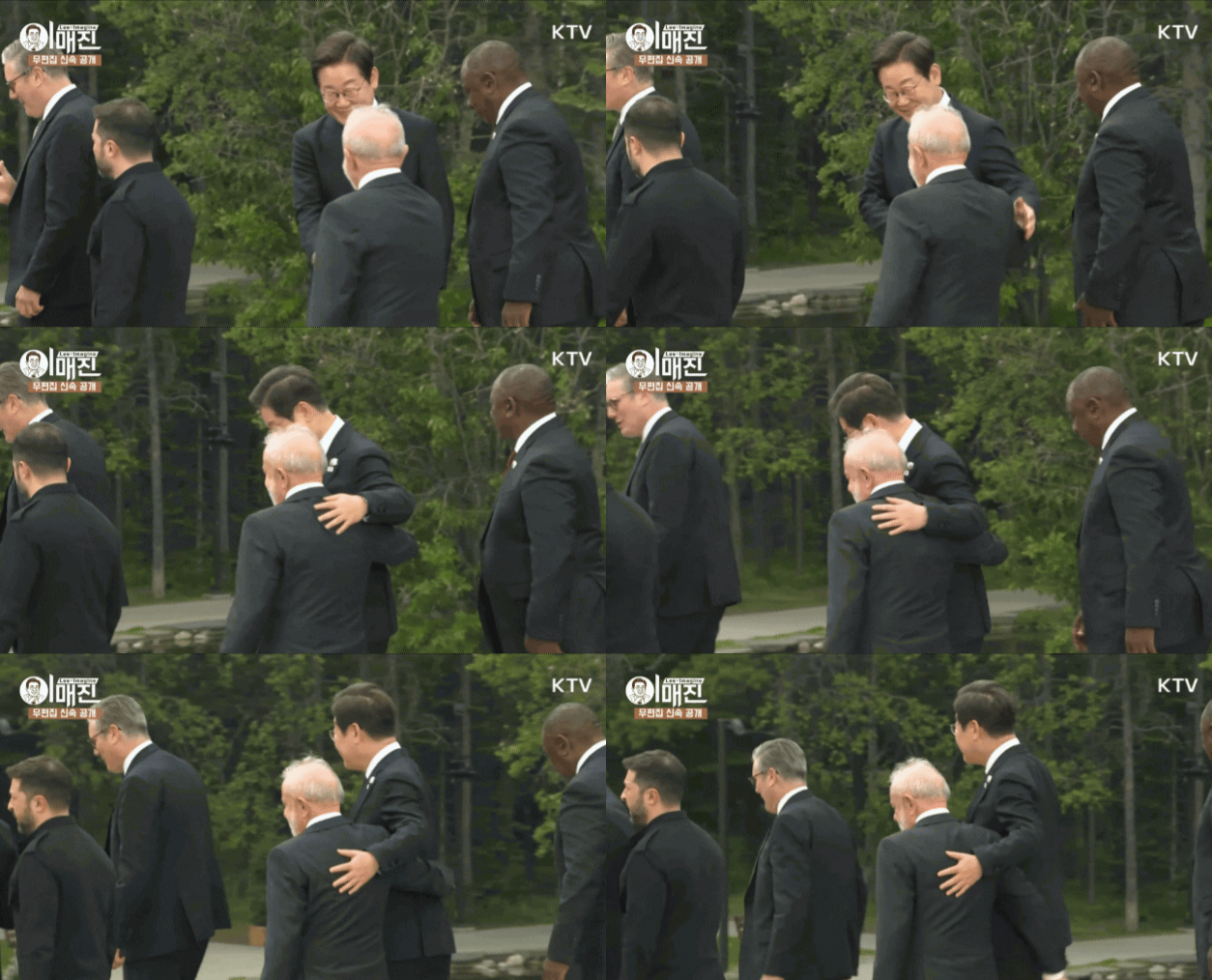
There was something evocative about Lee and Lula shaking hands and wrapping an arm around each other’s backs. Members of Lee’s Democratic Party were overcome with emotion, including former party leader Park Chan-dae, who remarked, “To think this day would finally come!”
Lee and Lula’s meeting was viewed with such interest because of the remarkable similarities between their lives, including their upbringings, their reasons for entering politics, and the way they surmounted political oppression to reach the presidency.
The factory boy and the shoeshine boy
Poverty and disability are key threads that weave through Lee’s and Lula’s lives.
Lee, who grew up in an impoverished neighborhood in Seongnam, couldn’t afford to pay tuition for middle school, so at the age of 12, he took on a factory job.
Lula was also born into grinding poverty. Since he dropped out of elementary school in the fifth grade, he doesn’t have a single diploma to his name. He began selling peanuts and shining shoes at the age of 7 and became a lathe operator at the age of 14.
Lee and Lula became factory workers around the same age, and their jobs presented similar challenges.
At Lee’s fifth workplace, a factory making ski gloves and baseball mitts, his left wrist was caught in a press, leaving him disabled and his arm permanently disfigured.
Lula was in his third year working the lathe at a machine shop near São Paulo when he lost the little finger on his left hand while doing an overnight shift.
Lee regarded his twisted arm as having been “made by a twisted world,” while Lula’s missing finger has been a source of “sadness and resentment” for his whole life.
No wonder Lula eagerly inquired about how old Lee had been at the time of his industrial accident when Lee related the anecdote during the summit.
The pain of poverty and want propels them to politics
Such experiences of immiseration ironically were what propelled the two figures into politics. Lee has often said that his childhood experiences of confronting poverty and discrimination were foundational in finding his political calling of creating a society in which “a life free from want is afforded to all,” and “no one is left behind.”
This echoes Lula’s own entry into politics, which was inspired in part by the tragic loss of his pregnant wife and child in utero to hepatitis after failing to receive adequate care. The personal tragedy led the Brazilian leader to politics and the labor movement, where he vowed to create a society in which all those suffering from poverty would be afforded dignity and respect.
Many see similarities in how the two leaders rose to the presidency after being the subject of political persecution as well. After losing the presidential race in 2022, Lee’s political career was jeopardized multiple times by investigations by prosecutors that have been characterized as designed to wipe out the then-president’s political opponents.
Lee’s very eligibility for the snap election he won earlier this month was nearly revoked when just before the campaign period started, the Supreme Court took the unprecedented move of overturning an acquittal for Lee and remanding his trial on alleged election law violations to a lower court with the recommendation of a conviction.
Lula himself spent time behind bars after stepping down following his second term after becoming implicated in the sweeping “Car Wash” corruption investigations by Brazil’s prosecutors. But the country’s Supreme Federal Court annulled bribery and money laundering convictions against Lula, finding that the lower court that convicted him had conspired with prosecutors and been biased in its ruling, thus paving the way for Lula to become Brazil’s first president to be elected to a third term.
Lula has cemented himself as a model of a successful leader, having been praised for ushering in the golden era of modern Brazil during his two terms in office between 2003 and 2010. By 2010, near the end of his second term, his approval rating had soared to 87%, and he is credited with having lifted more than 25 million Brazilians out of poverty.
“My approval ratings have always been higher when leaving office than when entering it,” Lee told reporters aboard the presidential jet as he left for his first trip overseas of his term. “I hope that’s the same this time around.”
Lula, who has achieved this political goal of Lee’s, offered his sage advice to the Korean president during their encounter in Canada: “Never forget why your people elected you.”
By Shim Woo-sam, staff reporter
Please direct questions or comments to [english@hani.co.kr]

Editorial・opinion
![[Correspondent’s column] Coupang’s game in Washington follows familiar pattern](https://flexible.img.hani.co.kr/flexible/normal/500/300/imgdb/original/2025/1226/8217667391873536.jpg "[Correspondent’s column] Coupang’s game in Washington follows familiar pattern") [Correspondent’s column] Coupang’s game in Washington follows familiar pattern
[Correspondent’s column] Coupang’s game in Washington follows familiar pattern![[Editorial] Coupang’s attempt to hide behind US won’t win back Korean consumers](https://flexible.img.hani.co.kr/flexible/normal/500/300/imgdb/original/2025/1226/1817667387971465.jpg "[Editorial] Coupang’s attempt to hide behind US won’t win back Korean consumers") [Editorial] Coupang’s attempt to hide behind US won’t win back Korean consumers
[Editorial] Coupang’s attempt to hide behind US won’t win back Korean consumers- Coupang under fire for possible obstruction of investigation into its customer data leak
- [Editorial] Coupang founder’s contempt for workers, customer security knows no bounds
- [Column] Confessions of a Coupang-holic
- [Editorial] Kim Bom-suk’s arrogance on full display in boycott of Coupang leak hearing
- [Editorial] The facts of Yoon’s insurrection are clear — justice cannot be further delayed
- [Column] Trump destroys government
- [Column] A post-Western world approaches
- [Column] Offshore balancing, or carving out spheres of influence?
Most viewed articles
- 1Korea to trial next-gen train capable of sub-2-hour Seoul-Busan trip starting 2030
- 2Kim Jong-un’s hidden motive in criticizing South Korea’s nuclear submarine push
- 3[Editorial] Coupang’s attempt to hide behind US won’t win back Korean consumers
- 4Coupang under fire for possible obstruction of investigation into its customer data leak
- 5[Correspondent’s column] Coupang’s game in Washington follows familiar pattern
- 6Real-life heroes of “A Taxi Driver” pass away without having reunited
- 7Moon Jae-in renews call for end-of-war declaration, peace treaty on Korean Peninsula
- 8Chang Chun-ha’s family hopes to know truth of his death after 37 years
- 9Chinese money flooding into South Korean companies
- 10Russian architect personally witnessed Empress Myeongseong’s assassination by Japanese ronin, accoun