hankyoreh
Links to other country sites 다른 나라 사이트 링크
Trump entertains Iranian regime change, a losing scenario for all
 Add as preferred source on Google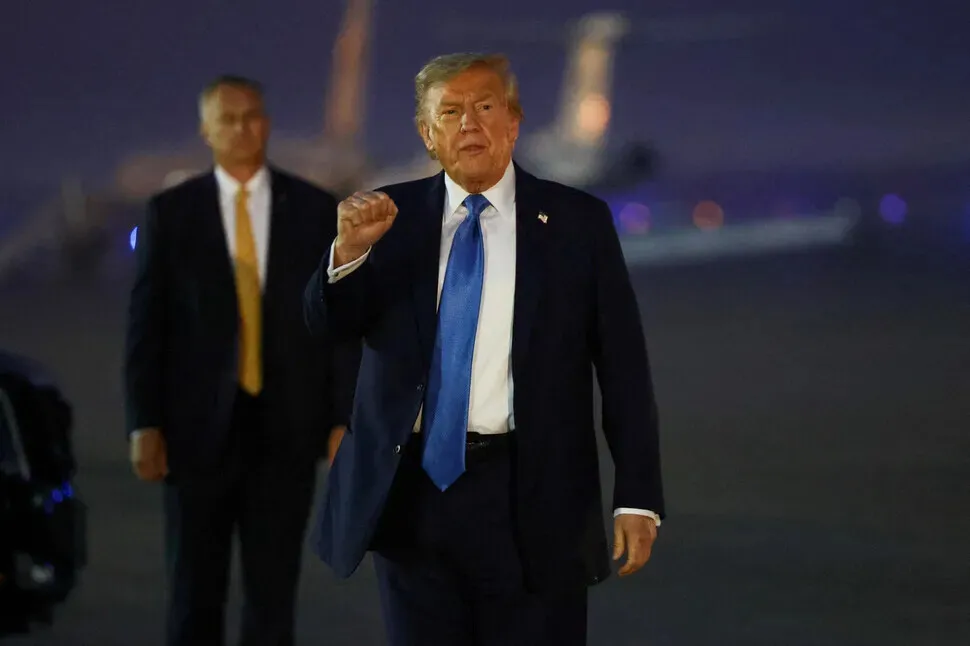
US President Donald Trump has been shifting toward more bellicose remarks that could be seen as an ultimatum for Iran. It remains to be seen whether his rhetoric will help him achieve his goals or only thwart them.
“We know exactly where the so-called ‘Supreme Leader’ is hiding,” Trump wrote on his Truth social media platform while returning to the US on Tuesday after ducking out of the Group of Seven summit in Canada. Minutes later, he posted the brief message “UNCONDITIONAL SURRENDER” in all caps.
Presuming that Ayatollah Ali Khamenei, Iran’s supreme leader, does not cave to Trump’s bluster — and Khamenei has declared he will never compromise) — Trump’s inflammatory rhetoric may come back to bite him.
The US’ first choice for bringing Iran to its knees would be dropping “bunker buster” bombs on the key nuclear facility at Fordo, which is buried about 80 meters underground. The bombs — which are only available to the US — are seen as a potential game changer since they are theoretically capable of penetrating the hardened Fordo base. But there’s no guarantee the base would be completely destroyed.
Second, the US could try assassinating Khamenei to topple the Islamic Republic of Iran. But Khamenei’s death would not necessarily mean the immediate collapse of the regime.
A third option for the US is prolonging the bombing campaign to progressively weaken Iran, again with the goal of engineering the regime’s collapse. But Iran could counter by closing the Strait of Hormuz, a chokehold controlling one-sixth of the world’s oil and a third of its natural gas shipping. That’s not a desirable outcome for the US.
Even if the US could manage to effect regime change in Iran, that would create problems of its own. The concept of “regime change” has been taboo in American politics since the Iraq War.
The US launched the Iraq War in 2003 with the goal of toppling Iraqi leader Saddam Hussein and installing a pro-Western democratic government. While Hussein was soon swept aside, his ouster led to a long period of chaos, including a civil war. Many American soldiers lost their lives before the US pulled out in 2011, having spent an astronomical sum of money along the way.
The US’ invasion of Iraq planted seeds of chaos that would affect not only Iraq itself but the entire Middle East. After the Islamist extremist militant group known as the Islamic State (IS) endangered both Iraq and Syria, the US had to send troops back into Iraq in 2014, where some are still stationed to this day.
“It looked great when the statue of Saddam Hussein fell,” commented Ben Rhodes, who served as deputy national security adviser under President Barack Obama, comparing the ebullience of the time with the sober reality of later years.
Trump himself has been more hostile to the idea of regime change than most American politicians, and he has often criticized the US’ military interventionism overseas. While on the campaign trail last year, he blasted then President Joe Biden for sending “our blood and treasure to back regime change in Iraq, regime change in Libya, regime change in Syria and every other globalist disaster for half a century.”
While Trump may be once again applying his cherished strategy of maximum pressure as a negotiating ploy to extract concessions from his opponents, there are concerns he has gone too far this time.
In an edited conversation, three of the Washington Post’s foreign affairs columnists predicted that the current conflict would end in some kind of settlement that would further destabilize the Middle East and entangle the US. The columnists observed that while Trump prefers negotiations to war, his showmanship and inconsistency have left him with few options.
But Iran’s geopolitical predicament is daunting. Following Israel’s attack on Israel, Europe has defended Israel and criticized Iran. The leaders of the G7 countries (which include the leading European countries of Germany, France and the UK) said in a statement on Tuesday that “Iran is the principal source of regional instability and terror” and that “Iran can never have a nuclear weapon.”
Even Russia, which is on friendly terms with Iran, has maintained its distance on Iran’s conflict with Israel. While the Kremlin issued a statement denouncing Israeli actions that are in violation of the UN Charter and international law following a phone call between Russian President Vladimir Putin and Iranian President Masoud Pezeshkian on Friday, Russia has not intervened in the conflict, nor has Putin commented about it directly.
China does not seem interested in intervening either, although Chinese President Xi Jinping did make his first public comment about the conflict during a summit Tuesday with the leaders of five Central Asian countries. Xi noted during the summit that “Israel’s military actions against Iran have led to a sudden escalation of tensions in the Middle East, which deeply concerns China.”
By Jung E-gil, senior staff writer
Please direct questions or comments to [english@hani.co.kr]

Editorial・opinion
![[Column] The unspoken deal that made China a nation led by engineers](https://flexible.img.hani.co.kr/flexible/normal/500/300/imgdb/original/2026/0821/381787301627593.jpg "[Column] The unspoken deal that made China a nation led by engineers") [Column] The unspoken deal that made China a nation led by engineers
[Column] The unspoken deal that made China a nation led by engineers![[Column] Does the US deserve allies’ trust?](https://flexible.img.hani.co.kr/flexible/normal/500/300/imgdb/original/2026/0818/8417870405925049.jpg "[Column] Does the US deserve allies’ trust?") [Column] Does the US deserve allies’ trust?
[Column] Does the US deserve allies’ trust?- [Column] No, tactical nukes aren’t practical for real-world use
- [Column] ‘The Odyssey’: Finally, a good chamber drama
- [Column] How will the US uphold deterrence when it runs out of weapons?
- [Column] US isn’t pulling out of the Middle East — it’s being kicked out
- [Editorial] Will shift in US nuclear strategy reintroduce tactical nukes to Korea, Japan?
- Why does the USFK commander keep butting heads with Seoul?
- [Guest essay] Futures thinking in science fiction
- [Editorial] New US envoy must stick to her diplomatic mission
Most viewed articles
- 1[Reportage] US looks to Korean experience to ease its critical mineral reliance on China
- 2Last time they met, Kim Jong-un needed Trump. Have the tables turned?
- 3[Exclusive] SK Hynix to build memory fab in Japan’s Miyagi
- 4[Column] The unspoken deal that made China a nation led by engineers
- 5The bill for America’s superpower status is coming due
- 6[News analysis] Is Trump about to undo US policy on North Korea’s denuclearization?
- 7[News analysis] Truncated military drills: Bad for OPCON transfer, good for peace?
- 8Former bodyguard’s dark tale of marriage to Samsung royalty
- 9[Column] ‘The Odyssey’: Finally, a good chamber drama
- 10Pyongyang has ‘no interest’ in Trump’s cut to SK-US military drills, says Kim Yo-jong