hankyoreh
Links to other country sites 다른 나라 사이트 링크
Trump squeezes Korea with claim it pays ‘very little’ for US troop presence
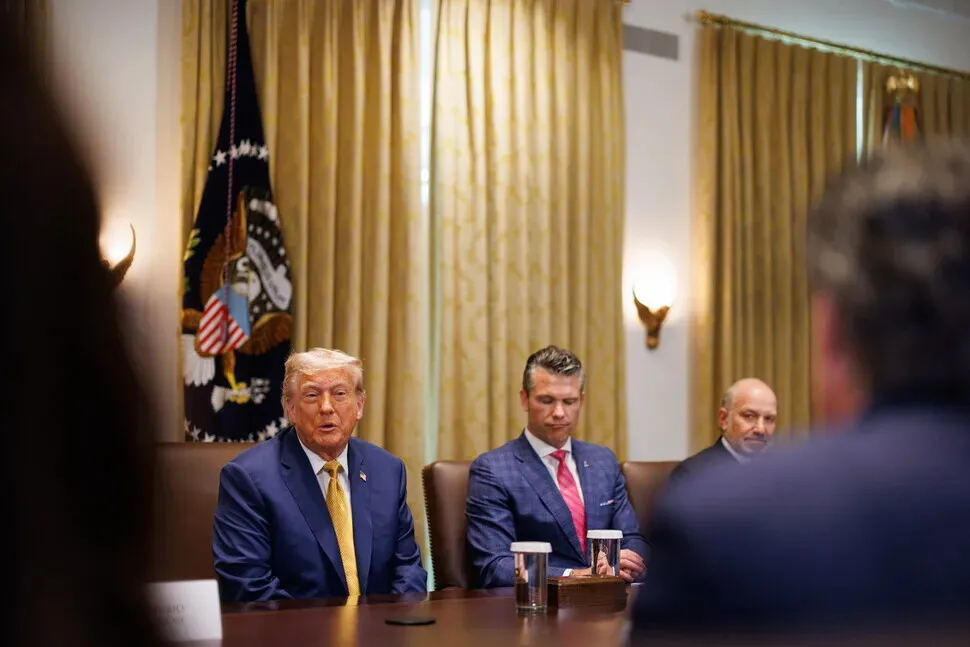
On Tuesday, US President Donald Trump said Korea pays “very little” towards the cost of stationing US Forces Korea (USFK) and should pay for its own defense.
On the previous day, he issued a letter stating the US would levy 25% tariffs on 14 countries, including Korea and Japan. Now, he’s pushing Korea to up its defense spending, suggesting Korea is in the crosshairs.
Trump will likely crank up the pressure on Seoul as the Aug. 1 negotiating deadline approaches.
During a Cabinet meeting at the White House, Trump said “they pay us very little for the military,” referring to the presence of US troops in South Korea.
“We supplied the military. So many very successful countries. South Korea is making a lot of money and they are very good. They are very good. But, you know, they should be paying for their own military,” he also said.
These comments come as Trump openly claims the US has been exploited by its trading partners through unbalanced trade agreements. He argued that most countries levy tariffs against the US, which he said has maintained deficits with nearly all its trading partners for years, or even decades.
“We were like this big monolith that made bad deals with everybody,” he continued before directly mentioning USFK.
“We rebuilt South Korea, we stayed there. It’s okay, we rebuilt it and we stayed there and they pay us very little for the military,” he said.
“I got them to pay billions of dollars, and Biden then canceled it when he came in. I said for South Korea as an example, you know, we give you free military, essentially very little, and I think you should pay us US$10 billion a year.”
“And they went crazy, but they agreed to three. So I got three with a phone call. I was satisfied. I said, but next year we have to talk. And then we had a rigged election, and we never got to talk,” he continued.
“They probably went to him and they said, ‘Listen, Trump treated us terribly, and we shouldn’t be paying anything.’ And he cut it down to nothing,” Trump said.
“That’s what happens. It’s ridiculous.”
During talks for the 11th Special Measures Agreement (SMA) in 2019, during Trump’s first term, the Trump administration demanded an increase of US$5 billion (5.7 trillion won), not US$10 billion. That was five times the amount South Korea paid in 2019 (1.04 trillion won).
In March 2021, shortly after Biden’s inauguration, the agreement was finalized. The 1.04 trillion won South Korea paid from 2019 to 2020 was raised to 1.18 trillion won for 2021, with steady annual increases equivalent to increases in South Korea’s national defense spending.
This year, South Korea paid 1.4 trillion won.
In October 2024, South Korea and the US agreed to a new agreement during the 12th SMA talks. South Korea agreed to pay 1.52 trillion won in 2026, with annual adjustments between 2027 and 2030 equivalent to increases in the consumer price index.
Trump’s remarks during the Cabinet meeting indicate that South Korea’s defense spending and financial contributions to USFK will come up during trade talks — a contingency for which the new Korean administration under President Lee Jae-myung is already preparing.
Wi Sung-lac, Lee’s national security adviser, admitted that possibility in a press scrum with foreign correspondents at Dulles International Airport on July 6. “A number of issues will be on the table. Various interconnecting and correlated issues are at stake,” Wi said when asked whether defense burden sharing might be broached during the trade negotiations.
During the election cycle last year, Trump referred to Korea as a “money-making machine,” repeatedly declaring that Seoul should pay US$10 billion towards USFK.
During the Cabinet meeting, Trump said that USFK comprises around 45,000 troops, but it’s closer to 28,000.
The day before the Cabinet meeting, Trump announced 25% tariffs against 14 countries, including Korea and Japan. Now he has specifically called for Korea to increase its defense spending. Some analysts say this is the beginning of Trump’s “onslaught” on South Korea.
“Korea, due to internal political issues, could not finalize a trade deal with the US by the end of June,” said James Park, a research associate with the Quincy Institute’s East Asia Program, in an interview with the Hankyoreh on Tuesday.
“Due to the escalating situation in the Middle East and other international issues, Korea is currently not a priority for Trump. However, Korea accounts for the US’ ninth largest trade deficit, so the White House is obviously going to start taking notice,” Park said.
“It looks like Trump will gradually amp up pressure on South Korea as the Aug. 1 trade talk deadline approaches. His remarks during the Cabinet meeting were nothing new, but they reaffirmed his expectations and can be interpreted as him saying, ‘Korea, the ball is in your court.”
By Kim Won-chul, staff reporter
Please direct questions or comments to [english@hani.co.kr]

Editorial・opinion
![[Editorial] PPP leader’s trip to US is a stunt without substance](https://flexible.img.hani.co.kr/flexible/normal/500/300/imgdb/original/2026/0417/4317764157621763.jpg "[Editorial] PPP leader’s trip to US is a stunt without substance") [Editorial] PPP leader’s trip to US is a stunt without substance
[Editorial] PPP leader’s trip to US is a stunt without substance![[Editorial] Remembering Sewol tragedy is how we prevent another](https://flexible.img.hani.co.kr/flexible/normal/500/300/imgdb/original/2026/0416/6617763295917051.jpg "[Editorial] Remembering Sewol tragedy is how we prevent another") [Editorial] Remembering Sewol tragedy is how we prevent another
[Editorial] Remembering Sewol tragedy is how we prevent another- [Editorial] Close communication with incoming US ambassador will be key for alliance
- [Editorial] World must stand against any and all tolls in Strait of Hormuz
- [Correspondent’s column] Trump’s real red line isn’t Iran’s nuclear program
- [Column] Who’s calling whom a rogue state?
- [Column] Xi Jinping exploits growing rift in Transatlantic alliance
- [Column] Trump’s war boomerangs on US hegemony and alliances
- [Column] Negotiating with bombs
- [Column] What the debate over Atlas and robots in factories missed
Most viewed articles
- 1Korean A-bomb victims head to UN to tell their stories and seek accountability
- 2[Interview] Key to stewardship code is sustainable value, not box-ticking, says expert
- 3South Korea positions itself for greater influence after end of Iran war
- 4Trump hints at renewed talks with Iran, but nuclear enrichment remains a sticking point
- 5World is ‘being ravaged by a handful of tyrants ’ pope says in dig at Trump
- 6Pushed into a corner, Sewol memorial fights to keep memory alive
- 7Trump hints second round of talks with Iran could take place over weekend
- 8Lee becomes first sitting president to attend Sewol memorial ceremony
- 9Sewol survivors say their mistake was making it off the ferry alive
- 10[Editorial] PPP leader’s trip to US is a stunt without substance