hankyoreh
Links to other country sites 다른 나라 사이트 링크
3 reasons Lee chose to cozy up to Ishiba before meeting Trump
 Add as preferred source on Google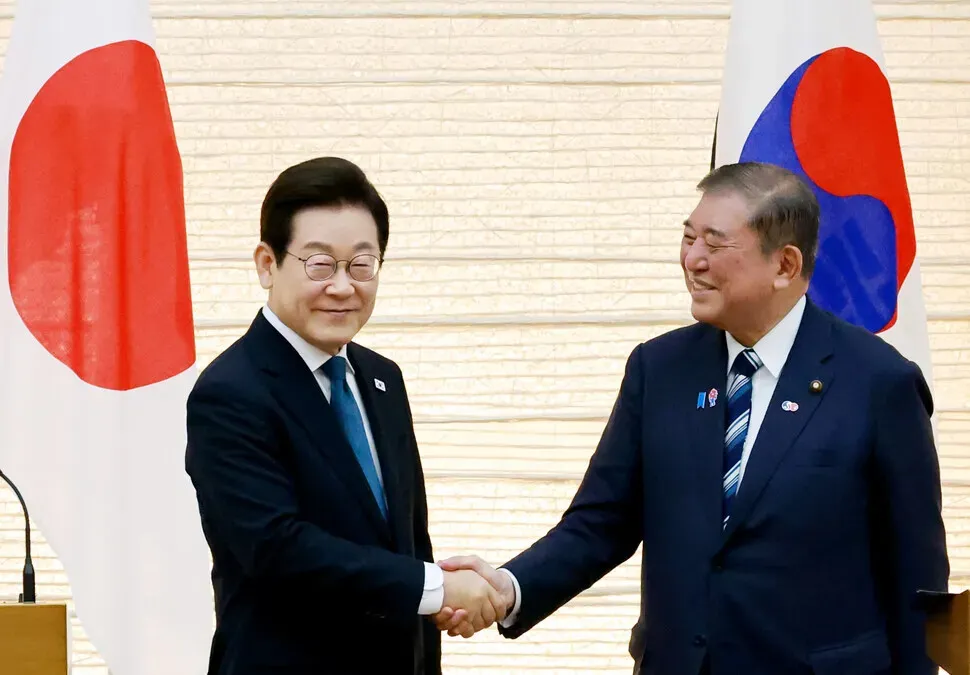
Following President Lee Jae Myung’s first visit to Japan, which wrapped up on Sunday, Japanese media have praised the meeting as a strong first step by the two nations’ leaders toward a stable relationship.
The move to swiftly confirm friendly relations between Japan and Korea, such as by hailing the return of “shuttle diplomacy,” is interpreted as a result of complex overlapping political interests in the trilateral dynamic amongst South Korea, the United States and Japan.
“At the Korea-Japan summit on Aug. 23, President Lee and Prime Minister Ishiba agreed to build a future-oriented relationship,” Japan’s Asahi Shimbun reported in its Sunday edition following the summit. “Lee aimed to stabilize Korea-Japan relations as he keeps the Trump administration in mind, a goal Prime Minister Ishiba welcomed.”
In a joint press statement following the summit, the two leaders emphasized the importance of “future-oriented, mutually beneficial cooperation” and described the meeting as an early resumption of shuttle diplomacy between Korea and Japan. They also agreed to strengthen communication between each nation’s leaders across different levels in various fields, including security and the economy.
At the dinner banquet following the summit, Ishiba demonstrated thoughtful hospitality by serving Andong-style braised chicken along with Andong soju, two specialties from Lee’s home region in Korea. Ishiba’s own trademark curry, which he once introduced on a TV program, was also part of the welcome meal.
Hand in hand, South Korea and Japan gain an advantage in response to Trump
One of the reasons Japanese media cited for Lee’s prioritization of Japan through this unusually early visit is the need to cooperate with Japan in response to the Trump administration.
The Asahi Shimbun suggested that behind Lee’s focus on Japan is “an intention to build stable relations with Japan to respond to the Trump administration.”
Korea, like Japan, is “pressured by the Trump administration’s economic policies as well as unpredictable security issues,” the paper stated, pointing to the reality that neither South Korea nor Japan is able to respond independently to matters the Trump administration has posed, such as tariffs, among other diplomatic concerns.
The newspaper quoted a senior South Korean government official as saying that the new trade and economic order set by the United States requires more “strategic communication between South Korea and Japan.” This stance is in line with Lee’s emphasis on pragmatic diplomacy.
In a joint written interview with four major Japanese media outlets — Asahi, Mainichi, Nihon Keizai, and Sankei — on Saturday, Lee underscored the need for “coexistence and cooperation” recognized by the people of Korea and Japan.
“My belief and our government’s diplomatic principle toward Japan is to expand Korea-Japan cooperation to meet the expectations of our people,” he said.
The US finds relief from mediator role
The US is also expected to welcome the strengthening of Korea-Japan relations. For the US to be able to respond to North Korea and China within East Asia, the cooperation of its allies, South Korea and Japan, is essential.
While Washington sees triad with South Korea and Japan with itself at the center as a necessary security framework, it has often been called upon to act as a mediator whenever South Korea-Japan relations have been soured due to historical issues. The fact that there were no significant objections from the US when Lee chose Japan as his first summit destination instead of the US supports this dynamic.
“When relations between South Korea and Japan were strained, the US would often take the lead in promoting cooperation between the three countries. But this time, we are taking the lead to visit Japan and then the US,” national security adviser Wi Sung-lac noted in a briefing Sunday.
“Our efforts to develop strong ties with Japan and visiting the US for discussions will be a positive move for both Japan and the US,” he said.
Japanese media have expressed concerns Trump may not take on the mediator role should Korea-Japan relations deteriorate down the line, which could destabilize the trilateral security framework.
Japan must cooperate with South Korea as trilateral ties between North Korea, China, and Russia strengthen
Japan also has its own international and domestic interests that lead it to welcome Lee’s focus on Japan.
As North Korea, China and Russia expand their military cooperation in the region, Japan finds itself in a situation where strengthening its security cooperation with Korea is essential.
In fact, officials in the Japanese Ministry of Foreign Affairs are said to have observed how rare it is for South Korea and Japan’s interests to align as much as they currently do. Riding this wave, Japanese Defense Minister Gen Nakatani is coordinating a visit to Korea next month, the first by a sitting defense minister in 13 years.
Some also suggest Ishiba’s personal characteristics make for a good match with Lee’s prioritization of Japan. Despite opposition from hard-line conservatives within the ruling Liberal Democratic Party, Ishiba has repeatedly emphasized the need to apologize and reflect on the Pacific War.
The joint statement released after this weekend’s summit included the following line: “Prime Minister Ishiba mentioned that he inherits the positions of previous cabinets on historical awareness, including the 1998 ‘Joint Declaration on a New Korea-Japan Partnership for the 21st Century.’”
This 1998 declaration by former Korean President Kim Dae-jung and Japanese Prime Minister Keizo Obuchi includes the following statement: “Prime Minister Obuchi regarded in a spirit of humility the fact of history that Japan caused, during a certain period in the past, tremendous damage and suffering to the people of the Republic of Korea through its colonial rule, and expressed his deep remorse and heartfelt apology for this fact.”
However, for the newly begun “bromance” between the two leaders to continue, Ishiba’s government will need to remain in power for the foreseeable future. Since taking office last October, Ishiba has faced consecutive defeats in the House of Representatives and House of Councillors elections, as well as a decline in approval ratings due to failed measures to curb the rising cost of living. This has left Ishiba politically cornered by calls within his party to remove him from office.
Potential candidates for the next prime minister include Shinjiro Koizumi, the current minister of agriculture, and Sanae Takaichi, a former minister of economic security. Both are considered hard-line conservatives on historical issues.
“If the Ishiba administration collapses and a new government is formed, it is difficult to predict whether Japan-South Korea relations will remain as they are now, given the possibility of reignited conflict over historical issues,” the Asahi Shimbun pointed out.
By Hong Seock-jae, Tokyo correspondent
Please direct questions or comments to [english@hani.co.kr]

Editorial・opinion
![[Column] The unspoken deal that made China a nation led by engineers](https://flexible.img.hani.co.kr/flexible/normal/500/300/imgdb/original/2026/0821/381787301627593.jpg "[Column] The unspoken deal that made China a nation led by engineers") [Column] The unspoken deal that made China a nation led by engineers
[Column] The unspoken deal that made China a nation led by engineers![[Column] Does the US deserve allies’ trust?](https://flexible.img.hani.co.kr/flexible/normal/500/300/imgdb/original/2026/0818/8417870405925049.jpg "[Column] Does the US deserve allies’ trust?") [Column] Does the US deserve allies’ trust?
[Column] Does the US deserve allies’ trust?- [Column] No, tactical nukes aren’t practical for real-world use
- [Column] ‘The Odyssey’: Finally, a good chamber drama
- [Column] How will the US uphold deterrence when it runs out of weapons?
- [Column] US isn’t pulling out of the Middle East — it’s being kicked out
- [Editorial] Will shift in US nuclear strategy reintroduce tactical nukes to Korea, Japan?
- Why does the USFK commander keep butting heads with Seoul?
- [Guest essay] Futures thinking in science fiction
- [Editorial] New US envoy must stick to her diplomatic mission
Most viewed articles
- 1[Reportage] US looks to Korean experience to ease its critical mineral reliance on China
- 2Last time they met, Kim Jong-un needed Trump. Have the tables turned?
- 3[Exclusive] SK Hynix to build memory fab in Japan’s Miyagi
- 4[Column] The unspoken deal that made China a nation led by engineers
- 5The bill for America’s superpower status is coming due
- 6[News analysis] Is Trump about to undo US policy on North Korea’s denuclearization?
- 7[News analysis] Truncated military drills: Bad for OPCON transfer, good for peace?
- 8Former bodyguard’s dark tale of marriage to Samsung royalty
- 9[Column] ‘The Odyssey’: Finally, a good chamber drama
- 10Pyongyang has ‘no interest’ in Trump’s cut to SK-US military drills, says Kim Yo-jong