hankyoreh
Links to other country sites 다른 나라 사이트 링크
Inking rash tariff deal with US would have shocked Korean economy, top diplomat says
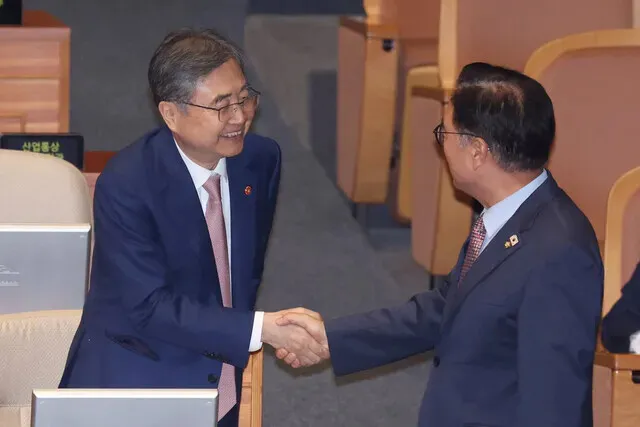
South Korea’s government suggested that its tariff negotiations with the US are in a stalemate because the US is demanding that it “follow Japan’s example” when it comes to the specific manner in which it invests the US$350 billion it pledged in July.
During a National Assembly inquiry about the Lee Jae Myung administration’s diplomacy, unification, and national security policies, Democratic Party lawmaker Kim Young-bae asked Prime Minister Kim Min-seok what the main sticking point in the trade talks was.
“Regarding the US$350 billion investment, the US fundamentally wants us to follow Japan’s example when it comes to the method of investment and the distribution of profits,” Kim responded.
“However, the scale of our economy and other factors would make such an investment difficult, so we are trying to adjust things to a level that suits our circumstances,” he added.
The US and Japan have reportedly signed an agreement whereby Japan makes investments in the US at the latter’s discretion. Once the US selects a project, Japan sends the cash within 45 days, and the US takes 90% of the profits after the principal is collected.
The US and South Korea agreed in principle on July 30 to a deal that would lower US “reciprocal tariffs” on Korean goods from 25% to 15%, but the two sides have failed to reconcile disagreements over the concrete methods of the US$350 billion investment fund.
The US is using the precedent set by Japan to pressure South Korea, but the Korean administration sees this pressure as a type of negotiation tactic.
“The US is making that argument [that South Korea should follow Japan’s example], but those claims may be more for the sake of negotiation leverage, rather than being based on the sincere belief that such investments will happen,” Kim told lawmakers.
US President Donald Trump has made reviving and rebuilding the American shipbuilding industry a key part of his platform. The Lee administration plans to utilize the critical role that South Korea can play in that ambition as its own negotiation leverage.
Government officials also clarified that the choice not to sign an official trade agreement document ahead of the Korea-US summit in Washington on Aug. 25 was based on the national interest.
“If we’d signed the agreement on the table at the time [of the bilateral meeting], the agreement contained worrying conditions that could have sent significant shocks through our economy,” said Foreign Minister Cho Hyun.
When a lawmaker noted that the Constitution requires that the National Assembly has the right to consent to the conclusion and ratification of agreements that will burden Korea with a major financial obligation, Cho said he agreed with this position. “We made that point very clear to the US,” he added.
The administration also announced that it had requested an unlimited currency swap arrangement during its negotiations regarding investments in the US. When asked to confirm if Korea had made such a request, Cho replied, “I will tell you that it was one of the several proposals we put forth to them [the US].”
By Seo Young-ji, staff reporter
Please direct questions or comments to [english@hani.co.kr]

Editorial・opinion
![[Editorial] North Korea’s rejection of unification doesn’t rule out coexistence](https://flexible.img.hani.co.kr/flexible/normal/500/300/imgdb/original/2026/0507/2517781427975787.jpg "[Editorial] North Korea’s rejection of unification doesn’t rule out coexistence") [Editorial] North Korea’s rejection of unification doesn’t rule out coexistence
[Editorial] North Korea’s rejection of unification doesn’t rule out coexistence![[Editorial] Coupang’s Kim must respect Korean law to earn Koreans’ trust](https://flexible.img.hani.co.kr/flexible/normal/500/300/imgdb/original/2026/0430/5717775362813378.jpg "[Editorial] Coupang’s Kim must respect Korean law to earn Koreans’ trust") [Editorial] Coupang’s Kim must respect Korean law to earn Koreans’ trust
[Editorial] Coupang’s Kim must respect Korean law to earn Koreans’ trust- [Editorial] USFK commander’s ‘kill web’ idea is dangerous and unworkable
- [Editorial] Appeal ruling rectifies lower court’s lenience on ex-first lady Kim Keon-hee’s corruption
- [Column] US shows China its limits in Iran war
- [Editorial] South Korea must turn to multifaceted diplomacy as North Korea-Russia military ties deepen
- [Column] Don’t shoot the messenger
- [Column] People do not live on bread alone
- [Editorial] Another act of political violence, another red flag for America’s democracy
- [Column] Trump has no idea how to fight a war
Most viewed articles
- 1Judge who convicted Korea’s ex-first lady last month found dead
- 2The 3 factors driving KOSPI’s unstoppable run
- 3As military might fails to secure victory over Iran, Trump makes rare turn to diplomacy
- 4‘Operation Fauxios’: Iran’s top negotiator denies report that US and Iran are nearing deal
- 5[Editorial] North Korea’s rejection of unification doesn’t rule out coexistence
- 6500 femicides: The epidemic of violence against women in Korea
- 7North Korea enshrines ‘two states’ doctrine in constitution, removes references to reunification
- 8New US counterterrorism strategy signals increased burden for allies like Korea
- 9Korean appeals court lowers ex-PM’s sentence to 15 years in insurrection trial
- 10With a click, 220,000+ member Telegram room generates illegal deepfake porn