hankyoreh
Links to other country sites 다른 나라 사이트 링크
Korea reaches preliminary agreement with US to allow nuclear enrichment, reprocessing, minister says
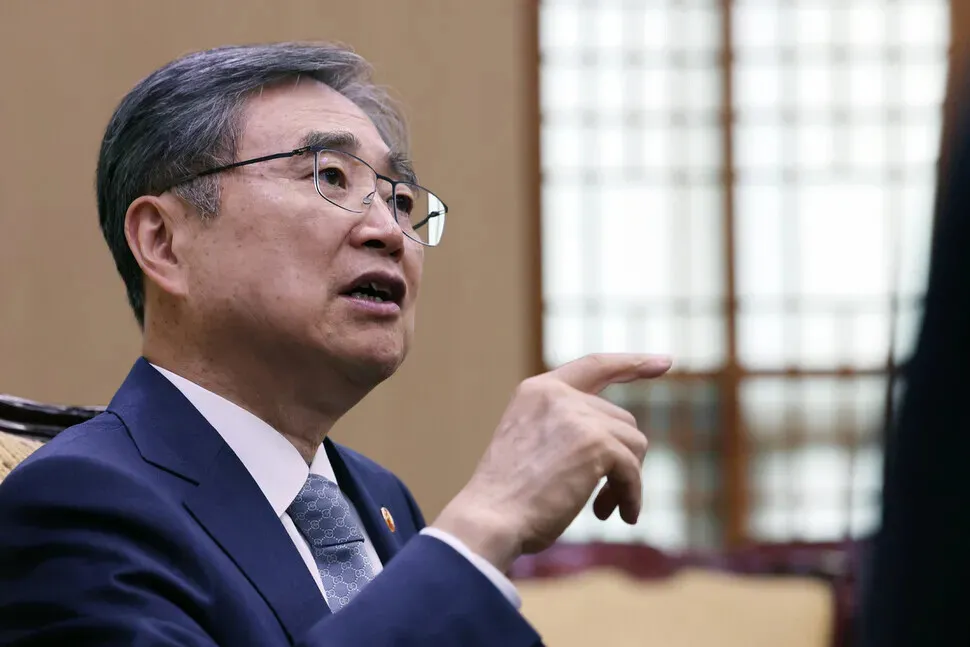
At their summit in August, South Korea and the US came to a preliminary agreement to ease restrictions on South Korea’s enrichment of uranium and reprocessing of spent nuclear fuel, South Korean Minister of Foreign Affairs Cho Hyun said on Friday.
Cho also explained that this agreement on South Korea’s use of nuclear technology would be included in the text of a final agreement to be drafted once the two sides have concluded their tariff negotiations.
In an interview with the Hankyoreh that took place on Friday at the Ministry of Foreign Affairs complex in Seoul’s Jongno District, Cho stressed the “significant strides” that had been made between the two sides as they drafted the text of a summit agreement, particular in regard to the “agreement on a basic direction that would also allow South Korea to pursue [uranium] enrichment and [spent nuclear fuel] reprocessing.”
Cho further stated that language related to the relaxation of restrictions on South Korea’s nuclear use would be included in a final agreement text to be drafted after the negotiations are concluded.
The nuclear cooperation agreement between the two countries, amended in 2015, prohibits Korea from reprocessing spent nuclear fuel and permits uranium enrichment only up to 20%. Even that level of enrichment is subject to a provision requiring Korea to first receive consent from the US.
Cho further said that Korea was “currently negotiating” the specifics of the defense spending increase with the US, such as timeline and scale, saying that he expects there to be a “basic outline” by the time of the Asia-Pacific Economic Cooperation summit to be held in the Korean city of Gyeongju at the end of October.
On the issue of expanding the strategic flexibility of the US Forces Korea, Cho noted the fear felt by many that South Korea could be dragged into a war if US troops in the country become involved in a conflict in the Taiwan Strait, but suggested that such fears are “unwarranted.”
Regarding tariff negotiations with the US, Cho suggested that slow and steady wins the race.
“The agreement made between Japan and the US contains some clauses that may prove to be problematic down the line,” the foreign minister said. “We’ll keep working [toward a better deal] while keeping our country’s interests the foremost priority, even if that means the process is slow.”
By Seo Young-ji, staff reporter; Park Min-hee, senior staff writer
Please direct questions or comments to [english@hani.co.kr]
Editorial・opinion
![[Correspondent’s column] Coupang’s game in Washington follows familiar pattern](https://flexible.img.hani.co.kr/flexible/normal/500/300/imgdb/original/2025/1226/8217667391873536.jpg "[Correspondent’s column] Coupang’s game in Washington follows familiar pattern") [Correspondent’s column] Coupang’s game in Washington follows familiar pattern
[Correspondent’s column] Coupang’s game in Washington follows familiar pattern![[Editorial] Coupang’s attempt to hide behind US won’t win back Korean consumers](https://flexible.img.hani.co.kr/flexible/normal/500/300/imgdb/original/2025/1226/1817667387971465.jpg "[Editorial] Coupang’s attempt to hide behind US won’t win back Korean consumers") [Editorial] Coupang’s attempt to hide behind US won’t win back Korean consumers
[Editorial] Coupang’s attempt to hide behind US won’t win back Korean consumers- Coupang under fire for possible obstruction of investigation into its customer data leak
- [Editorial] Coupang founder’s contempt for workers, customer security knows no bounds
- [Column] Confessions of a Coupang-holic
- [Editorial] Kim Bom-suk’s arrogance on full display in boycott of Coupang leak hearing
- [Editorial] The facts of Yoon’s insurrection are clear — justice cannot be further delayed
- [Column] Trump destroys government
- [Column] A post-Western world approaches
- [Column] Offshore balancing, or carving out spheres of influence?
Most viewed articles
- 1Korea to trial next-gen train capable of sub-2-hour Seoul-Busan trip starting 2030
- 2Kim Jong-un’s hidden motive in criticizing South Korea’s nuclear submarine push
- 3[Editorial] Coupang’s attempt to hide behind US won’t win back Korean consumers
- 4Coupang under fire for possible obstruction of investigation into its customer data leak
- 5[Correspondent’s column] Coupang’s game in Washington follows familiar pattern
- 6Real-life heroes of “A Taxi Driver” pass away without having reunited
- 7Moon Jae-in renews call for end-of-war declaration, peace treaty on Korean Peninsula
- 8Chang Chun-ha’s family hopes to know truth of his death after 37 years
- 9Chinese money flooding into South Korean companies
- 10Russian architect personally witnessed Empress Myeongseong’s assassination by Japanese ronin, accoun