hankyoreh
Links to other country sites 다른 나라 사이트 링크
After Trump’s shocking attack on Venezuela, China bides its time
 Add as preferred source on Google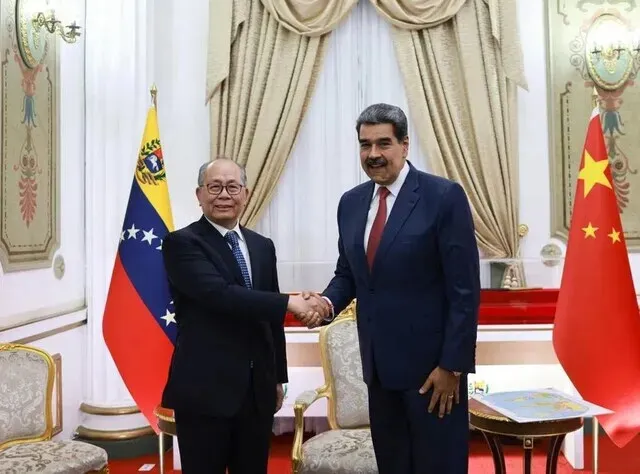
On Jan. 2, Venezuelan President Nicolás Maduro posted photos on social media of his meeting with Qiu Xiaoqi, Chinese President Xi Jinping’s special envoy to Latin America and the Caribbean, at the presidential palace in Caracas. In addition to this demonstration of amity, the Venezuelan presidential palace stated that the bilateral talks lasted for “over three hours,” adding that the two leaders reviewed over 600 agreements signed to date.
Just hours later, in the early hours of Jan. 3, the Trump administration invaded Venezuela and forcibly removed Maduro, leaving Chinese diplomats in shock. Critics argued that dispatching Qiu at this juncture was a miscalculation, demonstrating an utter failure to read the US’ operational direction and the political landscape.
“Chinese authorities did not anticipate that the US would resort to such an extreme method akin to kidnapping,” a Chinese expert well versed in diplomacy told the Hankyoreh in an interview after the fact.
“A structure where local embassies or Foreign Ministry officials only report what the higher-ups want to hear, continuously stating ‘the situation is stable,’ has led to this awkward outcome. I’m sure the leadership is quite angry,” the expert said.
Additionally, US media reports claiming that CIA spies had infiltrated the Venezuelan presidential office to monitor Maduro’s every move in real-time drew significant attention within China. Chinese media detailed the role the Venezuelan spy played in Maduro’s kidnapping and their infiltration routes. Internal crackdowns in China are expected to intensify.
In response to these US actions, the Chinese government is moving from expressing a principled standpoint toward leveling increasingly harsh criticism against the US. In a statement issued by its spokesperson the night of Jan. 3, the Chinese Foreign Ministry stated, “China is deeply shocked by and strongly condemns the US’ blatant use of force against a sovereign state and action against its president.” The statement also pointed out that such “hegemonic acts of the US seriously violate international law and Venezuela’s sovereignty, and threaten peace and security in Latin America and the Caribbean region.”
On Jan. 4, Chinese Foreign Minister Wang Yi strongly criticized the US’ actions, stating that China believes that no country should act as a “world policeman.”
“The sovereignty and security of all countries should be fully protected under international law,” he stressed.
“China is ready to work with the international community, [. . .] to firmly uphold the United Nations Charter, defend the fundamental principles of international justice, adhere to the sovereign equality of all countries, [and] jointly safeguard world peace and development,” he said.
On Jan. 5, during a summit meeting with the Irish prime minister, President Xi Jinping noted that “unilateral and bullying acts are dealing a serious blow to the international order.”
“All countries should [. . .] observe international law and the purposes and principles of the UN Charter. Major countries, in particular, should lead by example,” he said.
While Xi did not directly name the US, his message was clear. China emphasized that it is a major power that adheres to international law and morality, standing against US hegemony.
The US cited a crackdown on drug trafficking to justify the strike on Venezuela, but it was a clear move against China, and part of a larger effort to remove Chinese external influence and reshape the Western Hemisphere entirely under US leadership.
Trump’s emphasis on taking control of Venezuelan oil targeted the secure supply of oil that China has been acquiring from Venezuela for cents on the dollar. As of November of last year, 80% of Venezuelan oil exports went to China. Venezuela was China’s base of operations in South America, evidenced by the “all-weather strategic partnership” Caracas signed with Beijing.
The China National Petroleum Corporation, a state-owned Chinese energy firm, and Huawei, the cutting-edge tech firm, both have massive operations in Venezuela.
Among the weapons China exported to South and Central America from 2010 to 2020, 86% were purchased by Venezuela. Venezuela provided cheap oil and other natural resources to China; in exchange, Beijing exported weapons and telecommunications equipment to Venezuela. Notably, Venezuela’s oil exports were purchased with the Chinese yuan. This direct affront to US dollar hegemony likely provoked the US. Zhu Feng, the dean of Nanjing University’s School of International Studies, interpreted Trump’s intentions as “part of a larger war for oil, natural resources and currency dominance.”
However, other than amping up its anti-American rhetoric, China doesn’t look like it will take any direct action on Maduro’s behalf. Venezuela is not a part of China’s key interests. China does not want to disturb the hard-earned ceasefire it managed to eke out in its trade and tech wars with the US simply over Venezuela. Since September of last year, the US has been steadily concentrating forces in the waters and islands bordering Venezuela. Even when the US exerted military pressure on the Maduro regime, China did not provide weapons to Venezuela. This could be seen as a signal telling Trump that Beijing is not going to intervene.
Even China’s press and official channels aren’t expressing vehement support for Maduro. Hu Xijin, a former chief editor of the Global Times, declared three days after Maduro’s arrest in a WeChat post that Maduro “failed to mount effective resistance to the US incursion; instead, he was seized by US forces almost immediately.”
“He is more of a joke than any of Washington’s previous enemies,” Hu wrote, diving into straight-up mockery.
China’s response — or lack thereof — indicates that Beijing will closely monitor the US’ management of Venezuela after Maduro’s removal, while protecting China’s economic interests and political influence in South America as much as possible.
In an interview with China’s Guancha on Jan. 4, Niu Habin, the director of the Institute for Foreign Policy Studies and director of the Center for Latin America Studies under the Shanghai Institutes for International Studies, said, “It’s true that Venezuelan oil was one objective [of the US strike], but it’s not the main reason.”
“The key is that the US’ reassertion of dominance in the Western Hemisphere, as stated in the Trump administration’s new National Security Strategy, which declares that ‘the US will reassert and enforce the Monroe Doctrine to restore American preeminence in the Western Hemisphere.’ This reflects the strategy of Trump, who seeks to reaffirm US military dominance in the Western Hemisphere and lead the regional order,” he said.
Niu insisted that the US strategy is not compatible with the respective economic realities of each South American nation, which is why the US cannot replace China in the region.
“The US has a weak manufacturing base and limited demand for minerals, so it’s impossible to make South American nations forfeit their mineral transactions with China,” he argued. “Mineral resources are like a lifeline for South American countries, and China is their most trustworthy cooperative partner.”
In a column published by Guancha, Han Xiaopeng, a former professor at a Confucius Institute under the National Autonomous University of Mexico, claimed that the US strike on Venezuela produced a short-term loss for China but that it will result in a long-term loss for the US.
“While Trump has won this battle, all the chaos that’s to ensue will ultimately become burdens on the US’ shoulders,” he argued.
First off, if Venezuela descends into chaos, and if the military fractures into factions under various warlords, resulting in civil war, the violence will produce millions of refugees, who will head northward. This exacerbates the US’ immigration troubles. Second, while the blatant violation of international law will intimidate South American countries in the short term, in the long term, trust in the US in South America will vanish completely and push them closer to China, Han predicted.
“The US can’t provide the development and infrastructure that South American countries want, but still carries its ‘big stick,’” Han wrote. “This is where China’s opportunity will present itself. The US can strike ports, but it can’t build railways. That is our strength.”
Trump has clobbered the last of the remaining international order into pieces while laughing about it. Many are curious about how this act will impact China’s Taiwan strategy. There are many who claim that this latest action will leave a dangerous precedent.
Within China, internet users who identify as “patriots” online are claiming that if the US can illegally invade Venezuela and kidnap the president, then the People’s Liberation Army can “legally and legitimately exercise its national sovereignty regarding unification.”
The argument that China can also send its special forces to arrest Taiwanese President Lai Ching-te and declare its ownership of Taiwan before taking it over in a blitzkrieg is spreading on the Chinese net.
However, the Chinese leadership doesn’t appear likely to adjust its Taiwan strategy anytime soon. They know that Taiwan is an entirely different matter from Venezuela. Amid an economic collapse and a lack of rule of law, over 8 million Venezuelans have fled their homeland. But Taiwan has cutting-edge technology and a strong economy. China will not rush into things. Instead, Beijing will attempt to expand its political influence while spreading a message to the Global South that China is not like the evil American empire — it respects international laws and the UN Charter, and is a viable alternative for preserving global peace and stability.
Putin has invaded Ukraine, and Trump has invaded Venezuela. All around the world, people are exasperated about the world being on the verge of slipping back into the era of pillaging imperialism. If China “reunifies” Taiwan through the methods of Putin or Trump, the international order will collapse entirely and descend into lawlessness.
However, upon seeing trust in the US collapse after Trump’s gambit, China will wait for the most opportune moment to “solve” the Taiwan problem under optimal conditions. At that moment, the US will have no rhetorical ammunition to fire at China.
By Park Min-hee, senior international affairs and unification reporter
Please direct questions or comments to [english@hani.co.kr]

Editorial・opinion
![[Column] The unspoken deal that made China a nation led by engineers](https://flexible.img.hani.co.kr/flexible/normal/500/300/imgdb/original/2026/0821/381787301627593.jpg "[Column] The unspoken deal that made China a nation led by engineers") [Column] The unspoken deal that made China a nation led by engineers
[Column] The unspoken deal that made China a nation led by engineers![[Column] Does the US deserve allies’ trust?](https://flexible.img.hani.co.kr/flexible/normal/500/300/imgdb/original/2026/0818/8417870405925049.jpg "[Column] Does the US deserve allies’ trust?") [Column] Does the US deserve allies’ trust?
[Column] Does the US deserve allies’ trust?- [Column] No, tactical nukes aren’t practical for real-world use
- [Column] ‘The Odyssey’: Finally, a good chamber drama
- [Column] How will the US uphold deterrence when it runs out of weapons?
- [Column] US isn’t pulling out of the Middle East — it’s being kicked out
- [Editorial] Will shift in US nuclear strategy reintroduce tactical nukes to Korea, Japan?
- Why does the USFK commander keep butting heads with Seoul?
- [Guest essay] Futures thinking in science fiction
- [Editorial] New US envoy must stick to her diplomatic mission
Most viewed articles
- 1[Reportage] US looks to Korean experience to ease its critical mineral reliance on China
- 2Last time they met, Kim Jong-un needed Trump. Have the tables turned?
- 3[Exclusive] SK Hynix to build memory fab in Japan’s Miyagi
- 4[Column] The unspoken deal that made China a nation led by engineers
- 5The bill for America’s superpower status is coming due
- 6[News analysis] Is Trump about to undo US policy on North Korea’s denuclearization?
- 7[News analysis] Truncated military drills: Bad for OPCON transfer, good for peace?
- 8Former bodyguard’s dark tale of marriage to Samsung royalty
- 9[Column] ‘The Odyssey’: Finally, a good chamber drama
- 10Pyongyang has ‘no interest’ in Trump’s cut to SK-US military drills, says Kim Yo-jong