hankyoreh
Links to other country sites 다른 나라 사이트 링크
War in Middle East widens to 12 countries within 72 hours of US-Israeli strikes on Iran
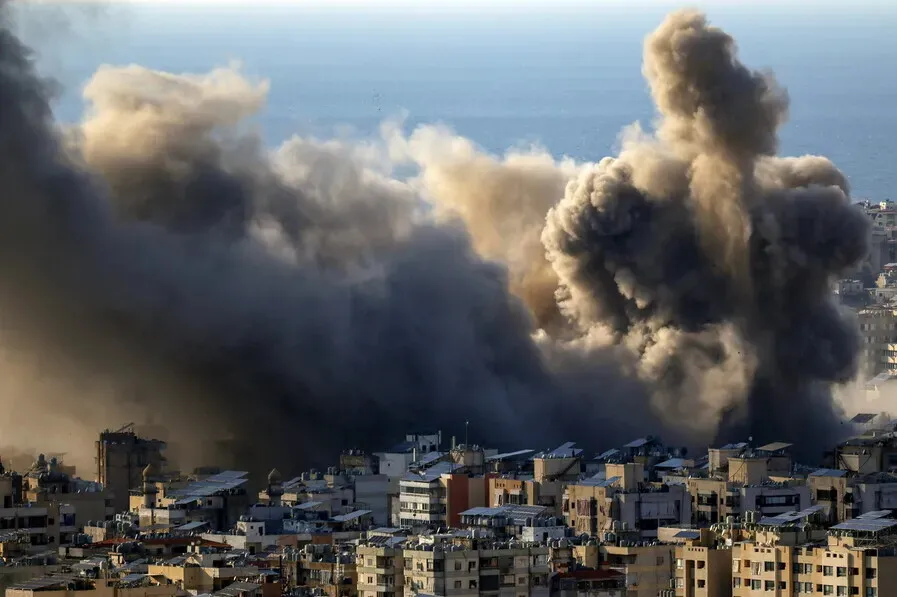
The war sparked by US and Israeli airstrikes on Iran has engulfed the Middle East within 72 hours, entangling a dozen countries in a rapidly widening conflict. Damage is mounting as US-Israeli attacks target not only Iran’s nuclear facilities and warships but also US embassies across the Middle East and a major bridge connecting Saudi Arabia and Bahrain. The US government has issued an emergency evacuation order for all Americans throughout the Middle East.
On Monday (local time), CNN reported that satellite image analysis confirmed Iran’s Natanz nuclear facility had been hit on Sunday and Monday. Mohammad Eslami, the head of Iran’s Atomic Energy Organization, stated in a letter to the International Atomic Energy Agency, “The criminal regimes of the United States and Israel, pursuing their aggression, again targeted the Natanz nuclear site on Sunday afternoon in two brutal attacks.” This marks the first attack on an Iranian nuclear facility since hostilities began on Saturday.
The US and Israeli attacks on Iran continued for the third consecutive day. The US Central Command announced on Monday that it had destroyed 11 Iranian ships in the Gulf of Oman. It also confirmed that it had struck over 1,250 targets within the first 48 hours of the war. Qatar also shot down two Iranian SU-24 bombers that day, becoming the first Gulf nation to directly strike an Iranian aircraft.
Casualties are also mounting. The Norwegian-based human rights group Hengaw stated that 150 cities in Iran had been attacked so far, resulting in at least 1,500 deaths, including 1,300 soldiers. This figure is roughly double the 787 Iranian deaths reported by the Iranian Red Crescent on Tuesday.
Israel launched a major offensive on Monday against the pro-Iranian Lebanese militia Hezbollah, which joined the conflict. Israel issued evacuation warnings for 53 villages, including Dahiya, a Hezbollah stronghold in Lebanon, and unleashed airstrikes on southern Lebanon. Approximately 30,000 people fled their homes, and the death toll rose to 52 with the deaths of Hezbollah’s intelligence chief and the Iranian Revolutionary Guard Corps’ official who oversaw the rebuilding of Hezbollah’s military capacity. Five rockets fired by Hezbollah at three Israeli military bases were intercepted and caused no damage.
Iran also mounted a fierce counterstrike. Iran’s Mehr News Agency, a semi-official outlet sponsored by the Iranian government, reported that a drone attacked the 25-kilometer-long King Fahd Causeway, a sea bridge connecting Saudi Arabia and Bahrain across the Gulf of Bahrain. It is the only bridge linking the island nation of Bahrain to the mainland. On Tuesday, air raid sirens sounded across Israel, including Jerusalem, with 11 deaths reported.
Attacks also continued on energy facilities, the vital nerve centers of Gulf oil-producing nations. On Monday, Iran’s drones attacked the Ras Laffan LNG plant in northern Qatar, halting operations. On Tuesday, Duqm port in Oman, which had mediated US-Iran nuclear talks, was attacked by drones for the second consecutive day, causing a fire in an oil storage tank.
Attacks on US bases in the Middle East also continued. Following an attack near the US Embassy in Kuwait on Monday, the US Embassy in Riyadh, Saudi Arabia, was hit by two drones on Tuesday, leading to a fire. Three Amazon Web Services data centers in the United Arab Emirates were also attacked by drones. Xinhua News Agency reported that the pro-Iranian militia group Islamic Resistance in Iraq claimed to have carried out 28 operations on Monday, launching dozens of missiles and drones toward enemy bases.
On Monday, the US State Department urged its citizens residing in 14 Middle Eastern countries, including Saudi Arabia, Qatar, and the UAE, to leave the area immediately using commercial transportation. On Tuesday, it issued a mandatory departure order for non-essential government personnel and their families in Jordan, Bahrain and Iraq.
Amid the escalating conflict, Bloomberg News reported on Tuesday that Qatar and the UAE, which have insufficient air defense missile stocks, are rallying neighboring Gulf states to help US President Donald Trump find a swift end to the conflict. According to anonymous informants, Qatar has only four days’ worth of air defense missiles left to counter Iran’s drone and missile attacks, while the UAE has requested assistance from its allies with medium-range air defense.

By Kim Ji-hoon, staff reporter
Please direct questions or comments to [english@hani.co.kr]

Editorial・opinion
![[Editorial] Head of USFK continues to cross the line with inappropriate political remarks](https://flexible.img.hani.co.kr/flexible/normal/500/300/imgdb/original/2026/0528/4817799568931091.jpg "[Editorial] Head of USFK continues to cross the line with inappropriate political remarks") [Editorial] Head of USFK continues to cross the line with inappropriate political remarks
[Editorial] Head of USFK continues to cross the line with inappropriate political remarks![[Editorial] A disgraced former president like Park Geun-hye has no place on the campaign trail](https://flexible.img.hani.co.kr/flexible/normal/500/300/imgdb/original/2026/0526/2117797859381587.jpg "[Editorial] A disgraced former president like Park Geun-hye has no place on the campaign trail") [Editorial] A disgraced former president like Park Geun-hye has no place on the campaign trail
[Editorial] A disgraced former president like Park Geun-hye has no place on the campaign trail- [Editorial] Korea’s online hate problem calls for platform regulation and anti-discrimination law
- [Reporter’s notebook] Trump’s primary purge of ‘traitors’ won’t win him anything
- [Guest essay] Moscow-Pyongyang ties are rewriting security in NE Asia
- [Reporter’s notebook] Trump’s primary purge of ‘traitors’ won’t win him anything
- [Column] An incompetent ally is worse than no ally at all
- [Editorial] Samsung’s tentative bonus deal highlights need for profit-sharing rules
- [Editorial] Crisis averted at Samsung, but society must continue chip profit-sharing debate
- [Editorial] Seoul and Tokyo should focus on pragmatic cooperation, not countering China
Most viewed articles
- 1K-pop wins big at AMAs, with BTS taking home artist of the year
- 2[Editorial] Head of USFK continues to cross the line with inappropriate political remarks
- 3KFTC eyes criminal proceedings against Coupang founder over alleged false filings
- 4[Editorial] Samsung’s tentative bonus deal highlights need for profit-sharing rules
- 5[Editorial] Crisis averted at Samsung, but society must continue chip profit-sharing debate
- 6[Reporter’s notebook] Trump’s primary purge of ‘traitors’ won’t win him anything
- 7Ambassador denies Iranian involvement after Korea concludes ship was hit by Iran-linked missiles
- 8Lee pulls off pragmatic diplomacy balancing act between strongmen Trump and Xi
- 9Seoul stops short of naming Iran as attacker in strike on ship in Hormuz
- 10[Guest essay] Moscow-Pyongyang ties are rewriting security in NE Asia