hankyoreh
Links to other country sites 다른 나라 사이트 링크
White House denies Iranian reports that Strait of Hormuz is closed
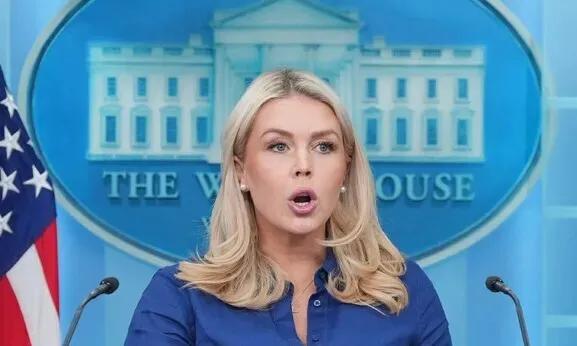
The White House on Wednesday denied Iranian state media reports that the Strait of Hormuz had been closed again, saying traffic there had instead increased.
The Trump administration also said Iran indicated a willingness to hand over highly enriched uranium to the US, adding that an American delegation led by Vice President JD Vance will hold face-to-face talks with Iran in Islamabad, Pakistan, on Saturday.
In a news briefing that day, White House spokesperson Karoline Leavitt dismissed Iranian reports that Tehran had cut off access to the strait over Israel’s attack on Lebanon.
“This is a case of what they’re saying publicly is different privately,” she said. “We have seen an uptick of traffic in the strait today.”
On a proposal for Washington and Tehran to jointly collect transit fees to passage through the strait, she said, “It’s an idea the president has floated, as you know, and it’s something that will continue to be discussed over the course of the next two weeks. But the immediate priority of the president is the reopening of the strait without any limitations, whether in the form of tolls or otherwise.”
When asked if Iran showed a willingness to hand over its stockpile of highly enriched uranium to the US, Leavitt said, “They have.”
“This is on the top of the priority list for the president and his negotiating team as they head into this next round of discussions,” she said. “And as I said in my opener, that is a red line that the president is not going to back away from, and he’s committed to ensuring that takes place.”
“The president’s red lines, namely the end of [uranium] enrichment in Iran, have not changed,” she added.
On the process leading to the deal, Leavitt made clear that Iran’s original proposal was rejected, saying, “The Iranians originally put forward a 10-point plan that was fundamentally unserious, unacceptable, and completely discarded. It was literally thrown in the garbage by President Trump and his negotiating team.”
“With the president's deadline fast approaching and the United States military completely decimating Iran with each passing hour, the regime acknowledged reality to the negotiating team,” she added. “They put forward a more reasonable and entirely different and condensed plan to the president and his team.”
“President Trump and the team determined the new modified plan was a workable basis on which to negotiate and to align it with our own 15-point proposal,” Leavitt went on to say.
The spokesperson said Lebanon, the center of a dispute between Iran and Israel, would not be included in the two-week ceasefire agreement. She also indicated China’s involvement by saying high-ranking US and Chinese officials held talks in the process of securing the ceasefire.
Calling ceasefires “fragile by nature,” she noted that it “takes time” for them to come into full effect.
“One of the results of Operation Epic Fury was we completely dismantled Iran’s command and control center, which makes it difficult for them to pass messages up and down the chain,” she said. “And so, we understand that. I would caution a little bit of patience.”
The White House also said Trump will send to Pakistan a negotiating team led by Vance, who will be joined by the special envoy Steve Witkoff and Trump’s son-in-law Jared Kushner. The first round of in-person talks is scheduled for Saturday morning in Islamabad.

The Trump administration also hit out at member states of NATO who shunned cooperation with the US in its war with Iran. Leavitt quoted Trump as saying, “They were tested, and they failed.”
Leavitt noted, “I would add it’s quite sad that NATO turned their backs on the American people over the course of the last six weeks, when it’s the American people who have been funding their defense.”
This reflected the administration’s disappointment with European countries that restricted overflight access related to the strikes on Iran or gave lukewarm responses to requests for military support to counter the blockade on the Strait of Hormuz.
During a recent interview with The Telegraph, Trump drove home that Iran was a “test” for NATO allies.
“It was a test, and we were there for them, and we would always have been there for them. They weren’t there for us,” he said.
Amid this tension, his administration is reportedly mulling retaliatory measures against NATO member states. The Wall Street Journal, citing administration officials, said discussions were underway about withdrawing US troops from NATO countries deemed uncooperative during the conflict and deploying them to more cooperative allies such as Poland, Romania, Lithuania and Greece.
Though still in its early stages, the plan has reportedly gained support among senior officials in recent weeks. The prospect of closing American bases in Europe is also under consideration, with those in Spain or Germany mentioned as potential targets.
By Kim Won-chul, Washington correspondent
Please direct questions or comments to [english@hani.co.kr]

Editorial・opinion
![[Editorial] Head of USFK continues to cross the line with inappropriate political remarks](https://flexible.img.hani.co.kr/flexible/normal/500/300/imgdb/original/2026/0528/4817799568931091.jpg "[Editorial] Head of USFK continues to cross the line with inappropriate political remarks") [Editorial] Head of USFK continues to cross the line with inappropriate political remarks
[Editorial] Head of USFK continues to cross the line with inappropriate political remarks![[Editorial] A disgraced former president like Park Geun-hye has no place on the campaign trail](https://flexible.img.hani.co.kr/flexible/normal/500/300/imgdb/original/2026/0526/2117797859381587.jpg "[Editorial] A disgraced former president like Park Geun-hye has no place on the campaign trail") [Editorial] A disgraced former president like Park Geun-hye has no place on the campaign trail
[Editorial] A disgraced former president like Park Geun-hye has no place on the campaign trail- [Editorial] Korea’s online hate problem calls for platform regulation and anti-discrimination law
- [Reporter’s notebook] Trump’s primary purge of ‘traitors’ won’t win him anything
- [Guest essay] Moscow-Pyongyang ties are rewriting security in NE Asia
- [Reporter’s notebook] Trump’s primary purge of ‘traitors’ won’t win him anything
- [Column] An incompetent ally is worse than no ally at all
- [Editorial] Samsung’s tentative bonus deal highlights need for profit-sharing rules
- [Editorial] Crisis averted at Samsung, but society must continue chip profit-sharing debate
- [Editorial] Seoul and Tokyo should focus on pragmatic cooperation, not countering China
Most viewed articles
- 1K-pop wins big at AMAs, with BTS taking home artist of the year
- 2[Editorial] Head of USFK continues to cross the line with inappropriate political remarks
- 3KFTC eyes criminal proceedings against Coupang founder over alleged false filings
- 4[Editorial] Samsung’s tentative bonus deal highlights need for profit-sharing rules
- 5[Editorial] Crisis averted at Samsung, but society must continue chip profit-sharing debate
- 6[Reporter’s notebook] Trump’s primary purge of ‘traitors’ won’t win him anything
- 7Ambassador denies Iranian involvement after Korea concludes ship was hit by Iran-linked missiles
- 8Lee pulls off pragmatic diplomacy balancing act between strongmen Trump and Xi
- 9Seoul stops short of naming Iran as attacker in strike on ship in Hormuz
- 10[Guest essay] Moscow-Pyongyang ties are rewriting security in NE Asia