hankyoreh
Links to other country sites 다른 나라 사이트 링크
South Korean researchers produce most complete Korean genome to date
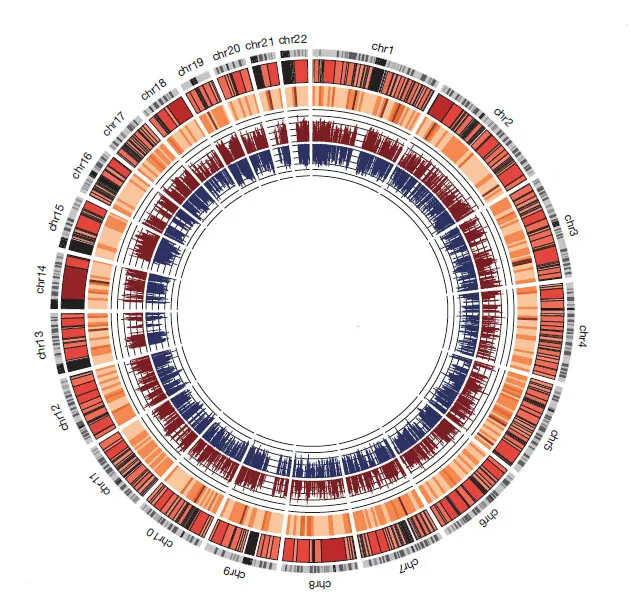
A South Korean team of researchers has produced a Korean genome that is more complete than any other genome to date, creating new possibilities for developing customized medicine.
“Using a new method of genome sequencing, we have created the most complete map of the human genome of any existing genomic data,” the Genomic Medicine Institute at Seoul National University (directed by Seo Jeong-sun) and biotechnology company Macrogen announced on Oct. 5. A paper by the team of researchers and a map of the genome were printed in the Oct. 6 issue of leading scientific journal Nature.
Even though the human genome was sequenced long ago, Nature explained in a press release, this genome was limited by incomplete base sequence data and by its failure to reflect the unique characteristics of different populations. But the Korean research team was able to fill in the gaps in the base sequences and create a perfect map of the human genome to a high degree of accuracy, the journal said.
The new genomic information will help bring about the age of precision medicine, which will provide medical services that are customized to the genetic characteristics of each individual, the journal added.
The reference human genome that has been used thus far was largely designed using Caucasian and African genomic information after the first map of the human genome was released in 2000. The genome maps that have been released subsequently have been made by treating the standard genome as a sample and only compiling the matching parts. Since that was also the approach that South Korean researchers used in their analysis of the genome of a Korean male that they submitted to Nature in 2009, their analysis was far from complete.
But instead of plugging data into the reference genome, the research team used a powerful computer program and the long read sequencing method, which reads 15,000 bases at once, to complete the map of the human genome from scratch.
The biggest achievement of this study was the fact that it filled in a substantial number of the 190 DNA sections that had been left blank in the reference genome map because of technical limitations. The researchers completely closed 105 (55%) of the gaps in the genome. If 72 partially closed gaps are included, the study can be said to have closed 93% of the gaps. This is why Nature used the expression “perfect.”
The researchers also found clear structural differences between the reference genome and the Asian genome in more than 18,000 locations. They also found that there were 800 species-wide structural variations that were missing from the reference genome. This makes it possible to confirm whether medicines that are genetically appropriate for Westerners are also appropriate for Asians.
By introducing a new method for separately analyzing the genome that people inherit from their parents (half from one and half from the other), the researchers were successful at reassembling human leukocyte antigen DNA, which is used to test for organ transplants. This makes it possible for doctors who are preparing for an organ transplant to determine who is the best source for an organ through genomic analysis alone.
The study also found the types of DNA that determine the speed of drug metabolism, making it possible to minimize the side effects of a drug overdose by accurately predicting how quickly an individual will metabolize drugs.
“The completion of a perfect Korean reference genome will not only provide the framework for moving forward with the project to analyze the genomic information of 100,000 Asians that was launched in February but will also lay the foundation for developing customized medicine for 4.5 billion Asians,” said Seo Jeong-seon.
By Lee Keun-young, senior staff writer
Please direct questions or comments to [english@hani.co.kr]

Editorial・opinion
![[Column] The megalomanic dictator with tariffs in one hand, missiles in the other](https://flexible.img.hani.co.kr/flexible/normal/500/300/imgdb/original/2026/0313/86177339097223.jpg "[Column] The megalomanic dictator with tariffs in one hand, missiles in the other") [Column] The megalomanic dictator with tariffs in one hand, missiles in the other
[Column] The megalomanic dictator with tariffs in one hand, missiles in the other![[Editorial] Korea can’t let US trade probes strong-arm it into concessions](https://flexible.img.hani.co.kr/flexible/normal/500/300/imgdb/original/2026/0313/3517733915192038.jpg "[Editorial] Korea can’t let US trade probes strong-arm it into concessions") [Editorial] Korea can’t let US trade probes strong-arm it into concessions
[Editorial] Korea can’t let US trade probes strong-arm it into concessions- [Editorial] Trump’s baseless claim that Iran bombed girls’ school crosses line
- [Correspondent’s column] JD Vance’s 67-hour disappearance
- [Column] Withstanding Trump’s predatory hegemony
- [Editorial] US dragging Kurds into its war with Iran would be a disaster
- [Column] US allies in the Gulf are in flames. Can Korea avoid a similar fate?
- [Editorial] North Korea’s tough talk mustn’t deter Seoul’s efforts to rebuild trust
- [Editorial] Attack on Iranian girls’ school is an indefensible crime against humanity
- [Editorial] Trump’s unjustified war with Iran threatens chaos for us all
Most viewed articles
- 1[Exclusive] Scholars behind Nobel nomination call Korea’s ‘Revolution of Light’ a beacon of democratic resilience
- 2[Column] The megalomanic dictator with tariffs in one hand, missiles in the other
- 3Iran sets terms for ending war, but US unlikely to acquiesce
- 4Hankyoreh reporters win Kwanhun Press Award for reporting on Telegram digital sex crimes
- 5Top 3 Scottish pension fund poised to lead US class action against Coupang
- 6[Interview] Abandoning reunification is survival strategy for North Korea, expert says
- 7Iran’s new supreme leader vows to keep Strait of Hormuz closed in first public address
- 8[Editorial] Korea can’t let US trade probes strong-arm it into concessions
- 9‘Warped view of history on display’: Korean lawmakers return from visit to Sado mine
- 1065% of Korean men say gender equality has gone ‘far enough’; only 42% of women agree