hankyoreh
Links to other country sites 다른 나라 사이트 링크
“On the brink of paralysis”: S. Korea’s healthcare system buckles under record critical COVID-19 cases
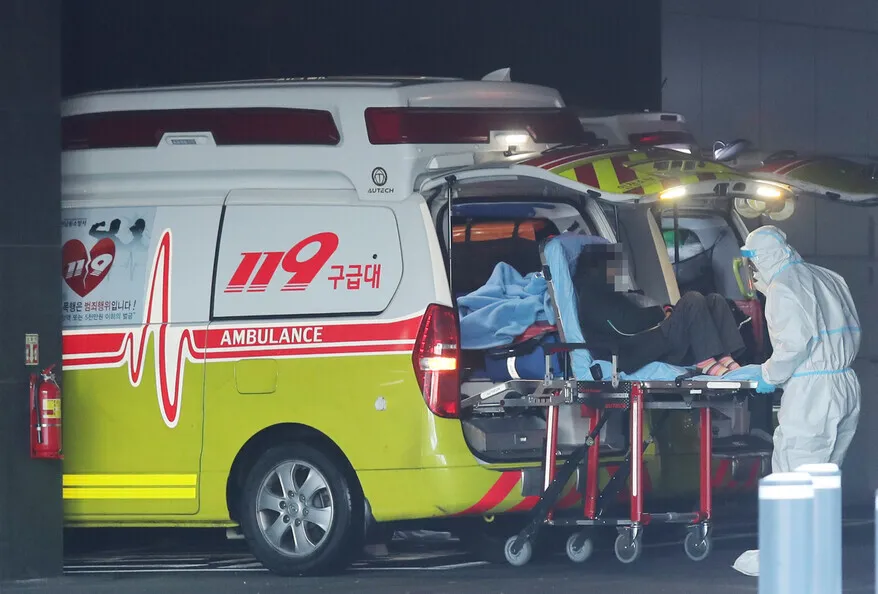
The number of daily new confirmed COVID-19 cases in South Korea declined over the weekend, while the number of patients with critical symptoms exceeded 1,000 for the first time.
The situation is becoming dire due to delays in acquiring dedicated COVID-19 sickbeds, despite a series of administrative orders by the government.
According to the Central Disease Control Headquarters, the number of COVID-19 patients in critical condition stood at 1,025 as of the end of the day Saturday. The trend of increase had continued from the day before, when a total of 1,016 critical patients were counted — marking the first time the number had exceeded 1,000 since the pandemic began.
A critical COVID-19 caseload of 1,000 patients has been regarded as a “red line” in terms of preventing the collapse of Korea’s healthcare system. Disease control authorities have predicted that a caseload of more than 1,000 critical patients could have a negative impact on the healthcare system as a whole.
“When you have 1,000 or more [critical and] severe patients, that means you need more COVID-19 critical care beds, which can impact other forms of [non-COVID-19 related] medical treatment,” explained Park Hyang, director of the Central Disaster Management Headquarters’s disease control policy coordination team, in a regular briefing on Tuesday.
“It could result in a situation where patients with severe symptoms remain in beds for patients with moderate symptoms rather than being given beds for people with severe symptoms,” she predicted.
The reason severe and critical cases have been on the rise despite the drop in confirmed cases comes as a result of the lag between diagnosis and the emergence symptoms. The number of severe and critical patients at any given time is a reflection of the number and age distribution of confirmed cases over the preceding one to two weeks.
During the first full week of December (Dec. 5 to 11), the percentage of confirmed cases among seniors aged 60 and older peaked at 35.8% — a trend subsequently reflected in the rise in severe and critical cases over this past weekend.
According to Korea Disease Control and Prevention Agency figures, the percentage of confirmed cases among people aged 60 and up dropped to 31.7% during the third week of December (Dec. 12 to 15).
The trend appears to reflect an increase in the COVID-19 vaccine booster shot administration rate for the 60-and-over population. As of the end of the day Saturday, 56.5% of people in that age group had received a third COVID-19 shot.
Analysts also said the number of new confirmed cases appeared to have fallen due to a drop in testing amid a cold snap and snowfall throughout South Korea. At 6,236, the number of new confirmed cases Saturday was lower than the 6,689 counted one week earlier.
“There have been cases when cold weather and snowfall have caused people waiting for [COVID-19] tests to give up and go home, and we could see a trend as a result where confirmed cases drop temporarily before rising again next year,” predicted Eom Joong-sik, a professor of infectious disease at Gachon University Gil Medical Center.
The outlook for the severe patient sickbed situation remains poor, with nationwide occupancy rates consistently exceeding the “critical mass” level of 75% since Nov. 28.
As of 5 pm on Saturday, the occupancy rate for COVID-19 critical care beds nationwide stood at 79.1%, with 1,058 out of 1,337 beds in use. The situation was even worse in the greater Seoul region that includes Seoul, Incheon, and Gyeonggi Province, where the occupancy rate was 85.9%, with 719 out of 837 beds in use.
The South Korean government has noted that even a 75% occupancy rate is dangerous, with the lack of medical staff to care for patients even when critical care beds are available and the inability to use 100% of all available beds due to issues with procuring extra beds as a precaution.
Physicians treating patients on the front lines agreed that problems have already begun cropping up all around.
Eom Joong-sik said, “The other evening, we had two severe/critical COVID-19 patients [one requiring a ventilator and the other requiring ECMO treatment] arrive in the emergency room, and they’ve had to stay in the emergency center’s negative pressure isolation ward because there are no beds in the critical care ward.”
“There are also patients currently hospitalized in moderate care beds who need to be moved to critical care beds for treatment. The healthcare situation is on the brink of paralysis,” he warned.
The government has been slow to acquire additional sickbeds. Since the decision to relax disease control restrictions as part of a “gradual return to everyday life,” disease control authorities have only added approximately 170 critical care beds.
Under pressure, the government moved on Friday to increase critical care bed efficiency by amending its sickbed operation guidelines to transfer patients with severe symptoms once 20 days have passed since their first COVID-19 symptoms. But even that approach appears to be a tall order due to the outcry from physicians.
“While infectivity decreases for the most part in severe COVID-19 patients once 20 days have passed, cases where severe patients still have some infectivity could lead to cluster infections at healthcare institutions,” warned the Korea Medical Association.
In response to the backlash, the government stressed that this was “not an ironclad standard.”
“Since there may be some infectivity [even after 20 days have passed since the patient’s first symptoms], we are listening to what [physicians] have to say on the front lines as we adjust the determination on whether to release [patients] from isolation,” it said.
By Lee Jae-ho and Kwon Ji-dam, staff reporters
Please direct questions or comments to [english@hani.co.kr]

Editorial・opinion
![[Correspondent’s column] Coupang’s game in Washington follows familiar pattern](https://flexible.img.hani.co.kr/flexible/normal/500/300/imgdb/original/2025/1226/8217667391873536.jpg "[Correspondent’s column] Coupang’s game in Washington follows familiar pattern") [Correspondent’s column] Coupang’s game in Washington follows familiar pattern
[Correspondent’s column] Coupang’s game in Washington follows familiar pattern![[Editorial] Coupang’s attempt to hide behind US won’t win back Korean consumers](https://flexible.img.hani.co.kr/flexible/normal/500/300/imgdb/original/2025/1226/1817667387971465.jpg "[Editorial] Coupang’s attempt to hide behind US won’t win back Korean consumers") [Editorial] Coupang’s attempt to hide behind US won’t win back Korean consumers
[Editorial] Coupang’s attempt to hide behind US won’t win back Korean consumers- Coupang under fire for possible obstruction of investigation into its customer data leak
- [Editorial] Coupang founder’s contempt for workers, customer security knows no bounds
- [Column] Confessions of a Coupang-holic
- [Editorial] Kim Bom-suk’s arrogance on full display in boycott of Coupang leak hearing
- [Editorial] The facts of Yoon’s insurrection are clear — justice cannot be further delayed
- [Column] Trump destroys government
- [Column] A post-Western world approaches
- [Column] Offshore balancing, or carving out spheres of influence?
Most viewed articles
- 1Korea to trial next-gen train capable of sub-2-hour Seoul-Busan trip starting 2030
- 2Kim Jong-un’s hidden motive in criticizing South Korea’s nuclear submarine push
- 3[Editorial] Coupang’s attempt to hide behind US won’t win back Korean consumers
- 4Coupang under fire for possible obstruction of investigation into its customer data leak
- 5[Correspondent’s column] Coupang’s game in Washington follows familiar pattern
- 6Real-life heroes of “A Taxi Driver” pass away without having reunited
- 7Moon Jae-in renews call for end-of-war declaration, peace treaty on Korean Peninsula
- 8Chang Chun-ha’s family hopes to know truth of his death after 37 years
- 9Chinese money flooding into South Korean companies
- 10Russian architect personally witnessed Empress Myeongseong’s assassination by Japanese ronin, accoun