hankyoreh
Links to other country sites 다른 나라 사이트 링크
Absorbing Gimpo would put Seoul on border with N. Korea – and in reach of its mortars
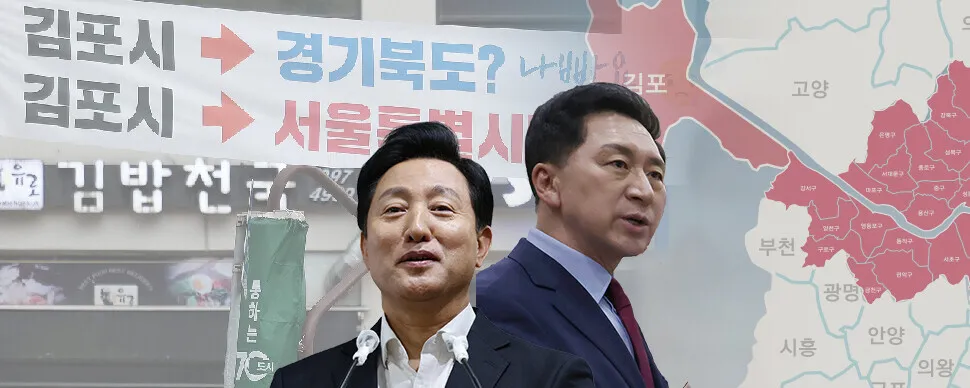
As the ruling People Power Party pursues a platform of incorporating the city of Gimpo into part of Seoul, some observers are voicing concerns about potential disruptions to capital defense planning if Seoul becomes part of the region directly bordering North Korea.
During a luncheon meeting with the Ministry of National Defense press corps at the ministry’s complex in Seoul on Friday, Minister of National Defense Shin Won-sik commented on the security issues that would arise if Gimpo is incorporated into Seoul.
While he acknowledged that there would be “some symbolism attached if press reports [about a North Korean infiltration of Gimpo] were to say that they had ‘landed in Seoul,’” he added that the matter was a “value-neutral” one with “no positive or negative ramifications in terms of military operations.”
“If Gimpo is made part of Seoul, we would just need to make a determination on matters such as whether to assign the Army divisions or Marines in charge of Seoul to the Capital Defense Command,” he explained.
“It isn’t that difficult to adjust the units to align with adjustments to the areas of responsibility,” he added.
But the nature of the threat faced by Seoul does shift if Gimpo becomes another district within the city.
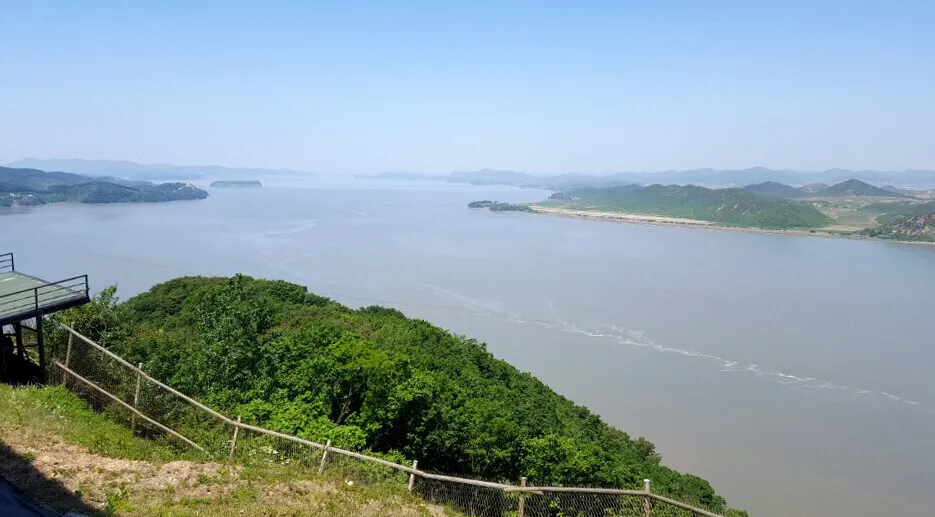
The river separating Gimpo from North Korea reaches a width of 1.25 kilometers — a distance that can be covered by a North Korean mortar shot. This means that the “mega-Seoul” vision could expose the city not only to the threat of North Korean multiple rocket launchers but also mortar fire.
Gimpo has been used by defector groups as a location for sending leaflet balloons into North Korea. As recently as 2014, a metal tower decorated with Christmas lights on Aegibong Peak was kept illuminated there as part of a psychological warfare campaign against the North.
Residents of the city have had to live with anxieties over North Korean threats of “targeted fire” at the site of leaflet distribution and the mountain peak. In the event of an emergency, threats against the “border city” of Gimpo would turn into threats against the capital city itself.
Apart from the events of Jan. 21, 1968, when North Korean guerrillas launched a raid against the Blue House, there has not been an armed clash between South and North in Seoul since the armistice.
A North Korean attack against Gimpo is unacceptable regardless of whether it is considered part of Gyeonggi Province or Seoul — but the effects on South Korea change with the nature of the threat.
In 2011, US media reporting on the 9/11 terrorist attacks described the situation as “America under attack.” It was the first instance of the US suffering an attack on its soil since Pearl Harbor in 1941.
If articles in the foreign press report on an emergency by describing it as “Seoul under attack,” it becomes impossible to rule out the potential for severe blows to national competitiveness and the attraction of foreign investment.
Incorporating Gimpo into Seoul could also have a huge impact on the armed forces’ current operational plan for defending the capital.
Seoul’s current borders place it 40 to 50 kilometers from the Military Demarcation Line. This means that the operational depth is shallow.
For the purposes of defending the capital, the military distinguishes the region south of this border into categories labeled GP (guard post), GOP (general outpost), FEBA (forward edge of the battle area), A (Alpha), B (Bravo), C (Charlie), D (Delta), and E (Echo).

To protect the city, it has deployed large numbers of troops and weapons to the FEBA region, which is established north of Seoul. This means that making Gimpo part of Seoul could create disruptions to the current plans for the city’s defense operations.
With the inter-Korean military agreement of Sept. 19, 2018, former President Moon Jae-in expanded the buffer zone north of Seoul. In 1978, then-President Park Chung-hee considered relocating the capital to the Chungcheong region to put it out of reach of the North Korean military’s multiple rocket launchers.
But if Gimpo is made into a district of Seoul, the buffer zone with North Korea effectively disappears, shifting the city “northward” into North Korean mortar range.
“If we lose the buffer zone north of Seoul, the concern is that Seoul could end up directly exposed to a North Korean attack along the same lines as Hamas’ assault on regions [of Israel] adjacent to Gaza,” a reserve general previously in charge of defense for the capital region told the Hankyoreh in a telephone interview.
By Kwon Hyuk-chul, staff reporter
Please direct questions or comments to [english@hani.co.kr]

Editorial・opinion
![[Correspondent’s column] Coupang’s game in Washington follows familiar pattern](https://flexible.img.hani.co.kr/flexible/normal/500/300/imgdb/original/2025/1226/8217667391873536.jpg "[Correspondent’s column] Coupang’s game in Washington follows familiar pattern") [Correspondent’s column] Coupang’s game in Washington follows familiar pattern
[Correspondent’s column] Coupang’s game in Washington follows familiar pattern![[Editorial] Coupang’s attempt to hide behind US won’t win back Korean consumers](https://flexible.img.hani.co.kr/flexible/normal/500/300/imgdb/original/2025/1226/1817667387971465.jpg "[Editorial] Coupang’s attempt to hide behind US won’t win back Korean consumers") [Editorial] Coupang’s attempt to hide behind US won’t win back Korean consumers
[Editorial] Coupang’s attempt to hide behind US won’t win back Korean consumers- Coupang under fire for possible obstruction of investigation into its customer data leak
- [Editorial] Coupang founder’s contempt for workers, customer security knows no bounds
- [Column] Confessions of a Coupang-holic
- [Editorial] Kim Bom-suk’s arrogance on full display in boycott of Coupang leak hearing
- [Editorial] The facts of Yoon’s insurrection are clear — justice cannot be further delayed
- [Column] Trump destroys government
- [Column] A post-Western world approaches
- [Column] Offshore balancing, or carving out spheres of influence?
Most viewed articles
- 1Korea to trial next-gen train capable of sub-2-hour Seoul-Busan trip starting 2030
- 2Kim Jong-un’s hidden motive in criticizing South Korea’s nuclear submarine push
- 3[Editorial] Coupang’s attempt to hide behind US won’t win back Korean consumers
- 4Coupang under fire for possible obstruction of investigation into its customer data leak
- 5[Correspondent’s column] Coupang’s game in Washington follows familiar pattern
- 6Real-life heroes of “A Taxi Driver” pass away without having reunited
- 7Moon Jae-in renews call for end-of-war declaration, peace treaty on Korean Peninsula
- 8Chang Chun-ha’s family hopes to know truth of his death after 37 years
- 9Chinese money flooding into South Korean companies
- 10Russian architect personally witnessed Empress Myeongseong’s assassination by Japanese ronin, accoun