hankyoreh
Links to other country sites 다른 나라 사이트 링크
Korea sent Czech Republic letter indicating possibility of financing reactor construction
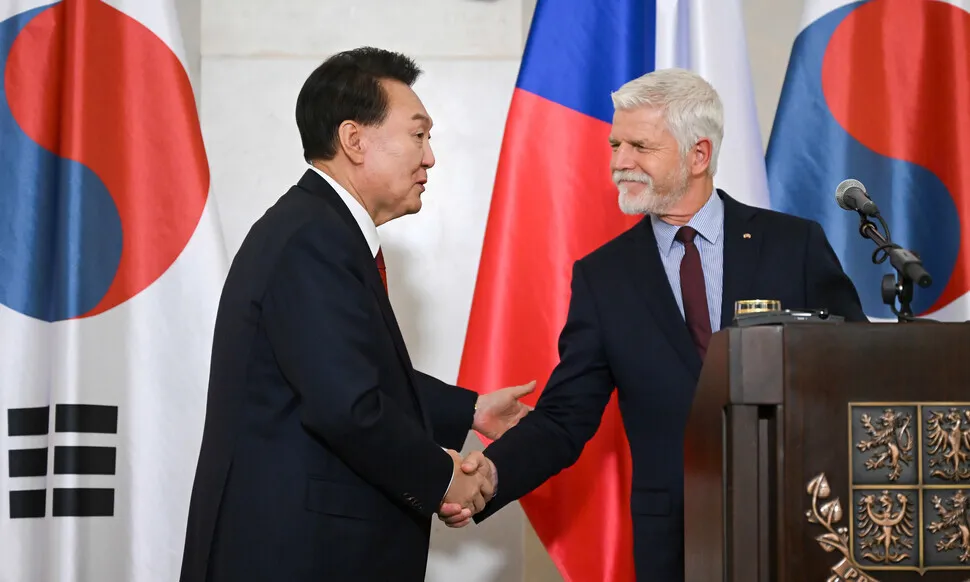
Korea Hydro & Nuclear Power (KHNP) submitted a letter of interest during bidding for a nuclear plant project in Dukovany, Czech Republic, that indicated the availability of financial assistance, the Hankyoreh has learned. That implies that the Czech government could receive loans for three planned nuclear reactors that currently lack funding, which contradicts the Korean government’s claim that it is not helping fund the project.
The news is likely to arouse controversy about the economic viability of a project to build nuclear reactors which is both built by and funded by Korea.
According to a document titled “Nuclear Power Plant Project unit Dukovany 6 & Temelin 3/4 Project in the Czech Republic,” KHNP received letters of interest from the Export-Import Bank of Korea (Korea Eximbank) and the Korea Trade Insurance Corporation (K-SURE) on April 4 stating that the two organizations will “consider financing the above Project where KHNP is preparing to bid.”
The Hankyoreh obtained the document via the office of Cha Gyu-geun, a lawmaker with the Rebuilding Korea Party, on Thursday.
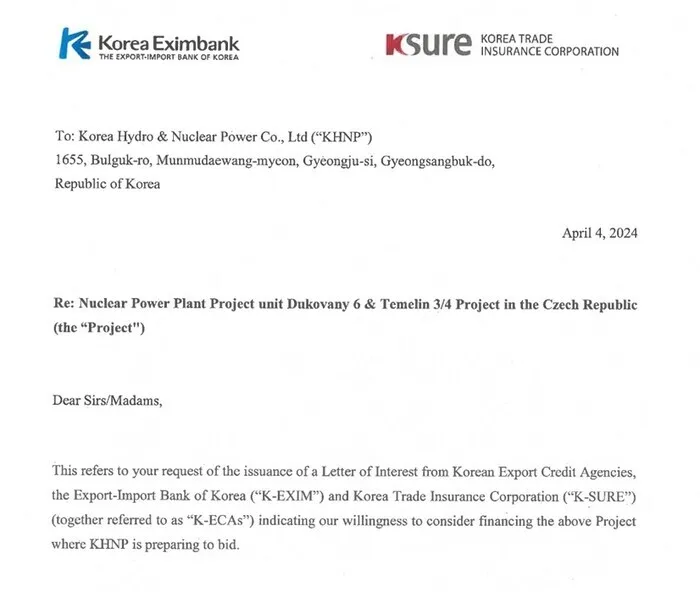
KHNP had submitted its bid for the Czech nuclear plant project in November 2023, but it apparently sent the letter of interest to the Czech government after US-based Westinghouse was eliminated from consideration early this year, leaving KHNP and French-based EDF as the only two contenders.
Letters of interest are typically composed and issued on behalf of countries seeking bids for extremely costly projects in such sectors as nuclear energy and national defense. The letters serve as a pledge of financial assistance from the country selling equipment for the project.
Notably, this document describes loans not only for Dukovany 6 but also for Temelin units 3 and 4, which would represent a separate project. The Czech government had originally been pushing to build four nuclear reactors altogether. But this past April, Prague only received approval from the European Commission for a funding plan for one of those four (Dukovany 5).
The KHNP document expresses willingness to provide loans for the other three reactors, which Prague has yet to arrange funding for. In July, KHNP was only selected as the preferred bidder for the two Dukovany reactors. Since EU member states share the same power network, they must receive approval from the European Commission before building power plants.
The possibility of Korea helping to fund the nuclear power construction project has been raised before. The cost of building two nuclear reactors at the Dukovany plant is 15 billion euros (US$15.74 billion), or 17.3% of the Czech government’s total budget of 87.8 billion for the year.
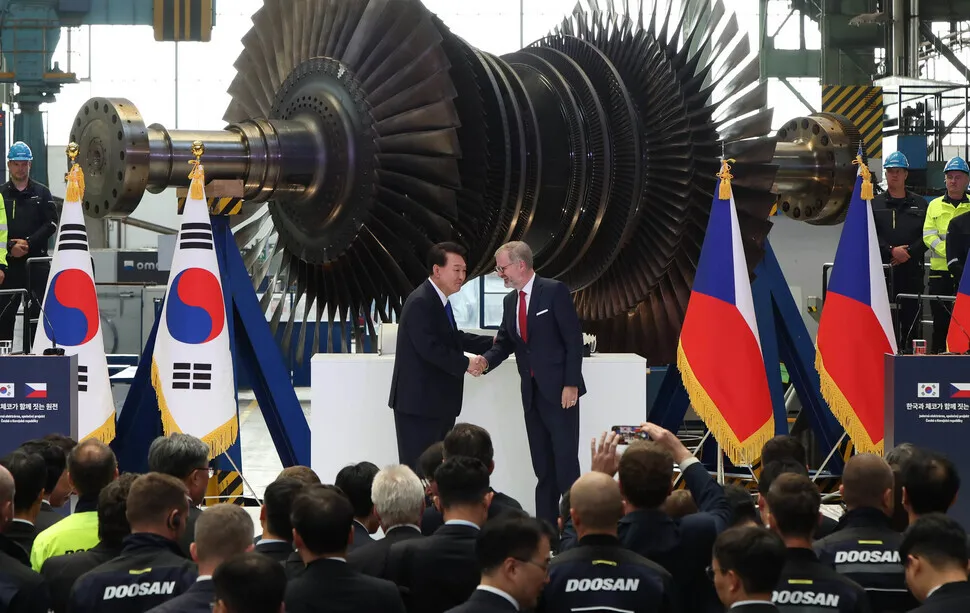
“Given the fiscal state of the Czech government, there was never any chance of it raising the money for a large nuclear plant, with each reactor costing over 10 trillion won [US$7.56 billion], on its own. If Korea agrees to provide low-interest loans for building the other three reactors or consents to penalties for construction delays as conditions for signing the deal, Korea’s profit from the project will decrease considerably,” assessed Seok Gwang-hoon, an adviser for the Energy Transition Forum, speaking to the Hankyoreh.
The Korean government has said the Czech government will raise its own funds for the project.
“What I’m hearing is that [construction of the nuclear reactors] will be entirely funded by the Czech government, and that Korea won’t be providing financing,” Minister of Trade, Industry and Energy Ahn Duk-geun said in a press conference after KHNP was selected as the preferred bidder on July 18.
KHNP declined to answer questions about whether and why letters of interest about financial assistance had been issued, noting that “this matter concerns a contract between two countries.”
The K-SURE acknowledged issuing a letter of interest. “The Czech government hasn’t asked for financial assistance yet, but if we do receive such a request, we’ll review it and then decide whether to provide assistance,” a spokesperson said.
The Ministry of Trade, Industry and Energy and the Korea Eximbank issued a release on Friday in response to media reports.
“The documentation that KHNP provided during the bidding process was a ‘non-binding letter of interest’ noting that financing could be looked into, and was not a commitment to financial provisions,” the release read, calling the document a “customary” part of the bidding process for major projects.
It went on to state that because the Czech government announced plans to raise its own funds to cover construction costs following KHNP’s selection as the preferred bidder in July, the administration had said that there had been no agreements as to financing and that no requests for cooperation on financing had been made of it by the Czech side. The statement stressed that there had been “no secret promise for financing behind the open statements that [Korea] would not provide financing.”
By Ock Kee-won, staff reporter
Please direct questions or comments to [english@hani.co.kr]

Editorial・opinion
![[Editorial] PPP leader’s trip to US is a stunt without substance](https://flexible.img.hani.co.kr/flexible/normal/500/300/imgdb/original/2026/0417/4317764157621763.jpg "[Editorial] PPP leader’s trip to US is a stunt without substance") [Editorial] PPP leader’s trip to US is a stunt without substance
[Editorial] PPP leader’s trip to US is a stunt without substance![[Editorial] Remembering Sewol tragedy is how we prevent another](https://flexible.img.hani.co.kr/flexible/normal/500/300/imgdb/original/2026/0416/6617763295917051.jpg "[Editorial] Remembering Sewol tragedy is how we prevent another") [Editorial] Remembering Sewol tragedy is how we prevent another
[Editorial] Remembering Sewol tragedy is how we prevent another- [Editorial] Close communication with incoming US ambassador will be key for alliance
- [Editorial] World must stand against any and all tolls in Strait of Hormuz
- [Correspondent’s column] Trump’s real red line isn’t Iran’s nuclear program
- [Column] Who’s calling whom a rogue state?
- [Column] Xi Jinping exploits growing rift in Transatlantic alliance
- [Column] Trump’s war boomerangs on US hegemony and alliances
- [Column] Negotiating with bombs
- [Column] What the debate over Atlas and robots in factories missed
Most viewed articles
- 1Korean A-bomb victims head to UN to tell their stories and seek accountability
- 2[Interview] Key to stewardship code is sustainable value, not box-ticking, says expert
- 3South Korea positions itself for greater influence after end of Iran war
- 4Trump hints at renewed talks with Iran, but nuclear enrichment remains a sticking point
- 5World is ‘being ravaged by a handful of tyrants ’ pope says in dig at Trump
- 6Pushed into a corner, Sewol memorial fights to keep memory alive
- 7Trump hints second round of talks with Iran could take place over weekend
- 8Lee becomes first sitting president to attend Sewol memorial ceremony
- 9Sewol survivors say their mistake was making it off the ferry alive
- 10[Editorial] PPP leader’s trip to US is a stunt without substance