hankyoreh
Links to other country sites 다른 나라 사이트 링크
President’s direct orders to penetrate parliament point to ‘ringleader’ role in insurrection
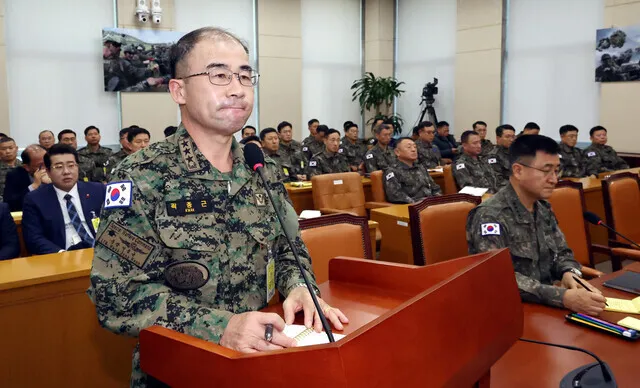
The head of the Army Special Warfare Command said that the South Korean president called him during the attempted insurrection on Dec. 3 and told him to “break down the doors” to the National Assembly and “drag out” the lawmakers within, stressing that lawmakers hadn’t yet reached the minimum number needed to lift martial law.
This testimony is expected to serve as a key piece of evidence that President Yoon Suk-yeol was the mastermind behind the attempted coup, as it shows he was deeply involved in the execution of the insurrection, demonstrated by his direct orders to troops to penetrate the National Assembly.
During an inquiry by the National Defense Committee, Lt. Gen. Kwak Jong-geun, who heads up the Army Special Warfare Command, said, “The president personally called me on an encrypted phone.”
“He told me that they hadn’t appeared to have reached a quorum yet, and to hurry up and break down the doors and drag out the lawmakers that were inside,” Kwak said.
“So I had to discuss with the commanders on site about whether to ‘fire blanks and breach, or cut off the electricity to prevent the vote.’ The commanders on site told me, ‘We can’t do that,’” Kwak added.
“Even if I’d followed his orders and penetrated the building, there was the issue of the soldiers in the operations later being deemed criminals who broke the law. If we forced our way inside, a lot of people would have gotten hurt, so I determined that wasn’t right,” Kwak continued.
Kwak also testified that on Dec. 1, two days before the president declared martial law, he received an order from former Defense Minister Kim Yong-hyun to secure the National Assembly and the three National Election Commission offices, as well as the Democratic Party headquarters and the opinion polling firm Flower. When National Defense Committee member Sung Il-jong asked him, “Are you saying you were given a six-pronged assignment on Dec. 1?” Kwak answered, “Yes.”
Kwak’s statements not only contradict his previous claims that he had found out about the martial law order while watching the news on Dec. 3, but they also acknowledge that he was aware that martial law would be declared before it happened. Kwak claims that, after the fact, he thought that people tied to the incident had gotten their stories straight in advance, so that’s why he didn’t tell these circumstances to the prosecutors’ special team for investigating the martial law incident during questioning.
The parliamentary National Defense Committee inquiry on Tuesday effectively reaffirmed that Kim Yong-hyun and Yeo In-hyeong, head of the Defense Counterintelligence Command — both of whom attended Choongam High School around the same time as the president — had performed essential duties in service of the attempted insurrection.
During the inquiry, Army Chief of Staff Park An-su, who was appointed to command martial law forces, testified that on Dec. 3, the day of the martial law declaration, Kim Yong-hyun had told him to “be on standby in the waiting room of his office at 2140 hours,” or 9:40 pm. Park said he had been planning to return to the Gyeryongdae military headquarters in South Chungcheong Province after giving his situation briefing to the defense minister at 4 pm that day, but Kim Yong-hyun had stopped him from leaving.
This could serve as proof that Kim Yong-hyun told Park to stand by at the Defense Ministry so that he could appoint him as the martial law commander.
Army Maj. Gen. Moon Sang-ho, the chief of the Defense Intelligence Command, testified during the inquiry that Kim Yong-hyun told the Defense Intelligence Command, “There could be a late-night dispatch to the National Election Commission, so stand by,” two days before the martial law declaration.
By Shin Hyeong-cheol, staff reporter
Please direct questions or comments to [english@hani.co.kr]

Editorial・opinion
![[Editorial] Head of USFK continues to cross the line with inappropriate political remarks](https://flexible.img.hani.co.kr/flexible/normal/500/300/imgdb/original/2026/0528/4817799568931091.jpg "[Editorial] Head of USFK continues to cross the line with inappropriate political remarks") [Editorial] Head of USFK continues to cross the line with inappropriate political remarks
[Editorial] Head of USFK continues to cross the line with inappropriate political remarks![[Editorial] A disgraced former president like Park Geun-hye has no place on the campaign trail](https://flexible.img.hani.co.kr/flexible/normal/500/300/imgdb/original/2026/0526/2117797859381587.jpg "[Editorial] A disgraced former president like Park Geun-hye has no place on the campaign trail") [Editorial] A disgraced former president like Park Geun-hye has no place on the campaign trail
[Editorial] A disgraced former president like Park Geun-hye has no place on the campaign trail- [Editorial] Korea’s online hate problem calls for platform regulation and anti-discrimination law
- [Reporter’s notebook] Trump’s primary purge of ‘traitors’ won’t win him anything
- [Guest essay] Moscow-Pyongyang ties are rewriting security in NE Asia
- [Reporter’s notebook] Trump’s primary purge of ‘traitors’ won’t win him anything
- [Column] An incompetent ally is worse than no ally at all
- [Editorial] Samsung’s tentative bonus deal highlights need for profit-sharing rules
- [Editorial] Crisis averted at Samsung, but society must continue chip profit-sharing debate
- [Editorial] Seoul and Tokyo should focus on pragmatic cooperation, not countering China
Most viewed articles
- 1K-pop wins big at AMAs, with BTS taking home artist of the year
- 2[Editorial] Head of USFK continues to cross the line with inappropriate political remarks
- 3KFTC eyes criminal proceedings against Coupang founder over alleged false filings
- 4[Editorial] Samsung’s tentative bonus deal highlights need for profit-sharing rules
- 5[Editorial] Crisis averted at Samsung, but society must continue chip profit-sharing debate
- 6[Reporter’s notebook] Trump’s primary purge of ‘traitors’ won’t win him anything
- 7Ambassador denies Iranian involvement after Korea concludes ship was hit by Iran-linked missiles
- 8Lee pulls off pragmatic diplomacy balancing act between strongmen Trump and Xi
- 9Seoul stops short of naming Iran as attacker in strike on ship in Hormuz
- 10[Guest essay] Moscow-Pyongyang ties are rewriting security in NE Asia