hankyoreh
Links to other country sites 다른 나라 사이트 링크
Yoon’s ’80s-throwback martial law met its match in the new livestreamed world
“The difference between the winter of 2024 and the situation back then [the martial law declared between 1979 and 1981] is that everything was being relayed live, which allowed everyone to see what was happening.”
These were the opening remarks made by author Han Kang in Stockholm on Friday at her first press conference since winning the Nobel Prize in literature.
Han explained that she had studied the way the military regime of Chun Doo-hwan assumed power through a martial law declaration as she was preparing to write her 2014 book “Human Acts,” which had to do with the events in Gwangju in May 1980.
While she said it came as a huge shock to see the same situation replaying itself 45 years later, she also described sensing the “truthfulness and courage” of “unarmed citizens attempting to stop armed soldiers” and “young police and soldiers who moved reluctantly, as if sensing some inner conflict.”
The scenes described by Han were witnessed together in real time by most South Koreans through the events of the Dec. 3 insurrection attempt.
“Night of insurrection” documented by everyone
The insurrection attempt that began with South Korean President Yoon Suk-yeol’s sudden declaration of martial law on Dec. 3 ended up collapsing 153 minutes later when the National Assembly approved a resolution to demand its lifting.
In contrast, the last previous martial law declaration, which was made by the military in 1979, lasted for over a year from Oct. 26 of that year to Jan. 24, 1981. The Yoon administration’s martial law lasted closer to the 141-minute running time of “12.12: The Day,” a 2023 blockbuster that focused on the December 1979 coup.
Observers said that among the complex mix of factors that frustrated the insurrectionists’ main goal of seizing the National Assembly and neutralizing its right to lift the martial law order, the new media environment played a pivotal part.
“If you look at the martial law declaration, it only mentions regulations on legacy media,” said Shim Young-sub, an adjunct professor of media video promotion at Kyung Hee Cyber University, in a telephone interview with the Hankyoreh on Tuesday.
“It didn’t include any measures for the internet, which is the most important space in terms of actual circulation of information,” he noted.
While the martial law command’s first edict, which was issued around an hour after the declaration was made, included items declaring a ban on “fake news, public opinion manipulation, and false propaganda” (paragraph 2) and announcing that “all media and publishing are subject to the martial law command’s controls” (paragraph 3), they did not have any effect.
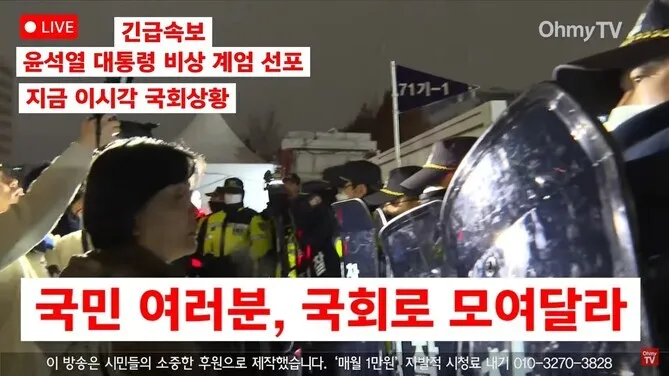
Broadcast news reports continued to be streamed on YouTube, while newspaper articles were shared through online communities and social media. Members of the public headed to the scene with their cameras running.
1980s-style martial law declaration a “pipe dream”
Considering the number of YouTube views and trends on the night of the martial law declaration, it seems that social media platforms, regardless of whether they were utilized by legacy media or new media, played a major role in getting information out.
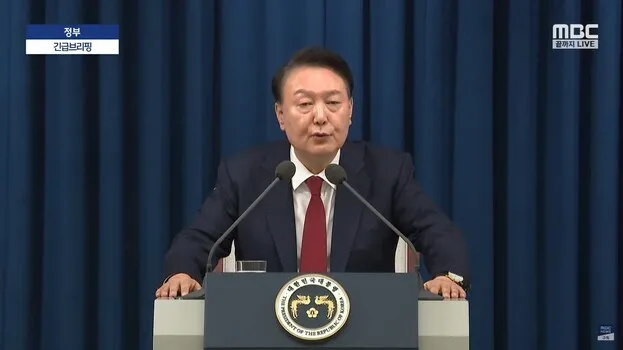
The YouTube livestream that garnered the most views that night was OhmyTV, operated by OhmyNews (up to 640,000 simultaneous viewers, according to Playboard). The live special report on MBC News’ YouTube channel took second place. Both Kim Ou-joon’s (@gyeomsonisnothin on YouTube) and Democratic Party leader Lee Jae-myung’s YouTube lives were within the top 10. MBC News’ YouTube channel had 4.89 million subscribers before the martial law declaration. After the night of the declaration, the channel saw increases of 10,000 to 30,000 and has more than 5.04 million subscribers as of Tuesday, Dec. 10. This is the biggest subscriber base of any news and politics channel in Korea.
Including YouTube, the majority of livestream broadcasts were transmitted through overseas platforms like Meta (Facebook) and X (formerly Twitter). Experts say that preventing access to these platforms would require cutting off the internet completely, which is, in actuality, impossible.
“Myanmar’s military government initiated a coup [in 2021] and paralyzed the country’s communications systems. Yet around 30 to 40 percent of shareholders of stakes in South Korea’s three telecommunications firms are foreign investors. It would be difficult to control telecommunications, as the economy would be the first to take a hit,” said Shim, the professor.
“Both legacy media and private citizens can broadcast on YouTube. Using a martial law document reminiscent of the 1980s to suppress freedom of speech today was a pipe dream,” he added.
Double-edged sword that helped spread far-right conspiracy theories
While social media served as a civic weapon against the authority of the state, some say platforms like YouTube have also been the source of serious political polarization and radicalization. On the night of Dec. 3, martial law troops were dispatched to the National Election Commission’s Gwacheon headquarters and Gwanak headquarters in Seoul and the commission’s Korean Civic Education Institute for Democracy in Suwon. Former Defense Minister Kim Yong-hyun testified that the objective was to investigate suspicions of election fraud, which have their basis in conspiracy theories. Such conspiracy theories have consistently been spread by a few far-right YouTubers, and have been determined to be false on multiple occasions by investigations by prosecutors and the police, as well as court rulings.
Yoon has long been suspected of being an avid watcher of far-right YouTube videos, with some going so far as to say his worldview was so warped by conspiracy theories that he wielded anti-constitutional power.
Kim Dong-chan, the policy director of the People’s Coalition Media Reform, told the Hankyoreh, “It looks like a plan to present election fraud allegations as the truth to justify martial law.”
“In the recent insurrection incident, YouTube and social media played a positive role, but we need to acknowledge that the media environment also presented a real threat to our democracy. We need to ruminate over the mechanical principles of that environment and the debate topography needs to change from the conditions present before the martial law declaration,” he added.
By Park Kang-su, staff reporter
Please direct questions or comments to [english@hani.co.kr]

Editorial・opinion
![[Editorial] North Korea’s rejection of unification doesn’t rule out coexistence](https://flexible.img.hani.co.kr/flexible/normal/500/300/imgdb/original/2026/0507/2517781427975787.jpg "[Editorial] North Korea’s rejection of unification doesn’t rule out coexistence") [Editorial] North Korea’s rejection of unification doesn’t rule out coexistence
[Editorial] North Korea’s rejection of unification doesn’t rule out coexistence![[Editorial] Coupang’s Kim must respect Korean law to earn Koreans’ trust](https://flexible.img.hani.co.kr/flexible/normal/500/300/imgdb/original/2026/0430/5717775362813378.jpg "[Editorial] Coupang’s Kim must respect Korean law to earn Koreans’ trust") [Editorial] Coupang’s Kim must respect Korean law to earn Koreans’ trust
[Editorial] Coupang’s Kim must respect Korean law to earn Koreans’ trust- [Editorial] USFK commander’s ‘kill web’ idea is dangerous and unworkable
- [Editorial] Appeal ruling rectifies lower court’s lenience on ex-first lady Kim Keon-hee’s corruption
- [Column] US shows China its limits in Iran war
- [Editorial] South Korea must turn to multifaceted diplomacy as North Korea-Russia military ties deepen
- [Column] Don’t shoot the messenger
- [Column] People do not live on bread alone
- [Editorial] Another act of political violence, another red flag for America’s democracy
- [Column] Trump has no idea how to fight a war
Most viewed articles
- 1Judge who convicted Korea’s ex-first lady last month found dead
- 2The 3 factors driving KOSPI’s unstoppable run
- 3As military might fails to secure victory over Iran, Trump makes rare turn to diplomacy
- 4‘Operation Fauxios’: Iran’s top negotiator denies report that US and Iran are nearing deal
- 5[Editorial] North Korea’s rejection of unification doesn’t rule out coexistence
- 6500 femicides: The epidemic of violence against women in Korea
- 7North Korea enshrines ‘two states’ doctrine in constitution, removes references to reunification
- 8New US counterterrorism strategy signals increased burden for allies like Korea
- 9Korean appeals court lowers ex-PM’s sentence to 15 years in insurrection trial
- 10With a click, 220,000+ member Telegram room generates illegal deepfake porn