hankyoreh
Links to other country sites 다른 나라 사이트 링크
PM may have deeper ties to martial law plot than previously assumed, Democrats say
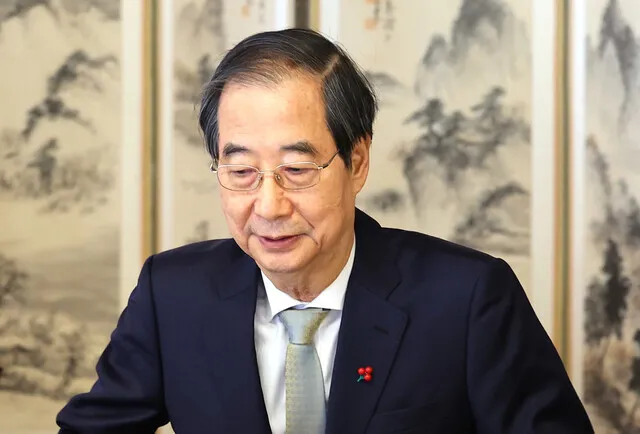
Despite the threat of impeachment from the Democratic Party, Korean acting President Han Duck-soo is refusing to move forward with nominating a permanent special counsel and has hinted he may veto a bill to appoint a normal special counsel into the martial law affair, raising suspicions that his ties to the martial law declaration go deeper than previously assumed.
President Yoon Suk-yeol’s abortive declaration of martial law on Dec. 3 is widely thought to represent insurrection under Korean law.
“Han Duck-soo appears to have been closely involved in the insurrection. There might be things we haven’t discovered yet, such as him potentially getting advance notice about the martial law declaration,” a source with the Democratic Party’s leadership told the Hankyoreh on Wednesday.
Considering that Yoon gave Deputy Prime Minister and Minister of Strategy and Finance Choi Sang-mok and Foreign Minister Cho Tae-yul instructions about what action their departments should take during the martial law declaration, the Democratic Party suspects that Han, who as prime minister was in charge of overseeing the government, was given instructions of even greater import.
On Dec. 9, the Democratic Party asked the Korean National Police Agency’s special investigation team dedicated to the martial law affair to investigate Han Duck-soo on insurrection charges, noting that, under the Martial Law Act, a declaration of martial law is supposed to be made through the prime minister.
In connection with that, Han said during a National Assembly hearing on Dec. 11 that he’d heard about Yoon’s plan to declare martial law at 8:40 pm on Dec. 3 and convened a Cabinet meeting at 9 pm.
Han said during that hearing that he and other Cabinet members had “sought to dissuade Yoon” from declaring martial law. But Democratic Party lawmakers suspect that Han may have convened the Cabinet to compensate for a procedural flaw in the martial law declaration.
“To take a simple example, the meeting consisted of 11 Cabinet members, which just happened to make a quorum,” said Lee Yong-woo, the chair of the Democratic Party’s legal committee.
Lee said that if Han was trying to prevent the martial law declaration, he ought to have assembled as many Cabinet members as possible. But instead, he only convened enough for a quorum, and the meeting ended after just five minutes.
The Democratic Party believes Han convened the Cabinet meeting — which he has no authority to do so, except when the president is indisposed — in an attempt to give Yoon’s martial law declaration a patina of procedural legitimacy.
Another suspicious point is that while the National Assembly passed the resolution demanding that martial law be lifted at 1 am on Dec. 4, Han slow-walked the Cabinet’s resolution to end martial law until 4:30 am that morning.
“Does it make sense for [Han] to be so hasty to convene the Cabinet meeting to declare martial law and then so tardy to convene the meeting to lift martial law? That’s why people think he [was playing for time to] while leaving open the option of a second martial law declaration,” Lee said.
By Ki Min-do, staff reporter; Ko Han-sol, staff reporter
Please direct questions or comments to [english@hani.co.kr]

Editorial・opinion
![[Correspondent’s column] Coupang’s game in Washington follows familiar pattern](https://flexible.img.hani.co.kr/flexible/normal/500/300/imgdb/original/2025/1226/8217667391873536.jpg "[Correspondent’s column] Coupang’s game in Washington follows familiar pattern") [Correspondent’s column] Coupang’s game in Washington follows familiar pattern
[Correspondent’s column] Coupang’s game in Washington follows familiar pattern![[Editorial] Coupang’s attempt to hide behind US won’t win back Korean consumers](https://flexible.img.hani.co.kr/flexible/normal/500/300/imgdb/original/2025/1226/1817667387971465.jpg "[Editorial] Coupang’s attempt to hide behind US won’t win back Korean consumers") [Editorial] Coupang’s attempt to hide behind US won’t win back Korean consumers
[Editorial] Coupang’s attempt to hide behind US won’t win back Korean consumers- Coupang under fire for possible obstruction of investigation into its customer data leak
- [Editorial] Coupang founder’s contempt for workers, customer security knows no bounds
- [Column] Confessions of a Coupang-holic
- [Editorial] Kim Bom-suk’s arrogance on full display in boycott of Coupang leak hearing
- [Editorial] The facts of Yoon’s insurrection are clear — justice cannot be further delayed
- [Column] Trump destroys government
- [Column] A post-Western world approaches
- [Column] Offshore balancing, or carving out spheres of influence?
Most viewed articles
- 1Korea to trial next-gen train capable of sub-2-hour Seoul-Busan trip starting 2030
- 2Kim Jong-un’s hidden motive in criticizing South Korea’s nuclear submarine push
- 3[Editorial] Coupang’s attempt to hide behind US won’t win back Korean consumers
- 4Coupang under fire for possible obstruction of investigation into its customer data leak
- 5[Correspondent’s column] Coupang’s game in Washington follows familiar pattern
- 6Real-life heroes of “A Taxi Driver” pass away without having reunited
- 7Moon Jae-in renews call for end-of-war declaration, peace treaty on Korean Peninsula
- 8Chang Chun-ha’s family hopes to know truth of his death after 37 years
- 9Chinese money flooding into South Korean companies
- 10Russian architect personally witnessed Empress Myeongseong’s assassination by Japanese ronin, accoun