hankyoreh
Links to other country sites 다른 나라 사이트 링크
Lee cries foul of 2-year sentence sought by prosecutors in election law case
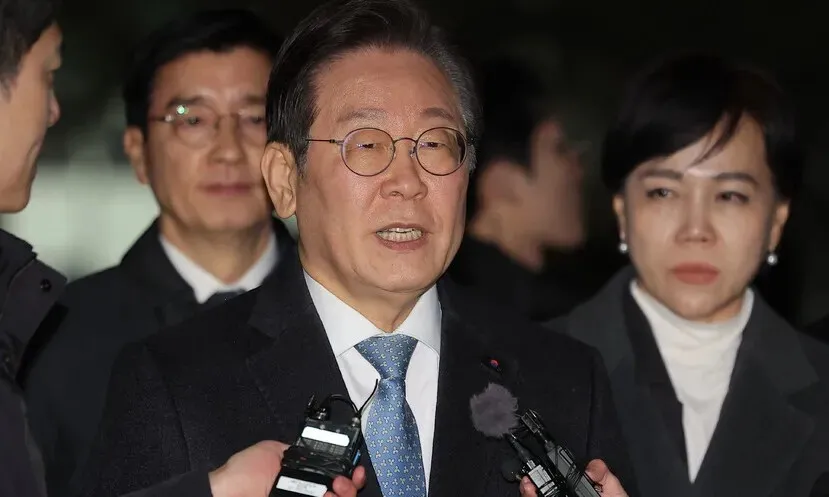
Korean prosecutors have asked an appellate court to sentence Lee Jae-myung to two years in prison. Lee, head of Korea’s main opposition party, is charged with violating the Public Official Election Act by spreading falsehoods.
Lee called the move by prosecutors “not a normal exercise of prosecutorial authority,” noting that falsehood charges are generally punished with a fine. Lee’s sentencing is scheduled for March 26.
In the final hearing of Lee’s appeal on Wednesday, the prosecution asked the judge trying the case at the Seoul High Court for a two-year prison sentence, just as they had in district court.
Lee was indicted for two instances of lying when he was running for president in the last election. First, he claimed not to know Kim Moon-ki, a former executive with Seongnam Development Corporation, who died while being investigated for allegedly receiving kickbacks in the Daejang neighborhood development project. Second, Lee said he’d been “threatened” by the Ministry of Land, Infrastructure and Transport to rezone the site of the Korea Food Research Institute in city’s Baekhyeon neighborhood.
Both neighborhoods are located in Seongnam, Gyeonggi Province. Lee previously served as mayor of Seongnam, and later as governor of Gyeonggi Province.
This past November, a district court convicted Lee on those charges and sentenced him to one year in prison, suspended for two years. If such a severe sentence is ultimately upheld, Lee must forfeit his seat in the National Assembly and will be barred from running in the next presidential election.
The prosecutors offered the following rationale for their sentencing request. “The defendant avoided acknowledging the risk that presented the gravest obstacle to his presidential ambitions and repeatedly lied with the hope of winning the election. Those are grave offenses.”
The prosecutors also urged the court to consider the fact that Lee “had allies coach bereaved family members of Kim Moon-ki and public servants in Seongnam on their testimony.” The prosecutors also noted that “Lee has a criminal history of violating the Public Official Election Act.”
On the witness stand and in a final statement, Lee defended himself by saying that he hadn’t denied having any relationship with the late Kim but had rather “meant I hadn’t really noticed him, even if we did interact.”
Lee also addressed the controversy over his claim about being “threatened” by the Ministry of Land, Infrastructure and Transport. “I said ‘threatened’ because I was flustered,” Lee said, clarifying that the ministry had actually “pressured” him.
“I’m not perfect, and I don’t always express myself very well. Some things I’ve said have ended up being falsehoods that have cost me a lot of money and trouble, so I’m on my best behavior. But how could any politician go on the record if we get blamed for saying things we never actually said?”
By Kim Ji-eun, staff reporter
Please direct questions or comments to [english@hani.co.kr]

Editorial・opinion
![[Correspondent’s column] Coupang’s game in Washington follows familiar pattern](https://flexible.img.hani.co.kr/flexible/normal/500/300/imgdb/original/2025/1226/8217667391873536.jpg "[Correspondent’s column] Coupang’s game in Washington follows familiar pattern") [Correspondent’s column] Coupang’s game in Washington follows familiar pattern
[Correspondent’s column] Coupang’s game in Washington follows familiar pattern![[Editorial] Coupang’s attempt to hide behind US won’t win back Korean consumers](https://flexible.img.hani.co.kr/flexible/normal/500/300/imgdb/original/2025/1226/1817667387971465.jpg "[Editorial] Coupang’s attempt to hide behind US won’t win back Korean consumers") [Editorial] Coupang’s attempt to hide behind US won’t win back Korean consumers
[Editorial] Coupang’s attempt to hide behind US won’t win back Korean consumers- Coupang under fire for possible obstruction of investigation into its customer data leak
- [Editorial] Coupang founder’s contempt for workers, customer security knows no bounds
- [Column] Confessions of a Coupang-holic
- [Editorial] Kim Bom-suk’s arrogance on full display in boycott of Coupang leak hearing
- [Editorial] The facts of Yoon’s insurrection are clear — justice cannot be further delayed
- [Column] Trump destroys government
- [Column] A post-Western world approaches
- [Column] Offshore balancing, or carving out spheres of influence?
Most viewed articles
- 1Korea to trial next-gen train capable of sub-2-hour Seoul-Busan trip starting 2030
- 2Kim Jong-un’s hidden motive in criticizing South Korea’s nuclear submarine push
- 3[Editorial] Coupang’s attempt to hide behind US won’t win back Korean consumers
- 4Coupang under fire for possible obstruction of investigation into its customer data leak
- 5[Correspondent’s column] Coupang’s game in Washington follows familiar pattern
- 6Real-life heroes of “A Taxi Driver” pass away without having reunited
- 7Moon Jae-in renews call for end-of-war declaration, peace treaty on Korean Peninsula
- 8Chang Chun-ha’s family hopes to know truth of his death after 37 years
- 9Chinese money flooding into South Korean companies
- 10Russian architect personally witnessed Empress Myeongseong’s assassination by Japanese ronin, accoun