hankyoreh
Links to other country sites 다른 나라 사이트 링크
Why April 18 is the make-or-break deadline for court ruling on Yoon’s impeachment
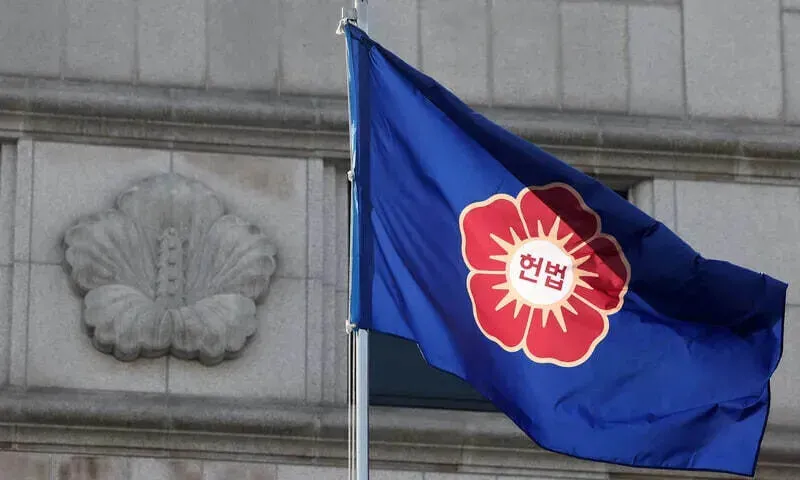
As prolonged deliberations continue to push back a decision on President Yoon Suk-yeol’s impeachment into April, many Koreans believe that the delay may be due to a split in opinion between Constitutional Court justices. Some fear the worst, worrying that a decision will not be reached by April 18, when the terms of two of the court’s justices are set to expire.
Following the closing arguments of Yoon’s case, which wrapped up on Feb. 25, many had predicted that the ruling would be announced by mid-March at the latest. Such expectations were grounded in the fact that decisions in the impeachment trials of former Presidents Roh Moo-hyun and Park Geun-hye were announced within two weeks of the closing arguments and how Yoon’s impeachment trial revealed how blatantly unconstitutional and illegal his declaration of martial law on Dec. 3 was. Smooth sailing in mid-March gave the impression that the pronouncement of the decision would take place on March 20 or 21.
However, a sudden shift in mood owing to the lack of a set timeline for a verdict and other factors has made it difficult to predict an outcome, or a timeframe for that matter.
One theory is that, after staying silent throughout the proceedings, one or more justices have voiced differing opinions at the 11th hour of organizing the points of the case. Contrary to expectations, the Constitutional Court gave no hints as to what its ruling on Yoon’s impeachment case would be when it delivered its verdict on the impeachment of Prime Minister Han Duck-soo on March 24. Instead, it demonstrated that there is discord among the justices, as Han’s impeachment was rejected with five justices rejecting the motion, one upholding it, and two dismissing the motion.
There are a number of theories from sources outside the Constitutional Court regarding what might be causing such discord.
Some suggest that nitpicking over procedural issues, such as the drafting of the decision, is behind the delay. Some believe that decision may have been drafted using statements obtained by prosecutors, meaning that time is now being dedicated to swapping out any relevant sections with testimony given before the court itself during the impeachment trial.
Still others have voiced concern that the delay could mean that the court is failing to meet the minimum threshold for upholding impeachment required to remove Yoon from office. Unless six or more judges move to uphold the motion, Yoon will return to office.
“It may be that the absence of a decision this late in the game means that the justices have failed to reach that six-vote minimum for removal from office,” commented a former high-ranking judge in a telephone interview with the Hankyoreh.
“If one justice decided to put a different opinion on the table, another may have joined. Even if dismissing and rejecting the motion seem completely illogical and far-fetched, if a justice refuses to budge, there is nothing anyone can do,” they said.
Other analyses point to how it may be difficult to conclude the case if the eight-member bench, which would become a nine-member bench if nominee Ma Eun-hyeok were to be appointed, is divided 5-3. Lee Jong-soo, a professor at Yonsei University Law School, said, “The judges may be divided sharply into a 5-3 split. Since there have been no cases in which a single vacant spot on the bench could make or break a decision, the court has no choice but to think long and hard about its decision.”
Though the court has up to 180 days after it receives a case to reach a decision, the general mood in Korea is that the deadline to rule on Yoon’s impeachment falls on April 18, when the terms of Constitutional Court Justices Moon Hyung-bae and Lee Mi-son are set to expire. April 10 will be the last day the Constitutional Court’s eight-member bench hands out its regular pronouncements.
The court reportedly plans to announce its ruling on Justice Minister Park Sung-jae’s impeachment before Moon and Lee leave the bench. With plenty of work still left to complete, some have raised the possibility that the decision on Yoon’s impeachment will not be made by the time the two justices leave their posts. If that happens, the Constitutional Court will effectively be paralyzed as it is reduced to a six-member bench.
“It should not take this long to finalize the court’s decision. This delay suggests that there may be one or more justices buying time out of political considerations,” said Lim Ji-bong, a professor at Sogang University Law School.
“The court has a duty to announce a decision that could be accepted by the public as soon as it can, but it has already missed the opportune timing to do so. The Constitutional Court’s decisions are as much about timing as they are about their persuasiveness,” Lim said.
By Jang Hyeon-eun, staff reporter; Oh Yeon-seo, staff reporter
Please direct questions or comments to [english@hani.co.kr]

Editorial・opinion
![[Editorial] Head of USFK continues to cross the line with inappropriate political remarks](https://flexible.img.hani.co.kr/flexible/normal/500/300/imgdb/original/2026/0528/4817799568931091.jpg "[Editorial] Head of USFK continues to cross the line with inappropriate political remarks") [Editorial] Head of USFK continues to cross the line with inappropriate political remarks
[Editorial] Head of USFK continues to cross the line with inappropriate political remarks![[Editorial] A disgraced former president like Park Geun-hye has no place on the campaign trail](https://flexible.img.hani.co.kr/flexible/normal/500/300/imgdb/original/2026/0526/2117797859381587.jpg "[Editorial] A disgraced former president like Park Geun-hye has no place on the campaign trail") [Editorial] A disgraced former president like Park Geun-hye has no place on the campaign trail
[Editorial] A disgraced former president like Park Geun-hye has no place on the campaign trail- [Editorial] Korea’s online hate problem calls for platform regulation and anti-discrimination law
- [Reporter’s notebook] Trump’s primary purge of ‘traitors’ won’t win him anything
- [Guest essay] Moscow-Pyongyang ties are rewriting security in NE Asia
- [Reporter’s notebook] Trump’s primary purge of ‘traitors’ won’t win him anything
- [Column] An incompetent ally is worse than no ally at all
- [Editorial] Samsung’s tentative bonus deal highlights need for profit-sharing rules
- [Editorial] Crisis averted at Samsung, but society must continue chip profit-sharing debate
- [Editorial] Seoul and Tokyo should focus on pragmatic cooperation, not countering China
Most viewed articles
- 1K-pop wins big at AMAs, with BTS taking home artist of the year
- 2[Editorial] Head of USFK continues to cross the line with inappropriate political remarks
- 3KFTC eyes criminal proceedings against Coupang founder over alleged false filings
- 4[Editorial] Samsung’s tentative bonus deal highlights need for profit-sharing rules
- 5[Editorial] Crisis averted at Samsung, but society must continue chip profit-sharing debate
- 6[Reporter’s notebook] Trump’s primary purge of ‘traitors’ won’t win him anything
- 7Ambassador denies Iranian involvement after Korea concludes ship was hit by Iran-linked missiles
- 8Lee pulls off pragmatic diplomacy balancing act between strongmen Trump and Xi
- 9Seoul stops short of naming Iran as attacker in strike on ship in Hormuz
- 10[Guest essay] Moscow-Pyongyang ties are rewriting security in NE Asia