hankyoreh
Links to other country sites 다른 나라 사이트 링크
South Korea returns to diplomatic stage as Lee sets off for G7 summit
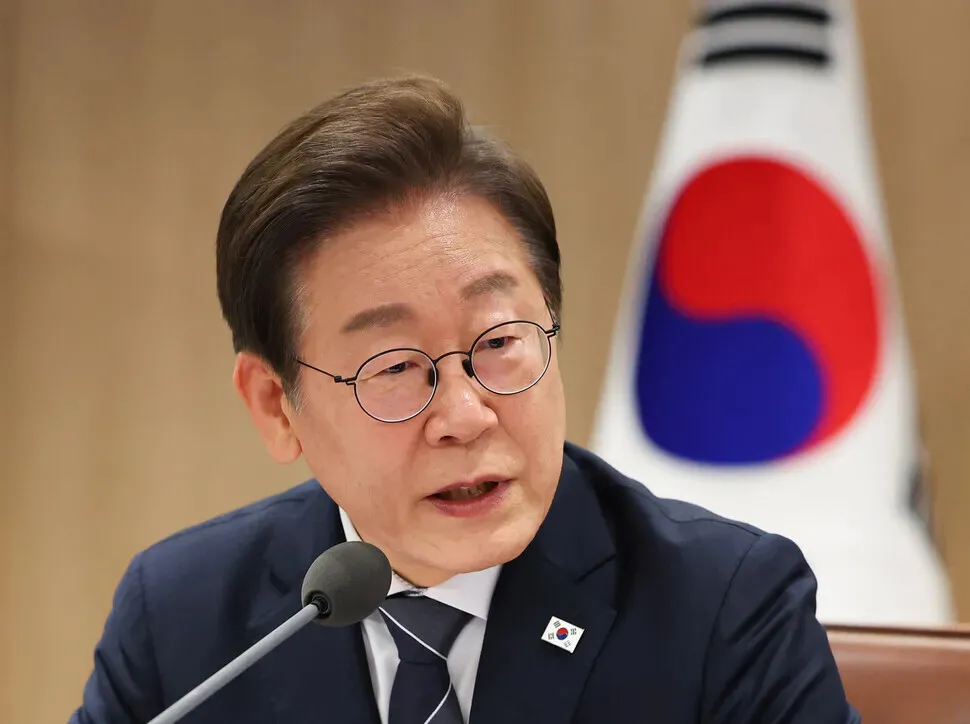
President Lee Jae-myung set off for Canada on Monday to attend the Group of Seven summit there, ending a six-month hiatus in South Korea’s summit diplomacy since his predecessor’s ill-fated declaration of martial law in December. There is considerable interest in whether Lee will hold a bilateral summit with US President Donald Trump over pressing issues, such as negotiations on tariffs, during his short three-day stay in Calgary.
“President Lee will travel overseas on a three-day trip on Monday to attend the G7 Summit in Canada,” said Wi Sung-lac, the head of Korea’s National Security Office, in a press briefing on Sunday.
Lee faces obvious limitations on his first foray into summit diplomacy 12 days after becoming president: the G7 summit is a multilateral event, and Korea only has observer status there.
But Wi underscored the significance of Lee’s attendance at “the first international event where we can send the international community a message that Korean democracy has survived the crisis posed by the martial law declaration.” Wi also said that Lee’s trip signals that Korean summit diplomacy is back on track, ending a six-month vacuum following the martial law fiasco.
“It’s significant [for Lee] to attend a forum of practical diplomacy focused on the national interest during a time of transition in the global economy and the security environment,” Wi added.
Lee plans to deliver two addresses on the topics of diversifying the energy supply chain and forging connections between artificial intelligence and the energy sector in an expanded session on the topic of “energy security” on Tuesday.
Given Lee’s pledges about adopting a pragmatic foreign policy and diversifying Korea’s diplomatic landscape, Lee is not only pursuing bilateral summits with the American and Japanese leaders at the summit, but will hold meetings with the leaders of various other nations as well.
“The first item on Lee’s itinerary after his arrival on Monday is holding bilateral meetings with the leaders of major countries invited to the summit. On Tuesday, he plans to hold bilateral summits with the leaders of major countries, including G7 member states,” Wi said.
The presidential office did not state exactly whether a Korea-US summit would be held — a question of much interest — but left open the possibility.
“Major issues such as tariffs and national security are currently up for debate, and President Lee has asked the negotiating team to strike a deal on pending issues through close deliberations with the US. A meeting between the two leaders could build momentum for working-level negotiators,” said a source at the presidential office.
“We’re preparing for several possibilities,” the official said, including the possibility of Trump bringing up tariffs and defense burden-sharing during the meeting, if it is indeed held.
“We’ll work for a quick breakthrough in the negotiations with an open-minded attitude and awareness of our status as allies,” the official added.
Regarding the possibility of a trilateral summit between the leaders of Korea, the US and Japan, the official noted that multilateral events are “currently being coordinated.”
“The Korea-US alliance and Korea-US-Japan cooperation are the foundation of our foreign policy and national security, as Lee himself has emphasized on several occasions,” the official added.
On Sunday, Lee unexpectedly named Ha Jung-woo, head of the NAVER Cloud Innovation Center, as his senior secretary for artificial intelligence affairs. Also appointed on Sunday were Kim Hyun-chong, former career soldier and former Blue House secretary for national defense reform, to serve as first deputy director of national security, Ambassador to Canada Lim Woong-sung as second deputy director of national security, and Ambassador to the Holy See Oh Hyun-joo as third deputy director of national security.
By Um Ji-won, staff reporter; Shin Hyeong-cheol, staff reporter
Please direct questions or comments to [english@hani.co.kr]

Editorial・opinion
![[Editorial] Head of USFK continues to cross the line with inappropriate political remarks](https://flexible.img.hani.co.kr/flexible/normal/500/300/imgdb/original/2026/0528/4817799568931091.jpg "[Editorial] Head of USFK continues to cross the line with inappropriate political remarks") [Editorial] Head of USFK continues to cross the line with inappropriate political remarks
[Editorial] Head of USFK continues to cross the line with inappropriate political remarks![[Editorial] A disgraced former president like Park Geun-hye has no place on the campaign trail](https://flexible.img.hani.co.kr/flexible/normal/500/300/imgdb/original/2026/0526/2117797859381587.jpg "[Editorial] A disgraced former president like Park Geun-hye has no place on the campaign trail") [Editorial] A disgraced former president like Park Geun-hye has no place on the campaign trail
[Editorial] A disgraced former president like Park Geun-hye has no place on the campaign trail- [Editorial] Korea’s online hate problem calls for platform regulation and anti-discrimination law
- [Reporter’s notebook] Trump’s primary purge of ‘traitors’ won’t win him anything
- [Guest essay] Moscow-Pyongyang ties are rewriting security in NE Asia
- [Reporter’s notebook] Trump’s primary purge of ‘traitors’ won’t win him anything
- [Column] An incompetent ally is worse than no ally at all
- [Editorial] Samsung’s tentative bonus deal highlights need for profit-sharing rules
- [Editorial] Crisis averted at Samsung, but society must continue chip profit-sharing debate
- [Editorial] Seoul and Tokyo should focus on pragmatic cooperation, not countering China
Most viewed articles
- 1K-pop wins big at AMAs, with BTS taking home artist of the year
- 2[Editorial] Head of USFK continues to cross the line with inappropriate political remarks
- 3KFTC eyes criminal proceedings against Coupang founder over alleged false filings
- 4[Editorial] Samsung’s tentative bonus deal highlights need for profit-sharing rules
- 5[Editorial] Crisis averted at Samsung, but society must continue chip profit-sharing debate
- 6[Reporter’s notebook] Trump’s primary purge of ‘traitors’ won’t win him anything
- 7Ambassador denies Iranian involvement after Korea concludes ship was hit by Iran-linked missiles
- 8Lee pulls off pragmatic diplomacy balancing act between strongmen Trump and Xi
- 9Seoul stops short of naming Iran as attacker in strike on ship in Hormuz
- 10[Guest essay] Moscow-Pyongyang ties are rewriting security in NE Asia