hankyoreh
Links to other country sites 다른 나라 사이트 링크
Korea says ‘real progress’ made on major sticking points with US on trade deal
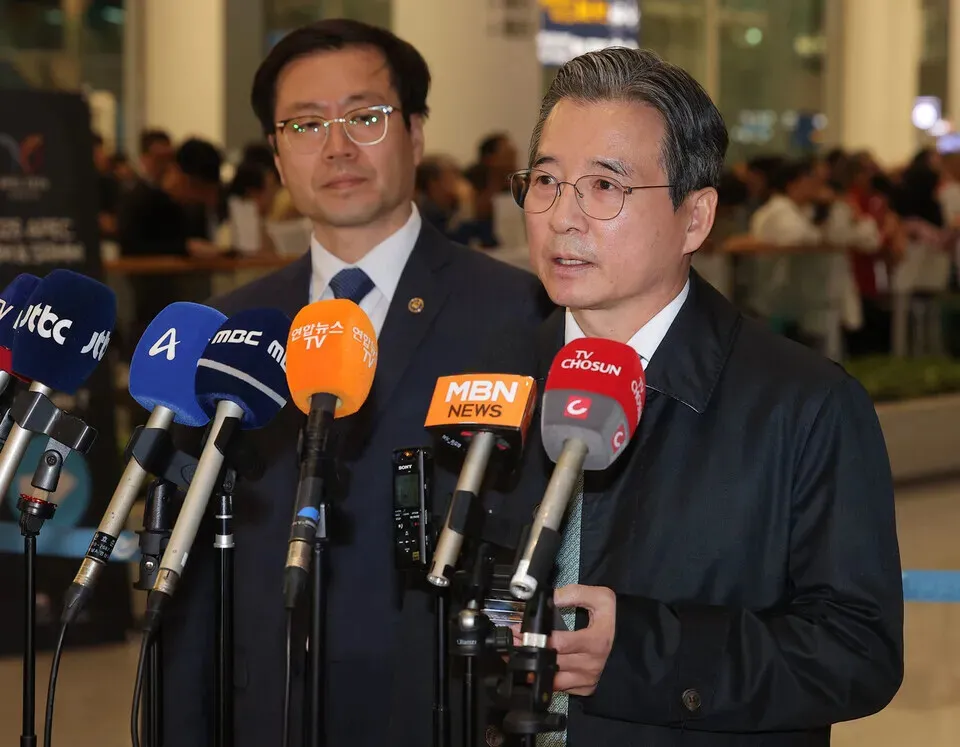
The top policy official in Korea’s presidential office said “real progress on most major issues” had been made after returning to Korea on Sunday following the latest round of tariff talks with US representatives in Washington, DC.
“The chances that a deal will be worked out during the APEC [Asia-Pacific Economic Cooperation] summit are higher than before this last visit to the US,” director of policy Kim Yong-beom told reporters upon arriving in Korea.
However, Kim admitted that there are still some critical issues where some “fine-tuning” is needed.
With US President Donald Trump recently claiming that the US only wants to be “treated fairly” by nations like Korea, which he said meant “hundreds of billions and even trillions of dollars coming into the United States,” many predict the two sides will continue their tug-of-war over the specifics of Korea’s pledged US$350 billion in investments in the US until a deal is finally inked.
“Aside from the official meeting we had [with US Commerce Secretary Howard Lutnick] that lasted well over two hours, we also had substantial dialogue during the banquet that followed,” Kim told reporters at Incheon International Airport on Sunday.
Kim went to Washington on Thursday, two weeks ahead of the APEC summit in Gyeongju, to finalize the details of a potential trade agreement. He returned on Sunday with Koo Yun-cheol, the minister of economy and finance, and Trade Minister Yeo Han-koo.
Kim Jung-kwan, the minister of trade, industry and energy, who recently visited the Hyundai Motor Company factory in the US state of Georgia, where illegal Korean workers were arrested and detained, arrived on Monday from Atlanta.
Regarding his recent US visit, Kim Yong-beom said, “We are considerably close to reaching a consensus that this must be a mutually beneficial program that is within the bounds of what South Korea can handle.”
“We found common ground on most of the issues of contention, but there are still one or two disputes that need some fine-tuning,” he added.
Kim did not specify what those “one or two” disputes were about.
There has been substantial skepticism about the two sides being able to narrow their differences regarding the specific form that Korea’s pledge US$350 billion in investments will take, the scale and timetable of a direct investment, the profit split, and the adoption of financial safety nets that will minimize the potential shock the investment could cause in Korea’s foreign exchange market.
Responding to a question about discussions regarding measures to spread the US$350 billion investment out over a 10-year period, Kim said he could not comment on the details of specific issues being discussed.
“We are aware of the figure of US$350 billion that we agreed to on July 31, and both parties are coming closer to finding common ground regarding a mutually beneficial program [for implementing the investment],” Kim added.
Regarding an agreement for a currency swap to minimize shocks to Korea’s foreign exchange market, Kim said he couldn’t comment on individual programs as they are directly related to the talks.
“We can’t allow a shock to Korea’s foreign exchange market,” he added.
During a press conference at the IMF headquarters in Washington, DC, on Thursday, Koo Yun-cheol said, “When it comes to commerce negotiations, the talks with Commerce Secretary Howard Lutnick form the crux, and if any foreign exchange disturbances results according to such a deal, we could have a currency swap to secure foreign exchange stability, or we could not.”
Koo’s comments seem to indicate that Korea’s priority when it comes to trade talks is not a currency swap but restricting the scale of direct investment in the US that could result in a fiscal and foreign exchange crisis.
Meanwhile, Trump has been dialing up the pressure on Korea. During his summit with Ukrainian President Volodymyr Zelenskyy at the White House on Friday, Trump told reporters that what the US wants from the EU, Japan and Korea is to be “treated fairly,” which he said meant “hundreds of billions and even trillions of dollars coming into the United States.”
Korean business leaders have stepped up to find a solution to the deadlock. Samsung Electronics Chairman Lee Jae-yong, SK Group Chairman Chey Tae-won, Hyundai Motor Group Chairman Chung Eui-sun, LG Group Chairman Koo Kwang-mo, and Hanwha Group Vice Chairman Kim Dong-kwan held a golf meeting with Trump at the Trump International Golf Club in West Palm Beach, Florida, on Saturday.
The golf meeting lasted over seven hours. With the game proceeding in groups of four, it is still unclear who exactly was in Trump’s group. As the companies the executives represent are pursuing deals that involve large-scale investments in strategic US industries such as chips, batteries, automobiles, and energy, it is likely that opinions were exchanged about the nearly completed trade talks between the two countries.
By Shin Hyeong-cheol, staff reporter
Please direct questions or comments to [english@hani.co.kr]

Editorial・opinion
![[Editorial] Head of USFK continues to cross the line with inappropriate political remarks](https://flexible.img.hani.co.kr/flexible/normal/500/300/imgdb/original/2026/0528/4817799568931091.jpg "[Editorial] Head of USFK continues to cross the line with inappropriate political remarks") [Editorial] Head of USFK continues to cross the line with inappropriate political remarks
[Editorial] Head of USFK continues to cross the line with inappropriate political remarks![[Editorial] A disgraced former president like Park Geun-hye has no place on the campaign trail](https://flexible.img.hani.co.kr/flexible/normal/500/300/imgdb/original/2026/0526/2117797859381587.jpg "[Editorial] A disgraced former president like Park Geun-hye has no place on the campaign trail") [Editorial] A disgraced former president like Park Geun-hye has no place on the campaign trail
[Editorial] A disgraced former president like Park Geun-hye has no place on the campaign trail- [Editorial] Korea’s online hate problem calls for platform regulation and anti-discrimination law
- [Reporter’s notebook] Trump’s primary purge of ‘traitors’ won’t win him anything
- [Guest essay] Moscow-Pyongyang ties are rewriting security in NE Asia
- [Reporter’s notebook] Trump’s primary purge of ‘traitors’ won’t win him anything
- [Column] An incompetent ally is worse than no ally at all
- [Editorial] Samsung’s tentative bonus deal highlights need for profit-sharing rules
- [Editorial] Crisis averted at Samsung, but society must continue chip profit-sharing debate
- [Editorial] Seoul and Tokyo should focus on pragmatic cooperation, not countering China
Most viewed articles
- 1K-pop wins big at AMAs, with BTS taking home artist of the year
- 2[Editorial] Head of USFK continues to cross the line with inappropriate political remarks
- 3KFTC eyes criminal proceedings against Coupang founder over alleged false filings
- 4[Editorial] Samsung’s tentative bonus deal highlights need for profit-sharing rules
- 5[Editorial] Crisis averted at Samsung, but society must continue chip profit-sharing debate
- 6[Reporter’s notebook] Trump’s primary purge of ‘traitors’ won’t win him anything
- 7Ambassador denies Iranian involvement after Korea concludes ship was hit by Iran-linked missiles
- 8Lee pulls off pragmatic diplomacy balancing act between strongmen Trump and Xi
- 9Seoul stops short of naming Iran as attacker in strike on ship in Hormuz
- 10[Guest essay] Moscow-Pyongyang ties are rewriting security in NE Asia