hankyoreh
Links to other country sites 다른 나라 사이트 링크
Why prosecutors are seeking the death penalty for Korea’s former president
 Add as preferred source on Google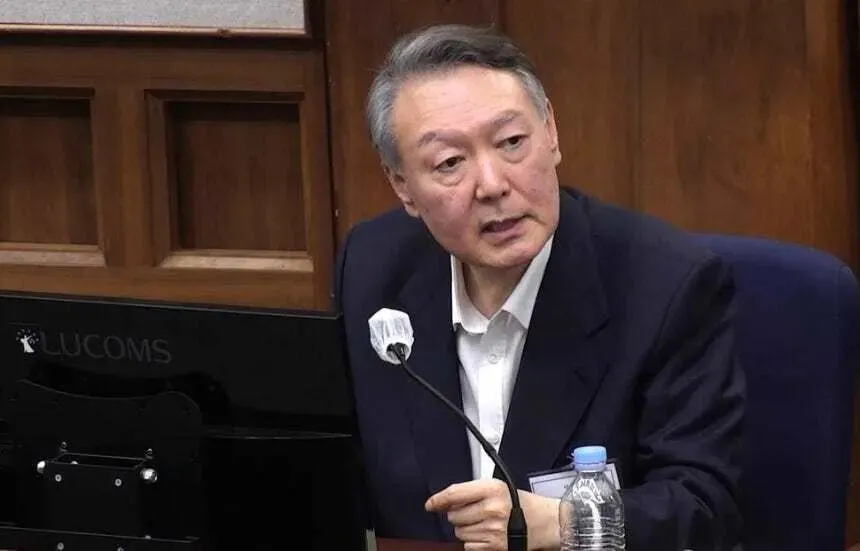
On Tuesday, prosecutors requested the death penalty for Yoon Suk-yeol, asking the court to throw the book at the disgraced former president for repeating the “history of insurrection.”
South Korea is a de facto abolitionist state that does not carry out executions, despite the death penalty remaining on the law books. As an explanation for why the death penalty was sought, the special counsel team prosecuting the case emphasized that seeking the death penalty represents a strong resolve to respond to the crimes in question and uphold trust in the judicial process.
Yoon is accused of leading an insurrection, which carries three possible statutory penalties: death, life imprisonment with labor, or life imprisonment without labor. In 1997, a court sentenced the former dictator Chun Doo-hwan to life imprisonment without parole for the same charge over his role in leading the May 17 military coup.
Despite this precedent from nearly 30 years ago, Yoon attempted to execute an even more thoroughly premeditated insurrection. The special counsel team argued to the court that severe punishment is necessary to prevent this history from repeating itself once more.
In particular, the special counsel team noted that former Prime Minister Han Duck-soo, other Cabinet members, and presidential aides such as Yoon’s former chief of staff, Chung Jin-suk, made no active attempts to stop the insurrection despite their awareness of Yoon’s plans. The prosecutors noted that these officials were “summoned ahead of the martial law declaration and were on standby for an extensive period until it was announced,” yet did not “release information about the declaration via text messages,” for example.
“Despite the convictions of the insurrectionary forces led by Chun Doo-hwan and Roh Tae-woo, the conduct of these elite public officials reveals that there remains a significant risk that attempts to destroy the constitutional order through a self-coup using martial law could recur,” argued assistant special counsel Park Eok-su.
“We must demonstrate that the Republic of Korea can defend its constitutional order through its own criminal justice system by sentencing these public officials to more severe punishments than the forces aligned with Chun and Roh received.”
Throughout the trial, Yoon repeatedly emphasized that the state of emergency was lifted after two and a half hours, and, unlike in past cases, no deaths occurred. The special counsel team, however, stressed the gravity of Yoon’s crime.
“This declaration of emergency martial law and the crimes of insurrection committed in this case severely damaged the national pride and international trust that had been painstakingly built over time — namely, our standing as a stable, democratic nation,” Park argued before the court.
“The Republic of Korea has a history of countless sacrifices made to secure democracy, including the 1960 April 19 Revolution, the 1980 May 18 Democratization Movement, and the 1987 June Democratization Movement. In light of these historical experiences, democracy must never again be undermined for the purpose of monopolizing and maintaining power,” the deputy special counsel argued.
The special counsel team also pointed out that Yoon mobilized the military and police in his insurrection attempt, although these organizations have a duty to maintain political neutrality and loyalty to the people. It further argued that he has been sowing public conflict and national division since Dec. 3, 2024.
The special counsel also noted that Yoon has repeatedly lied about the insurrection, and has yet to express remorse for his actions. It argued that Yoon had “deceived the nation” by having the presidential office deny that plans for the insurrection had been in motion since Yoon appointed Kim Yong-hyun as his defense minister.
The team went on to highlight three indications that Yoon lacks remorse for his actions. First, Yoon did not sincerely reflect on the insurrection or properly apologize to the public; second, he disregarded criminal justice procedures by refusing to cooperate with the investigation and trial; and lastly, he behaved irresponsibly by shifting blame onto subordinates.
“There is absolutely no room for leniency,” Park emphasized.
The special counsel team also demonstrated its resolve to put a halt to Korea’s history of repeated insurrections by requesting the death penalty, regardless of whether it is actually carried out.
“While the Republic of Korea is a [de facto] abolitionist state, death sentences are still being sought and handed down,” Park said.
“In Korea’s criminal justice system, the ‘death penalty’ does not mean the sentenced will be executed. It functions as a means for the public to demonstrate its resolve to respond to the crime in question and its trust that this resolve will be enacted through the judicial process,” he explained.
This is why the special counsel team argued that imposing the minimum sentence within the statutory range is “inappropriate” and sought the maximum sentence for Yoon.
By Oh Yeon-seo, staff reporter; Park Ji-young, staff reporter; Lee Na-young, staff reporter
Please direct questions or comments to [english@hani.co.kr]

Editorial・opinion
![[Column] The unspoken deal that made China a nation led by engineers](https://flexible.img.hani.co.kr/flexible/normal/500/300/imgdb/original/2026/0821/381787301627593.jpg "[Column] The unspoken deal that made China a nation led by engineers") [Column] The unspoken deal that made China a nation led by engineers
[Column] The unspoken deal that made China a nation led by engineers![[Column] Does the US deserve allies’ trust?](https://flexible.img.hani.co.kr/flexible/normal/500/300/imgdb/original/2026/0818/8417870405925049.jpg "[Column] Does the US deserve allies’ trust?") [Column] Does the US deserve allies’ trust?
[Column] Does the US deserve allies’ trust?- [Column] No, tactical nukes aren’t practical for real-world use
- [Column] ‘The Odyssey’: Finally, a good chamber drama
- [Column] How will the US uphold deterrence when it runs out of weapons?
- [Column] US isn’t pulling out of the Middle East — it’s being kicked out
- [Editorial] Will shift in US nuclear strategy reintroduce tactical nukes to Korea, Japan?
- Why does the USFK commander keep butting heads with Seoul?
- [Guest essay] Futures thinking in science fiction
- [Editorial] New US envoy must stick to her diplomatic mission
Most viewed articles
- 1[Reportage] US looks to Korean experience to ease its critical mineral reliance on China
- 2Last time they met, Kim Jong-un needed Trump. Have the tables turned?
- 3[Exclusive] SK Hynix to build memory fab in Japan’s Miyagi
- 4[Column] The unspoken deal that made China a nation led by engineers
- 5The bill for America’s superpower status is coming due
- 6[News analysis] Is Trump about to undo US policy on North Korea’s denuclearization?
- 7[News analysis] Truncated military drills: Bad for OPCON transfer, good for peace?
- 8Former bodyguard’s dark tale of marriage to Samsung royalty
- 9[Column] ‘The Odyssey’: Finally, a good chamber drama
- 10Pyongyang has ‘no interest’ in Trump’s cut to SK-US military drills, says Kim Yo-jong