hankyoreh
Links to other country sites 다른 나라 사이트 링크
Korean election body’s efforts to curb conspiracy theories backfire amid ballot shortages
 Add as preferred source on Google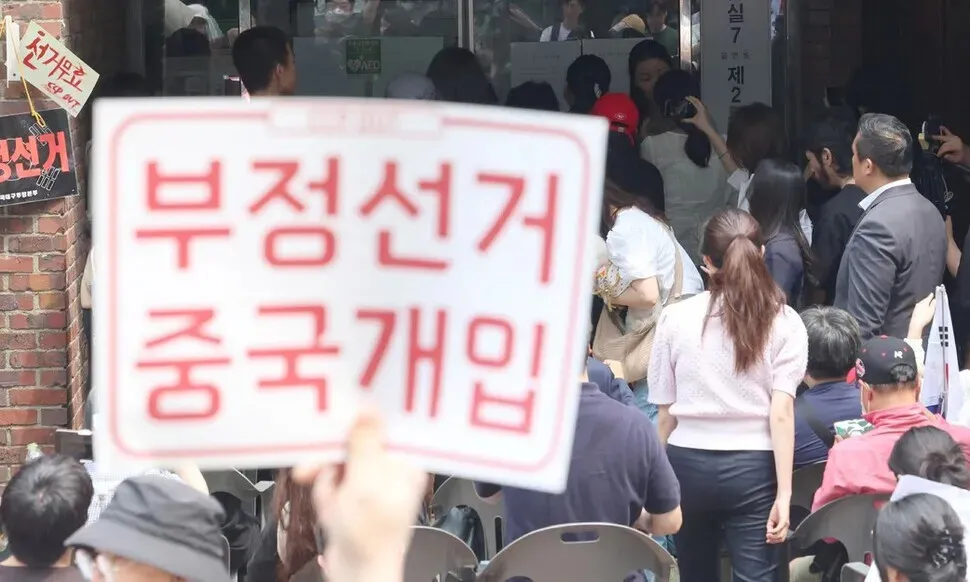
“We must protect the ballot boxes inside at all costs.”
Jeon Han-gil, a former history lecturer who peddles debunked theories about electoral fraud on his YouTube channel, held the microphone in front of a senior citizen center at an apartment complex in the Jamsil neighborhood of Seoul’s Songpa District at 7 pm on Thursday.
Hundreds of people packed inside the complex welcomed Jeon while waving placards accusing China of election-rigging.
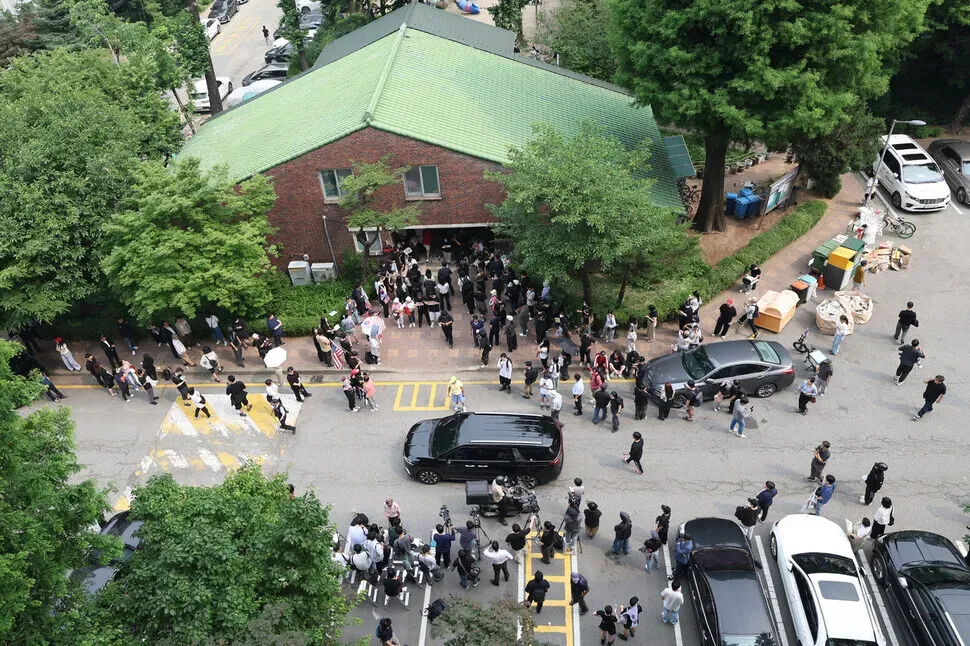
The crowd had gathered around a polling station in the Jamsil-7 neighborhood. Protesters had kept officials from removing two boxes of ballots from Wednesday’s local elections that were being stored there. Roughly 2,000 ballots remained uncounted in the boxes, preventing the completion of the vote tally and leaving the Seoul mayoral race and other races without final results.
The Jamsil polling station, where voting continued until 10 pm on election day because of a shortage of ballot sheets, became ground zero for those convinced that Korea’s elections are being rigged.
Protesters who attended a rally that same evening in front of the National Election Commission (NEC) in Gwacheon, Gyeonggi Province, congregated at the Jamsil polling station to block the removal of the ballot boxes, which they regard as evidence of fraud.
Hwang Kyo-ahn, the head of the Freedom & Innovation party, and members of the self-styled “Korea-US Election Fraud Joint Investigation Team” who entered Korea along with Morse Tan, a former dean of Liberty University’s Law School, whipped up the crowd with claims about stolen elections.
Ironically, it was the NEC’s own concerns about rumors of vote tampering that triggered the situation now supercharging election fraud conspiracy theories.
During the 2018 local elections, the NEC printed paper ballots equivalent to about 70% of eligible voters, but for Wednesday’s election, that figure was reduced to 50%.
This reflected the decrease in voters in local elections and the increase in early voters, but also because the NEC felt a considerable amount of pressure on the preservation and disposal of residual paper ballots after facing allegations of election fraud after every election.
Fuel was added to the fire when the inadequate on-the-ground response exposed the commission’s administrative shortcomings. Each election commission in every district, city and county determines the final print run for paper ballots based on internal guidelines, taking into account the minimum threshold for ballots on the day of the election — in this case, 50% — and estimated voter turnout.
The issue here was the lack of an adequate emergency response system. In Seoul’s Songpa District, which faced ballot shortages, only 12 out of 146 polling stations ran out of ballots, while the remaining 134 stations either had surplus ballots or no shortage at all.
A system to quickly transport and redistribute ballots from locations with surpluses to those with shortages should have been in place, but in practice, the system on the ground failed to function.
Even the reserve ballots set aside to prepare for increased demand were not promptly supplied to polling stations that needed them.
“Since we typically prepare a generous supply of ballots, such shortages are rare,” stated one election commission official.
Experts noted that the incident has deepened distrust in the electoral system.
“Even experts find it difficult to estimate voter turnout, so one cannot help but ask on what grounds the NEC decided to adhere to a policy that agreed to print ballots for only 50% of all eligible voters,” said Shin Yul, a professor of political science at Myongji University.
“Whatever the reasoning, the NEC brought this deep, deep distrust of the electoral system, which lies at the heart of democracy, onto itself,” he said.
By Lim Jae-woo, staff reporter; Park Go-eun, staff reporter; Jeong Bong-bi, staff reporter; Chung In-seon, staff reporter; Cho Hae-yeong, staff reporter
Please direct questions or comments to [english@hani.co.kr]

Editorial・opinion
![[Column] US isn’t pulling out of the Middle East — it’s being kicked out](https://flexible.img.hani.co.kr/flexible/normal/500/300/imgdb/original/2026/0812/4317865219661676.jpg "[Column] US isn’t pulling out of the Middle East — it’s being kicked out") [Column] US isn’t pulling out of the Middle East — it’s being kicked out
[Column] US isn’t pulling out of the Middle East — it’s being kicked out![[Editorial] Will shift in US nuclear strategy reintroduce tactical nukes to Korea, Japan?](https://flexible.img.hani.co.kr/flexible/normal/500/300/imgdb/original/2026/0807/6217860897464353.jpg "[Editorial] Will shift in US nuclear strategy reintroduce tactical nukes to Korea, Japan?") [Editorial] Will shift in US nuclear strategy reintroduce tactical nukes to Korea, Japan?
[Editorial] Will shift in US nuclear strategy reintroduce tactical nukes to Korea, Japan?- [Guest essay] Futures thinking in science fiction
- [Editorial] New US envoy must stick to her diplomatic mission
- [Editorial] Drone incident should serve as a wake-up call for US-Korea communication
- [Column] Lessons from the tragedy of the Donghak rebellion for regaining OPCON
- [Column] Can Korea advocate peace while selling weapons of war?
- [Column] The 40-year-old agreement haunting Korea’s booming semiconductor sector
- [Column] In an era of waning US hegemony, NE Asia needs the status quo
- [Editorial] The alarming prospect of more North Korean troops for Russia
Most viewed articles
- 1Pro-Yoon pastor claims he was jailed for criticizing Lee administration — here’s the truth
- 2US defense policy chief calls notion of US-less middle power alliance a ‘delusion’
- 3[Column] US isn’t pulling out of the Middle East — it’s being kicked out
- 4Coupang CEO Rogers files for sale of nearly $3.11M in company stock
- 5Zelenskyy says Russia used North Korean missiles in deadly strike on Zaporizhzhia
- 6Real-life heroes of “A Taxi Driver” pass away without having reunited
- 7[Editorial] Will shift in US nuclear strategy reintroduce tactical nukes to Korea, Japan?
- 8Another migrant worker dies in Korea’s heat wave. How many more deaths go uncounted?
- 9[Guest essay] Futures thinking in science fiction
- 10[Reportage] Francesca Hong, the Korean American democratic socialist winning over Wisconsinites, left and right