hankyoreh
Links to other country sites 다른 나라 사이트 링크
[Editorial] Teachers should be allowed to join political parties
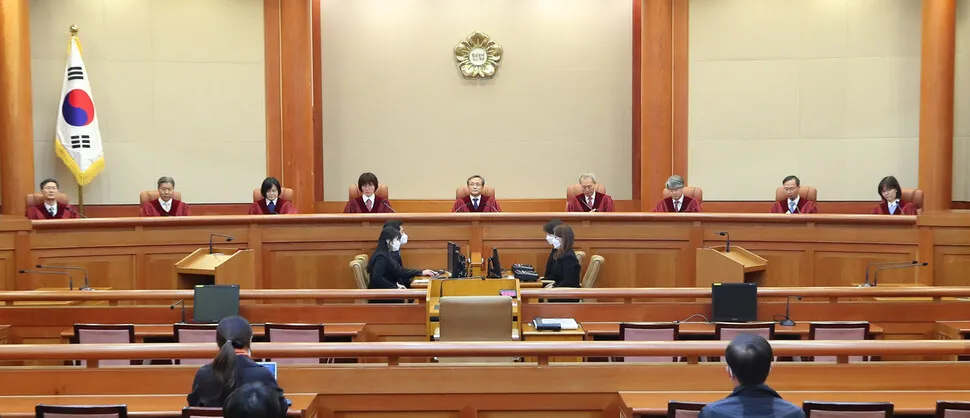
On Apr. 23, South Korea’s Constitutional Court ruled that a legal provision banning elementary, middle, and high school teachers from taking part in political organizations was unconstitutional. While this ruling is a step forward, since it removes some of the shackles on teachers’ basic political rights, it’s a shame that teachers are still banned from joining political parties.
The State Public Officials Act prohibits teachers from forming or joining political parties or other political organizations. The Constitutional Court said that the phrase about “other political organization” is an ambiguous and excessive regulation that infringes on teachers’ freedom of political expression and association.
“In a democratic state, all the social activities of a member of that state are related to politics and it’s impossible to concoct a standard for distinguishing between political and non-political organizations,” the court said. Banning participation in political organizations, the court said, infringes upon the basic rights that teachers, as individuals, are supposed to enjoy.
There have been several examples of teachers voicing their opinions about items of social interest only to be oppressed for “political activity,” such as after the tragic sinking of the Sewol ferry or during the previous administration’s attempt to place history textbook publication under state control. Even though “political neutrality” is “an abstract concept that is capable of multiple interpretations,” as the court said, that very ambiguity has been abused to suppress teachers’ individual freedom of expression. We must bring a halt to this abnormal situation in which teachers are punished for simply commenting on social issues.
“There are no grounds, either logical or experiential, to support the view that teachers who exercise their political freedom in a private capacity are thereby undermining the political neutrality of education on the job,” the court said in its ruling. The logical conclusion of the court’s argument is that teachers should also be allowed to participate in political parties.
But the court reverted to the original argument about maintaining the neutrality of education when it upheld the constitutionality of the ban on participating in political parties. Thus, it failed to expand upon the progressive conclusion it reached in regard to the ban on participating in political organizations. The court also upheld the constitutionality of the ban on collective action on matters unrelated to official duties.
On several occasions, Korea’s National Human Rights Commission has espoused the principle that the principle of teachers’ political neutrality only applies to their public responsibilities and that therefore they should not be banned from engaging in political activities as private citizens. There have also been calls from the international community — such as the UN special rapporteur on freedom of expression and the International Labor Organization — for the South Korean government to amend these laws. Considering that the Constitutional Court’s responsibility is to defend our basic rights, it’s a shame to see that it still lags behind international standards and the principles of human rights.
Please direct comments or questions to [english@hani.co.kr]

Editorial・opinion
![[Correspondent’s column] Coupang’s game in Washington follows familiar pattern](https://flexible.img.hani.co.kr/flexible/normal/500/300/imgdb/original/2025/1226/8217667391873536.jpg "[Correspondent’s column] Coupang’s game in Washington follows familiar pattern") [Correspondent’s column] Coupang’s game in Washington follows familiar pattern
[Correspondent’s column] Coupang’s game in Washington follows familiar pattern![[Editorial] Coupang’s attempt to hide behind US won’t win back Korean consumers](https://flexible.img.hani.co.kr/flexible/normal/500/300/imgdb/original/2025/1226/1817667387971465.jpg "[Editorial] Coupang’s attempt to hide behind US won’t win back Korean consumers") [Editorial] Coupang’s attempt to hide behind US won’t win back Korean consumers
[Editorial] Coupang’s attempt to hide behind US won’t win back Korean consumers- Coupang under fire for possible obstruction of investigation into its customer data leak
- [Editorial] Coupang founder’s contempt for workers, customer security knows no bounds
- [Column] Confessions of a Coupang-holic
- [Editorial] Kim Bom-suk’s arrogance on full display in boycott of Coupang leak hearing
- [Editorial] The facts of Yoon’s insurrection are clear — justice cannot be further delayed
- [Column] Trump destroys government
- [Column] A post-Western world approaches
- [Column] Offshore balancing, or carving out spheres of influence?
Most viewed articles
- 1Korea to trial next-gen train capable of sub-2-hour Seoul-Busan trip starting 2030
- 2Kim Jong-un’s hidden motive in criticizing South Korea’s nuclear submarine push
- 3[Editorial] Coupang’s attempt to hide behind US won’t win back Korean consumers
- 4Coupang under fire for possible obstruction of investigation into its customer data leak
- 5[Correspondent’s column] Coupang’s game in Washington follows familiar pattern
- 6Real-life heroes of “A Taxi Driver” pass away without having reunited
- 7Moon Jae-in renews call for end-of-war declaration, peace treaty on Korean Peninsula
- 8Chang Chun-ha’s family hopes to know truth of his death after 37 years
- 9Chinese money flooding into South Korean companies
- 10Russian architect personally witnessed Empress Myeongseong’s assassination by Japanese ronin, accoun