hankyoreh
Links to other country sites 다른 나라 사이트 링크
Trump ‘respects’ a negotiation — Seoul should stand up for its interests at the bargaining table, says expert
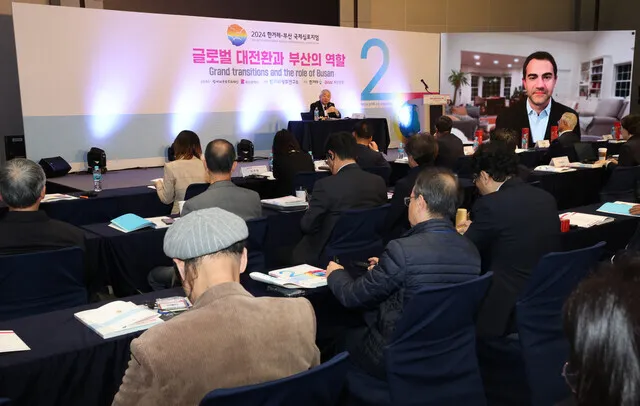
Could Donald Trump, after the war in Ukraine ends, partner up with Russian President Vladimir Putin to get his way with North Korea? So contended Stephen Wertheim, a senior fellow at the Carnegie Endowment for International Peace, during his keynote speech at the 2024 Hankyoreh-Busan International Symposium, held at the Nurimaru APEC House in the southern city’s Haeundae District on Wednesday morning.
When asked about the resumption of talks between the US and North Korea, Wertheim pointed out that we should focus on events that will take place after the resolution of the war in Ukraine.
Wertheim, who has researched US foreign policy and strategy as a historian, remarked during his keynote speech, “Many people [are] making grand pronouncements about the ‘end of the American order [and] Pax Americana,’ et cetera. The same opinions were offered eight years ago after Trump’s victory in 2016.”
“I don’t know how the US or the world will look in four years,” he said, while also predicting that “there will be uncertainty and there will be twists and turns.”
Wertheim advised that while people should not “employ wishful thinking” and think that everything will be fine, people should also not “get too alarmed by setbacks.”
When Moon Chung-in, the chairperson of the Hankyoreh Foundation for Reunification and Culture, posed the question of how Americans view Trump’s victory, Wertheim answered that while trust in Trump was low due to his radical and impulsive rhetoric, from the point of view of the average US citizen, during the first Trump administration there wasn’t inflation, the economy was doing well and the world was more stable. He also said that “under his presidency, catastrophe did not ensue.”
His analysis is that while Trump has made outlandish claims regarding foreign policy during his second term, there is more to Trump’s policies than those extremist declarations.
Wertheim predicted that Trump’s foreign and economic policy will differ from that of his first term, while emphasizing that in spite of Trump’s big personality, it’s also important to understand him in historical context.
“There was a great deal of continuity from the Obama administration to the Trump administration. NATO, despite all the criticism that it received, added two new members during his administration. If you look at the map of US troop deployments in the world, they too looked quite similar before [Trump] left office and after he left office.”
Since World War II, Wertheim said, the US pursued interventionist policy to confront totalitarian expansionist great powers, which he said was its ambitious grand strategy as a country and something that garnered much support.
However, the US no longer has the military superiority it had throughout the Cold War, nor has it maintained its dominance, leading Wertheim to see Trump’s victory as reflecting a reckoning with the US’ current situation and its commitments to allies.
Moon registered the possible changes in the foreign affairs and national security policy of a second Trump administration by inspecting the three main camps within his would-be administration — the transactionalists, who believe that foreign policy should be treated as deals to be made based on profits and losses, followed by the loyal MAGA camp, and the last camp of neo-conservatives, which is mostly constituted of hard-liner Republicans.
Remarking that the composition or combination of these three camps will form the foundation of US foreign policy during Trump’s second term, Moon and asked Wertheim which faction he believes will dominant or lead the conversation in the foreign policy-making process during a second Trump White House.
Wertheim brought up the recent nomination of Michael Waltz as Trump’s national security adviser before predicting that Trump is unlikely to pursue military interventions or push for the expansion of democracy.
When asked about the possibility of South Korea going nuclear, Wertheim said, “Those in South Korea who have been talking about acquiring nuclear weapons should think very specifically about the consequences of doing so and weigh the considerable costs and risks against what they see as the gain.”
When he asked Moon what South Korea would gain from going nuclear, Moon replied that Korea’s civilian atomic energy industry — which is lauded as one of the country’s proudest accomplishments by President Yoon Suk-yeol — “will be virtually ruined.”
“We will not have any chance to export our nuclear reactors to other countries,” he said.
In response to Moon’s question of what the South Korean government and people should do to prepare for Trump 2.0, Wertheim commented, “It won’t be easy,” and that people should “pay close attention to what Trump says” and “try to understand what he is getting at,” instead of relying on other people’s interpretations of his words.
The talk concluded with thoughts on whether Trump will try to pressure South Korea by threatening to withdraw or reduce US Forces Korea troops. When asked if he believed that South Korea should prepare for the possible withdrawal of US troops, Wertheim replied, “Trump does respect a negotiation. He understands that the other party has different interests from the US and tries to apply pressure.”
Moon wrapped the discussion up by stating, if South Korea “wises up and stands up for itself in its dealings with the US, it will see a way forward.”
By Kwon Hyuk-chul, staff reporter
Please direct questions or comments to [english@hani.co.kr]

Editorial・opinion
![[Editorial] Head of USFK continues to cross the line with inappropriate political remarks](https://flexible.img.hani.co.kr/flexible/normal/500/300/imgdb/original/2026/0528/4817799568931091.jpg "[Editorial] Head of USFK continues to cross the line with inappropriate political remarks") [Editorial] Head of USFK continues to cross the line with inappropriate political remarks
[Editorial] Head of USFK continues to cross the line with inappropriate political remarks![[Editorial] A disgraced former president like Park Geun-hye has no place on the campaign trail](https://flexible.img.hani.co.kr/flexible/normal/500/300/imgdb/original/2026/0526/2117797859381587.jpg "[Editorial] A disgraced former president like Park Geun-hye has no place on the campaign trail") [Editorial] A disgraced former president like Park Geun-hye has no place on the campaign trail
[Editorial] A disgraced former president like Park Geun-hye has no place on the campaign trail- [Editorial] Korea’s online hate problem calls for platform regulation and anti-discrimination law
- [Reporter’s notebook] Trump’s primary purge of ‘traitors’ won’t win him anything
- [Guest essay] Moscow-Pyongyang ties are rewriting security in NE Asia
- [Reporter’s notebook] Trump’s primary purge of ‘traitors’ won’t win him anything
- [Column] An incompetent ally is worse than no ally at all
- [Editorial] Samsung’s tentative bonus deal highlights need for profit-sharing rules
- [Editorial] Crisis averted at Samsung, but society must continue chip profit-sharing debate
- [Editorial] Seoul and Tokyo should focus on pragmatic cooperation, not countering China
Most viewed articles
- 1K-pop wins big at AMAs, with BTS taking home artist of the year
- 2Gwangju groups call for Shinsegae chief to resign after ‘insincere’ apology for ‘Tank Day’ promo
- 3[Editorial] Head of USFK continues to cross the line with inappropriate political remarks
- 4[Editorial] Samsung’s tentative bonus deal highlights need for profit-sharing rules
- 5[Editorial] Crisis averted at Samsung, but society must continue chip profit-sharing debate
- 6KFTC eyes criminal proceedings against Coupang founder over alleged false filings
- 7[Reporter’s notebook] Trump’s primary purge of ‘traitors’ won’t win him anything
- 8After decades of secrecy, South Korea goes public with nuclear submarine project
- 9Lee calls sovereign defense ‘fundamental’ amid rift with US over OPCON transfer timing
- 10[Guest essay] Moscow-Pyongyang ties are rewriting security in NE Asia