hankyoreh
Links to other country sites 다른 나라 사이트 링크
[News analysis] Lee’s ‘END’ initiative is a Hail Mary to reset inter-Korean relations
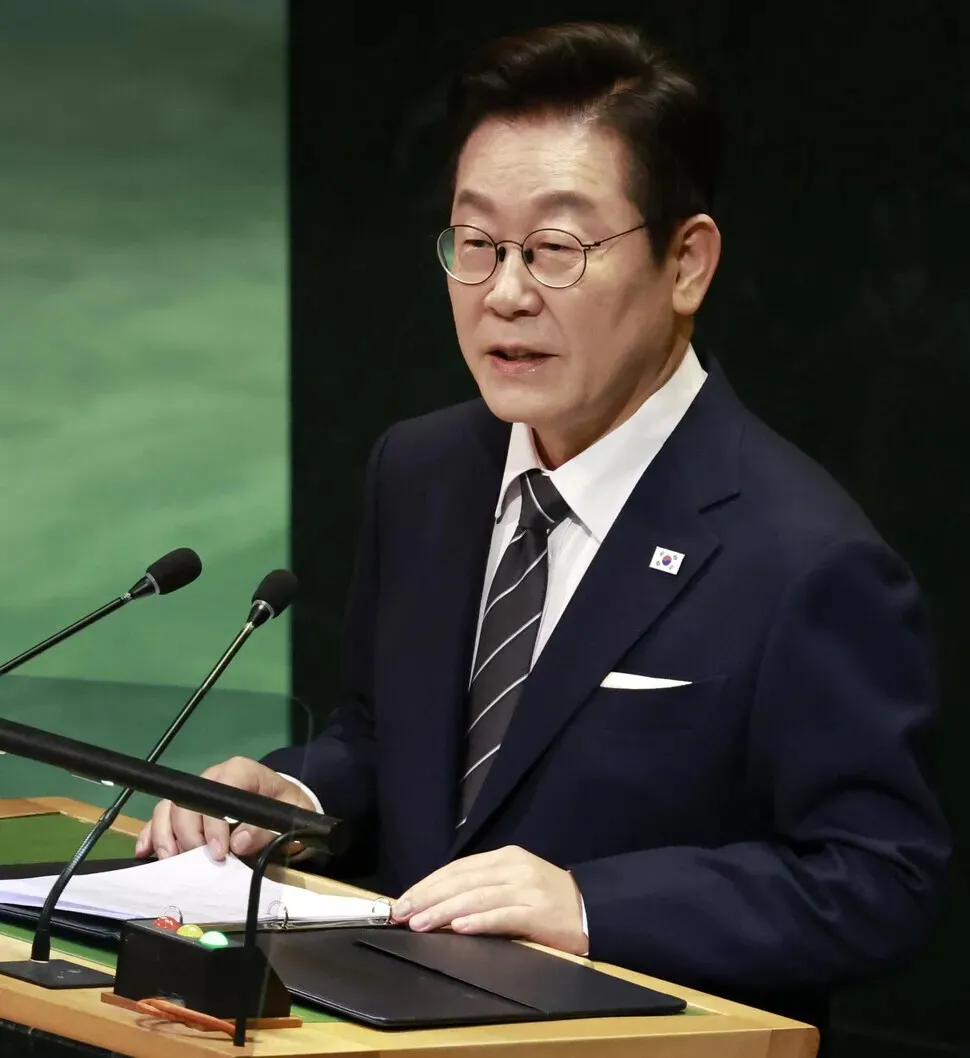
The “END” initiative announced by South Korean President Lee Jae Myung places “exchange” and “normalization” ahead of “denuclearization” and makes peace on the Korean Peninsula the top issue to address. Yet it remains unclear whether the new initiative can produce a breakthrough in inter-Korean relations, which have been deadlocked for years now.
Lee’s initiative, which he unveiled during a keynote address at the UN General Assembly on Tuesday, appears to have been the product of much thought about how to demonstrate his administration’s commitment to dialogue after North Korea declared that it will “never” denuclearize. Some see the initiative as an unrealistic blueprint given its lack of a set sequence of priority for the various tasks required, while others regard it as a new declaration for peace that could represent a turning point in Korean Peninsula affairs.
Why is it called the “END” initiative?
A central component of Lee’s proposed “END” initiative is that inter-Korean exchange and cooperation, normalization of relations, and denuclearization do not have to be pursued in any given order. That differs both from the “denuclearization first” approach maintained by both the US and conservative governments in South Korea, as well as the step-by-step simultaneous action approach preferred by North Korea.
Shortly after the president’s speech, the initiative was interpreted as representing three consecutive stages of exchange, normalization and denuclearization. But the presidential office immediately clarified that “there is no order of priority between the three tasks.”
“The individual principles of the END initiative are the same as those emphasized in past inter-Korean agreements, as well as in the joint statement made by the US and North Korea in Singapore in 2018. We were declaring before the international community our intention to resolve the Korean Peninsula issue and contribute to global peace and prosperity through a comprehensive approach [to denuclearization and the establishment of peace] based on those principles,” said Wi Sung-lac, head of Korea’s National Security Office, during a press conference in the US on Wednesday.
“There is no causal relationship or order of priority between those three principles. Our goal is to use inter-Korean dialogue and North Korea-US dialogue to pursue exchange, normalization and denuclearization in a mutually reinforcing arrangement,” Wi added.
In other words, none of those three tasks should be regarded as a prerequisite or precursor for the others.
Lee’s presentation of a peace plan that omits a step-by-step approach appears to represent a last-ditch attempt to carve out space for the South Korean government to serve as a “pacemaker” after North Korean leader Kim Jong underlined that he’s uninterested in improving inter-Korean relations but is open to dialogue with the US as long as denuclearization is not on the table.
Kim Yong-hyun, a professor of North Korean studies at Dongguk University, said that Lee’s initiative “represents an appeal to let North Korea-US relations proceed at their own pace while moving forward with inter-Korean relations in areas where that’s immediately feasible, such as with religious, sports and cultural exchange, if not state-to-state cooperation.”
“Our government appears to be signaling to the North Koreans that it’s determined to do something,” Kim added.
Why a nuclear “stop,” rather than a nuclear “freeze”?
The END initiative is closely tied to Lee’s previous comments about the three stages of denuclearization (freeze, reduction and dismantlement).
“The international community must gather its wisdom in a pragmatic and phased solution beginning with a ‘stop’ in the [growing] sophistication of nuclear and missile capabilities, going through a ‘reduction’ process and reaching ‘dismantlement,’” Lee emphasized during his message at the UN on Tuesday.
What is notable here is that Lee used the word “stop” for the first phase of denuclearization instead of “freeze,” the word he had used before. That shift seems aimed at forestalling potential pushback from North Korea.
For one thing, a “freeze” implies reporting and verification requirements. But verification is where previous denuclearization agreements with North Korea involving a “freeze” — such as the Agreed Framework, signed in Geneva in 1994 — have repeatedly broken down.
In contrast, a “stop” could be construed as North Korea only halting its nuclear tests. Unlike a “freeze,” a “stop” would not require separate verification.
“The question of verifying a stop is a problem for another day, and something we would have to discuss with North Korea,” Wi explained.
Given these difficulties, any attempt to implement the END initiative could be interpreted as basically tolerating North Korean nuclear weapons.
“In the current situation, a ‘stop’ without any reporting or verification requirements be nothing more than a political declaration,” said a former high-ranking official in the area of national security.
There’s also likely to be a debate about the interpretation of various terms. For example, some suspect that Lee’s reference to normalizing relations — which is predicated on diplomatic relations — implies accepting North Korean leader Kim Jong-un’s narrative about the Koreas being two separate states.
But Wi stipulated that “the government’s position is the same as that of the 1991 South-North Basic Agreement, which describes inter-Korean relations as being ‘a special interim relationship stemming from the process towards reunification.’”
Wishful thinking or real turning point?
The Lee administration appears to have expected some degree of controversy.
Lee himself acknowledged during his speech that his proposal “may sound like a rosy, dream-like vision.” For his part, Wi said, “The various goals cannot all be achieved right away. Exchange involves a long process, as do normalization of relations and denuclearization.”
The reason Lee proposed this initiative anyway is because of the lack of viable methods for resolving the yearslong impasse in inter-Korean relations that began when US President Donald Trump walked away from his Hanoi summit with Kim in 2019.
That’s why Yang Moo-jin, a professor at the University of North Korean Studies, describes Lee’s initiative as a new plan for peace that could be called the “New York declaration.”
“If we insist on denuclearization at a time of widespread distrust between South and North Korea and between North Korea and the US, we won’t be able to take a single step forward on the exchange needed to build peace. That’s apparently why [this initiative] begins with a ‘stop’ for denuclearization and ‘exchange’ for inter-Korean relations,” Yang said.
By Um Ji-won, staff reporter; Seo Young-ji, staff reporter; Park Min-hee, senior staff writer
Please direct questions or comments to [english@hani.co.kr]

Editorial・opinion
![[Editorial] Head of USFK continues to cross the line with inappropriate political remarks](https://flexible.img.hani.co.kr/flexible/normal/500/300/imgdb/original/2026/0528/4817799568931091.jpg "[Editorial] Head of USFK continues to cross the line with inappropriate political remarks") [Editorial] Head of USFK continues to cross the line with inappropriate political remarks
[Editorial] Head of USFK continues to cross the line with inappropriate political remarks![[Editorial] A disgraced former president like Park Geun-hye has no place on the campaign trail](https://flexible.img.hani.co.kr/flexible/normal/500/300/imgdb/original/2026/0526/2117797859381587.jpg "[Editorial] A disgraced former president like Park Geun-hye has no place on the campaign trail") [Editorial] A disgraced former president like Park Geun-hye has no place on the campaign trail
[Editorial] A disgraced former president like Park Geun-hye has no place on the campaign trail- [Editorial] Korea’s online hate problem calls for platform regulation and anti-discrimination law
- [Reporter’s notebook] Trump’s primary purge of ‘traitors’ won’t win him anything
- [Guest essay] Moscow-Pyongyang ties are rewriting security in NE Asia
- [Reporter’s notebook] Trump’s primary purge of ‘traitors’ won’t win him anything
- [Column] An incompetent ally is worse than no ally at all
- [Editorial] Samsung’s tentative bonus deal highlights need for profit-sharing rules
- [Editorial] Crisis averted at Samsung, but society must continue chip profit-sharing debate
- [Editorial] Seoul and Tokyo should focus on pragmatic cooperation, not countering China
Most viewed articles
- 1K-pop wins big at AMAs, with BTS taking home artist of the year
- 2[Editorial] Head of USFK continues to cross the line with inappropriate political remarks
- 3KFTC eyes criminal proceedings against Coupang founder over alleged false filings
- 4[Editorial] Samsung’s tentative bonus deal highlights need for profit-sharing rules
- 5[Editorial] Crisis averted at Samsung, but society must continue chip profit-sharing debate
- 6[Reporter’s notebook] Trump’s primary purge of ‘traitors’ won’t win him anything
- 7Ambassador denies Iranian involvement after Korea concludes ship was hit by Iran-linked missiles
- 8Lee pulls off pragmatic diplomacy balancing act between strongmen Trump and Xi
- 9Seoul stops short of naming Iran as attacker in strike on ship in Hormuz
- 10[Guest essay] Moscow-Pyongyang ties are rewriting security in NE Asia