hankyoreh
Links to other country sites 다른 나라 사이트 링크
[Column] Fukushima dumping is the culmination of the new Cold War
By Kim Jun-hyeon, adjunct professor at Hanshin University
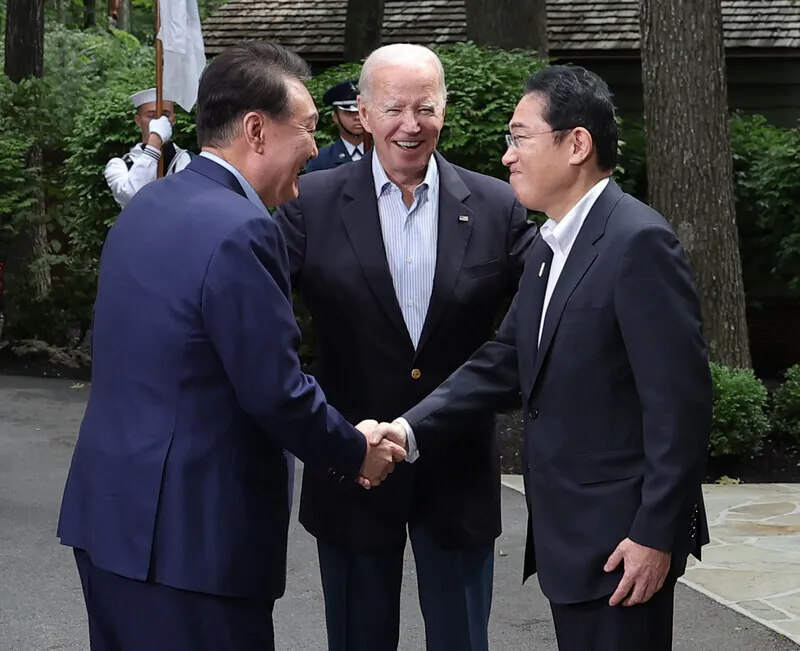
On Aug. 18, the New York Times dubbed the Camp David summit attended by the leaders of South Korea, the US, and Japan an “American diplomatic dream come true,” as discord between South Korea and Japan, considered the biggest roadblock for the US’ Indo-Pacific strategy, was finally deemed resolved, the liberal alliance against China virtually complete.
At the center of this seismic shift was President Yoon Suk-yeol, whose strong conviction in Cold War liberalism enabled this alliance.
During his National Liberation Day speech on Aug. 15, Yoon remarked, “We must never succumb to the forces of communist totalitarianism. We must not be deceived by those who follow and serve them.” In the same breath, he called the South Korea-US alliance one of peace “forged from universal values” while describing Japan as a partner “who share[s] universal values and pursue[s] common interests” with South Korea, pronouncing the South Korea-US-Japan summit at Camp David a new milestone in trilateral cooperation among the three countries.
Through this, Yoon characterized the liberal alliance among South Korea, the US, and Japan as necessary in the fight against communist totalitarianism. As such, Yoon took the stance that South Korea must do everything it can as a country on the front line of anti-communism from a geopolitical standpoint, and that not even the release of radioactive wastewater into the ocean matters in light of this. This rationale only makes sense if one views national survival through anti-communism to be in one’s best national interest.
The US and Japan applauded this turn of events. US news outlets assessed that Yoon’s Japan-friendly policies, such as his proposal of a solution to resolve the issue of forced labor during the Japanese colonial period, was what definitively occasioned the South Korea-US-Japan summit. US President Joe Biden also praised Yoon’s leadership in resolving issues between South Korea and Japan, stating that ties among the three democracies have become “stronger.” Japan didn’t hide the fact that better relations with South Korea would greatly help its national security either. By firing up Yoon’s Cold War mindset, the US and Japan plotted to use South Korea to the benefit of their security and economy.
Japan moved quickly. Having basically obtained approval to dump radioactive wastewater into the ocean at the South Korea-US-Japan summit, Japanese Prime Minister Fumio Kishida visited the Fukushima Daiichi nuclear plant and inspected the Advanced Liquid Processing System immediately upon returning to Japan, moving forward with the release on Thursday. Through Prime Minister Han Duck-soo, our government issued a statement asking the public to trust the administration as well as science, as the discharge of the wastewater would not cause major problems as long as it was carried out according to guidelines provided by the International Atomic Energy Agency. In essence, the government declared its support of Japan’s release of the radioactive wastewater.
In response, China banned seafood imports from Japan, while North Korea followed suit, slamming Japan’s release of the wastewater as an “unforgivable crime against humanity.” This turned the discharge of the irradiated water from Fukushima into a central issue in the game of international politics in Northeast Asia.
Amid China’s fierce opposition to what it called the “Asian NATO,” or the liberal alliance among South Korea, the US, and Japan, as well as Russia and North Korea’s support of China’s position, the confrontation between South Korea, US, Japan on one side and North Korea, China, and Russia on the other was reestablished, completing the new Cold War of the 21st century. More than anything, despite international controversy surrounding what the new Cold War will look like, South Korea alone seems to be trapped in the mindset of the old Cold War.
The recent South Korea-US-Japan summit paradoxically showed that US hegemony over the world is not what it used to be. Because its Europe initiative was shaken up by Russia’s invasion of Ukraine, and China realized its “Rise of Great Nations” (“da guo jue qi”), the US had no choice but to seek out a new strategy. In particular, containing China in the fields of economics and security became especially urgent.
The US started to give concrete shape to its containment policy against China starting with the Barack Obama administration, going on to establish an economic order excluding China during the Biden administration through the Indo-Pacific Economic Framework for Prosperity. Security-wise, the country strengthened its alliance systems, such as AUKUS (with the UK and Australia), and it is attempting to round off its net of encirclement against China by establishing a trilateral partnership with South Korea and Japan.
However, domestic politics is not looking good in both the US and South Korea. Whether Biden will manage to win a second term in next year’s presidential election remains unclear, and the domestic political situation in South Korea is such that it would not be surprising if the country broke away from its trilateral partnership with the US and Japan at any moment. This is why Biden pushed to institutionalize the trilateral partnership among South Korea, the US and Japan.
Following the end of the Cold War, South Korea has maintained a foreign policy of cooperating with China in the economic sphere while working together with the US in the security sphere, thereby achieving economic prosperity. Although each administration’s particular attitude differed, South Korea managed regional security in Northeast Asia by maintaining a policy of engagement regarding North Korea. However, trapped in a Cold War mindset, Yoon has pushed ahead with his so-called “values-based diplomacy,” endangering our pragmatic balanced diplomacy.
While the US rejoiced at Yoon’s values-based diplomacy, China lost nothing, and North Korea uttered yells of delight internally. At this juncture, the fact that Yoon is stuck in a Cold War mindset is cause for concern.
Please direct questions or comments to [english@hani.co.kr]

Editorial・opinion
![[Correspondent’s column] Coupang’s game in Washington follows familiar pattern](https://flexible.img.hani.co.kr/flexible/normal/500/300/imgdb/original/2025/1226/8217667391873536.jpg "[Correspondent’s column] Coupang’s game in Washington follows familiar pattern") [Correspondent’s column] Coupang’s game in Washington follows familiar pattern
[Correspondent’s column] Coupang’s game in Washington follows familiar pattern![[Editorial] Coupang’s attempt to hide behind US won’t win back Korean consumers](https://flexible.img.hani.co.kr/flexible/normal/500/300/imgdb/original/2025/1226/1817667387971465.jpg "[Editorial] Coupang’s attempt to hide behind US won’t win back Korean consumers") [Editorial] Coupang’s attempt to hide behind US won’t win back Korean consumers
[Editorial] Coupang’s attempt to hide behind US won’t win back Korean consumers- Coupang under fire for possible obstruction of investigation into its customer data leak
- [Editorial] Coupang founder’s contempt for workers, customer security knows no bounds
- [Column] Confessions of a Coupang-holic
- [Editorial] Kim Bom-suk’s arrogance on full display in boycott of Coupang leak hearing
- [Editorial] The facts of Yoon’s insurrection are clear — justice cannot be further delayed
- [Column] Trump destroys government
- [Column] A post-Western world approaches
- [Column] Offshore balancing, or carving out spheres of influence?
Most viewed articles
- 1Korea to trial next-gen train capable of sub-2-hour Seoul-Busan trip starting 2030
- 2Kim Jong-un’s hidden motive in criticizing South Korea’s nuclear submarine push
- 3[Editorial] Coupang’s attempt to hide behind US won’t win back Korean consumers
- 4Coupang under fire for possible obstruction of investigation into its customer data leak
- 5[Correspondent’s column] Coupang’s game in Washington follows familiar pattern
- 6Real-life heroes of “A Taxi Driver” pass away without having reunited
- 7Moon Jae-in renews call for end-of-war declaration, peace treaty on Korean Peninsula
- 8Chang Chun-ha’s family hopes to know truth of his death after 37 years
- 9Chinese money flooding into South Korean companies
- 10Russian architect personally witnessed Empress Myeongseong’s assassination by Japanese ronin, accoun