hankyoreh
Links to other country sites 다른 나라 사이트 링크
[Column] Korea’s insurrection continues — 1,009 hours and counting
 Add as preferred source on Google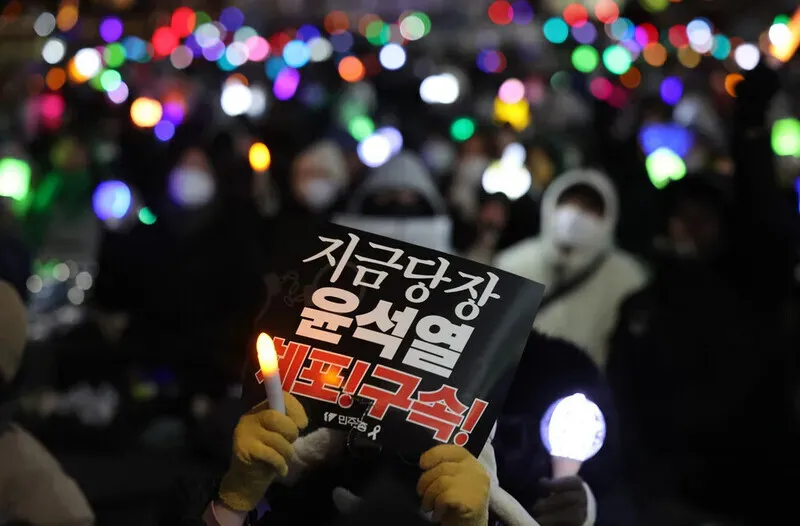

By Lee Jin-sun, executive director of We All Govern Lab (WAGL)
The insurrection that took place on Dec. 3 didn’t end that night. Nor did it conclude with the National Assembly’s impeachment of the president on Dec. 14.
No, that insurrection has continued without interruption until today from the moment President Yoon Suk-yeol sent armed soldiers to take over the National Assembly and the National Election Commission. Yoon remains as brashly intransigent today as when he first declared martial law.
Yoon is an insurrectionist — in short, “a person who creates violence for the purpose of excluding national power from all or part of the territory of the Republic of Korea or subverting the Constitution,” as stipulated in Article 87 of the Criminal Act.
Yoon said in a public statement nine days after his abortive martial law declaration that it was ridiculous to talk about a two-hour insurrection, as if he’d always intended martial law to only last two hours. But according to a previous ruling by the Supreme Court, “inciting violence with the purpose of subverting the Constitution represents the crime of insurrection regardless of whether that purpose was achieved.”
Besides, Yoon’s insurrection didn’t end in two hours.
Yoon has been continuing his insurrection in the form of subverting the constitution for a total of 42 days, one hour, and 40 minutes — more than 1,009 hours altogether — from his declaration of martial law on Dec. 3 until now (as of 12:01 Wednesday morning).
From his hidey-hole at the presidential residence at 128-24 Hannam-daero, Yongsan-gu, Seoul, he has been refusing to cooperate with a court-issued arrest warrant and has sought to turn agents of the Presidential Security Service (PSS) into a praetorian guard for his last stand. He reportedly even asked agents to carry around knives to stop the arrest warrant from being executed at all costs. It’s a totally unprecedented situation in Korean history.
Article 91 of the Criminal Act defines subverting the Constitution as actions designed to either “extinguish the function of the Constitution or Acts without observing the procedure provided by the Constitution or Acts” or “overthrow government organs established by the Constitution or to render the exercise of their functions impossible by force.”
By refusing to comply with a court-ordered arrest warrant, Yoon is seeking to prevent the law from functioning and to prevent a constitutional body from carrying out its function. Thus, his insurrection is ongoing.
How could dragging this out change anything? The prevailing view in the legal establishment is that there’s virtually no chance of Yoon’s bill of impeachment being rejected by the Constitutional Court or of Yoon being acquitted on charges of insurrection. His ultimate fate is to be removed from office and put in prison.
So why on earth is the People Power Party (PPP) making such a fuss about protecting Yoon?
Forty-four lawmakers from the party formed a human chain at Yongsan in an attempt to block the execution of Yoon’s arrest warrant. Here are some of the remarks made by PPP lawmakers at a meeting on Monday: “Yoon must have had his reasons for what he did.” “We ought to look into whether the martial law declaration was actually unconstitutional.” “The bill to appoint a special counsel to investigate charges of insurrection against Yoon is designed to crush the conservative movement.”
Perhaps PPP lawmakers have been emboldened by recent public opinion polls, which show that the PPP’s approval has regained its level before the martial law declaration and narrowed its deficit with the Democratic Party to within the margin of error. But polls were much the same before the party’s crushing defeat in the parliamentary elections last year. That’s the best the party can hope for if it relies on support from the far right.
Here’s what acting President Choi Sang-mok said in a statement a few days earlier, on Jan. 10: “An unprecedented conflict is occurring between the Corruption Investigation Office for High-ranking Officials and the Presidential Security Service over the arrest warrant for the sitting chief of state. The ruling and opposition parties need to work together to draft a special counsel bill that does not contain any unconstitutional elements.”
Choi characterized law enforcement’s attempt to deal with a criminal resisting arrest as a “conflict” between the CIO and the PSS and sought to avoid responsibility by calling on the ruling and opposition parties to reach a compromise.
But the actual battle being waged right now is not the conflict between the CIO and the PSS, nor is it a political tussle between the PPP and the Democratic Party.
Are protestors who spend the night on the asphalt wrapped in space blankets amid the drifting snow and biting wind there for the sake of the Democratic Party? Are they there to cheer for the CIO? Those protestors are resisting the destructive and tyrannical lunacy of the insurrection ringleader; they’re fighting to defend our democratic republic and to safeguard the dignity of innocent lives.
The Chosun Ilbo and other far-right media are clouding the issue by framing it as a struggle between conservatives and progressives, and between support and opposition for impeachment. That’s an age-old survival strategy used to perpetuate their power, a mentality that views reality as a zero-sum game between the conservatives on their team and their political enemies on the left.
But PPP lawmakers who opposed lifting martial law and who support the insurrectionist’s refusal to comply with the arrest warrant aren’t actually conservatives, because conservatism has already been wiped out. Those lawmakers have no interest in rebuilding the conservative movement; their only concern is the 30% of the country who inhabit the far right.
I hope the post-Yoon world will no longer be a game in which political parties exploit their opponents’ mistakes to extend their grip on power. Fortunately, we’re being led by passionate young people who refuse to fall for black-and-white thinking and who are surging forward, hand in hand, to aid the disadvantaged.
Even while I toss and turn with “insurrection insomnia,” it’s thrilling to contemplate the younger generation. As we prepare to pass the baton to them, we need to make it abundantly clear that nobody stands above the law or the Korean people.
Please direct questions or comments to [english@hani.co.kr]

Editorial・opinion
![[Column] The unspoken deal that made China a nation led by engineers](https://flexible.img.hani.co.kr/flexible/normal/500/300/imgdb/original/2026/0821/381787301627593.jpg "[Column] The unspoken deal that made China a nation led by engineers") [Column] The unspoken deal that made China a nation led by engineers
[Column] The unspoken deal that made China a nation led by engineers![[Column] Does the US deserve allies’ trust?](https://flexible.img.hani.co.kr/flexible/normal/500/300/imgdb/original/2026/0818/8417870405925049.jpg "[Column] Does the US deserve allies’ trust?") [Column] Does the US deserve allies’ trust?
[Column] Does the US deserve allies’ trust?- [Column] No, tactical nukes aren’t practical for real-world use
- [Column] ‘The Odyssey’: Finally, a good chamber drama
- [Column] How will the US uphold deterrence when it runs out of weapons?
- [Column] US isn’t pulling out of the Middle East — it’s being kicked out
- [Editorial] Will shift in US nuclear strategy reintroduce tactical nukes to Korea, Japan?
- Why does the USFK commander keep butting heads with Seoul?
- [Guest essay] Futures thinking in science fiction
- [Editorial] New US envoy must stick to her diplomatic mission
Most viewed articles
- 1[Reportage] US looks to Korean experience to ease its critical mineral reliance on China
- 2Last time they met, Kim Jong-un needed Trump. Have the tables turned?
- 3[Exclusive] SK Hynix to build memory fab in Japan’s Miyagi
- 4[Column] The unspoken deal that made China a nation led by engineers
- 5The bill for America’s superpower status is coming due
- 6[News analysis] Is Trump about to undo US policy on North Korea’s denuclearization?
- 7[News analysis] Truncated military drills: Bad for OPCON transfer, good for peace?
- 8Former bodyguard’s dark tale of marriage to Samsung royalty
- 9[Column] ‘The Odyssey’: Finally, a good chamber drama
- 10Pyongyang has ‘no interest’ in Trump’s cut to SK-US military drills, says Kim Yo-jong