hankyoreh
Links to other country sites 다른 나라 사이트 링크
[Column] Korea: A country defined by home loan debt
By Jae Jeong-im, Hankyoreh public editor and dean of Semyung University Graduate School of Journalism
In their book “House of Debt,” Princeton University professor Atif Mian and University of Chicago Booth School of Business professor Amir Sufi argue that a real estate bubble is always preceded by expanding household debt, citing several countries as examples.
Mian and Suni assert that when real estate prices are observed to soar above their actual value, home mortgages and other forms of household debt always rise rapidly in a low-interest-rate environment.
That held true in the subprime mortgage crisis in the US, which led to the global financial crisis of 2008. Financial institutions lured many people to take out massive loans — without the capacity to repay — with the promise of continually rising property values.
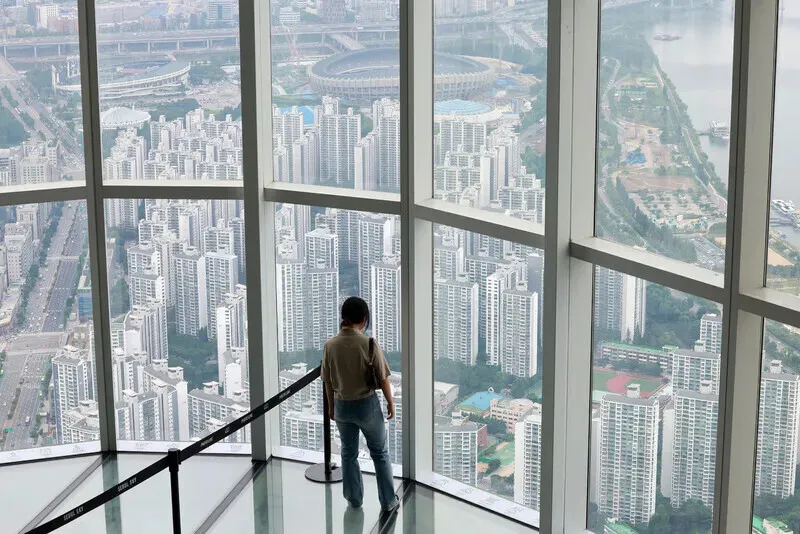
Many South Koreans feel compelled to do whatever is necessary to buy a home due to the promise that house values can only go up. That pressure is demonstrated by a handful of neologisms like “yeongkkeul,” meaning to put one’s soul on the line for a home loan, and “bittu,” as in taking on major debt to invest in real estate.
Not many will be lucky or rich enough to buy these astronomically expensive homes with cash. However, when those lucky few are joined by their desperate peers who willingly plunge themselves into debt and scrimp and save to become homeowners, houses that are worth 1 billion won magically become worth 2 billion to 3 billion. Then, the so-called “overnight beggars” — people who feel relatively poor due to stagnant incomes as their peers see home and stock values explode — feel shortchanged, while a generation of discouraged young people start to believe that they are not destined for home ownership and forsake their dreams of marrying and starting families.
The Lee Jae-myung administration’s attempts to restrict home loans to counter the recent surge in apartment prices in Seoul can be seen as a response to the problematic link between the real estate bubble and the financial system. The crux of this move is to cap mortgage loans for genuine homebuyers (as opposed to speculators) to 600 million won to block speculative demand by preventing people who own multiple properties from making “gap investments” — buying up properties for the difference between the sale price and the jeonse deposit that a renter has put down.
Stabilizing the real estate market requires a comprehensive approach that includes taxation, such as strengthening property taxes and expanding supply by increasing public rental housing. However, restricting loans is imperative when considering the speed at which the real estate bubble is blowing up.
Of course, we are seeing familiar protests erupt from certain political circles, such as the conservative opposition People Power Party and media outlets. We can see headlines slamming the move: “A real estate privilege package for the cash-rich,” “Real estate tyranny against laypersons,” “Stomping on the dreams of ordinary civilians, newly-weds and youth and kicking away opportunities,” “Chucking a grenade into the faces of the ordinary to take out a select few.”
Financial authorities explain that those affected by the new regulations will, based on the existing debt-service ratio, be in the top 10% of borrowers with an annual income of more than 100 million won (US$73,855). How many ordinary civilians, newlyweds and youth fit into that category?
Still, the government’s real estate policies are easily shaken by politics and the media. The strengthening of the comprehensive real estate tax during the Roh Moo-hyun and Moon Jae-in administrations was met with fierce backlash, with many slamming the policy as setting off a “tax bomb,” and restrictions on lending or transactions related to real estate have been attacked harshly, hindering their implementation.
Some media outlets have consistently opposed stricter property taxes and loan restrictions by rallying for the increase in the supply of privately owned apartments in Seoul through the development of national and public land, as well as the relaxation of reconstruction and redevelopment regulations. The fact that a large portion of these media outlets’ advertising revenue comes from construction companies and real estate developers, not to mention how some outlets are owned by such conglomerates, also probably has something to do with the issue.
A Bank of Korea analysis revealed that, in 2024, a median-income household in Seoul would have to save for 25 years without spending a single penny to buy the median home. This period is much longer than that of those living in Paris (17.8 years), Rome (15.1 years), London (14.8 years), and New York (14 years), putting South Korea at the top of the ranking internationally. As so many desperately save up to borrow just to buy houses at such exorbitant costs, South Korea’s ratio of household debt to disposable income is one of the highest in the world. As households are so solely focused on paying off their mortgages, they lack the freedom to spend their money elsewhere, causing demand in the domestic market to nosedive.
Mian and Sufi warned that excessive household debt can lead to a slowdown in consumption, a recession and even an economic crisis. Putting an end to real estate speculation, providing stable housing for everyone, reducing household debt and revitalizing the domestic market are all intertwined. Comprehensive measures are needed to prevent people who own multiple properties from speculative investments by limiting housing loans to genuine homebuyers, expanding high-quality public rental housing and strengthening property taxes. Efforts to spread out the metropolitan population to revitalize rural areas are also crucial.
Media outlets will need to adopt a healthy and proper attitude when leading the debate so that the public understands and supports these policies. Arguments based on vested political and commercial interests must be refuted in the public forum and put to rest.
Please direct questions or comments to [english@hani.co.kr]

Editorial・opinion
![[Editorial] PPP leader’s trip to US is a stunt without substance](https://flexible.img.hani.co.kr/flexible/normal/500/300/imgdb/original/2026/0417/4317764157621763.jpg "[Editorial] PPP leader’s trip to US is a stunt without substance") [Editorial] PPP leader’s trip to US is a stunt without substance
[Editorial] PPP leader’s trip to US is a stunt without substance![[Editorial] Remembering Sewol tragedy is how we prevent another](https://flexible.img.hani.co.kr/flexible/normal/500/300/imgdb/original/2026/0416/6617763295917051.jpg "[Editorial] Remembering Sewol tragedy is how we prevent another") [Editorial] Remembering Sewol tragedy is how we prevent another
[Editorial] Remembering Sewol tragedy is how we prevent another- [Editorial] Close communication with incoming US ambassador will be key for alliance
- [Editorial] World must stand against any and all tolls in Strait of Hormuz
- [Correspondent’s column] Trump’s real red line isn’t Iran’s nuclear program
- [Column] Who’s calling whom a rogue state?
- [Column] Xi Jinping exploits growing rift in Transatlantic alliance
- [Column] Trump’s war boomerangs on US hegemony and alliances
- [Column] Negotiating with bombs
- [Column] What the debate over Atlas and robots in factories missed
Most viewed articles
- 1Korean A-bomb victims head to UN to tell their stories and seek accountability
- 2[Interview] Key to stewardship code is sustainable value, not box-ticking, says expert
- 3South Korea positions itself for greater influence after end of Iran war
- 4Trump hints at renewed talks with Iran, but nuclear enrichment remains a sticking point
- 5World is ‘being ravaged by a handful of tyrants ’ pope says in dig at Trump
- 6Pushed into a corner, Sewol memorial fights to keep memory alive
- 7Trump hints second round of talks with Iran could take place over weekend
- 8Lee becomes first sitting president to attend Sewol memorial ceremony
- 9Sewol survivors say their mistake was making it off the ferry alive
- 10[Editorial] PPP leader’s trip to US is a stunt without substance