hankyoreh
Links to other country sites 다른 나라 사이트 링크
[Column] Trump’s offshore balancing could be an opportunity for South Korea
By Jung E-gil, senior international affairs writer
The bilateral summits between South Korea, the US and China during last month’s APEC summit in Gyeongju showcased a tectonic shift in East Asia’s geopolitical environment. The US is waning, China is thriving and South Korea is on the rise. By rise, I don’t necessarily mean that Korea has gotten any stronger; rather, that it has never been more important.
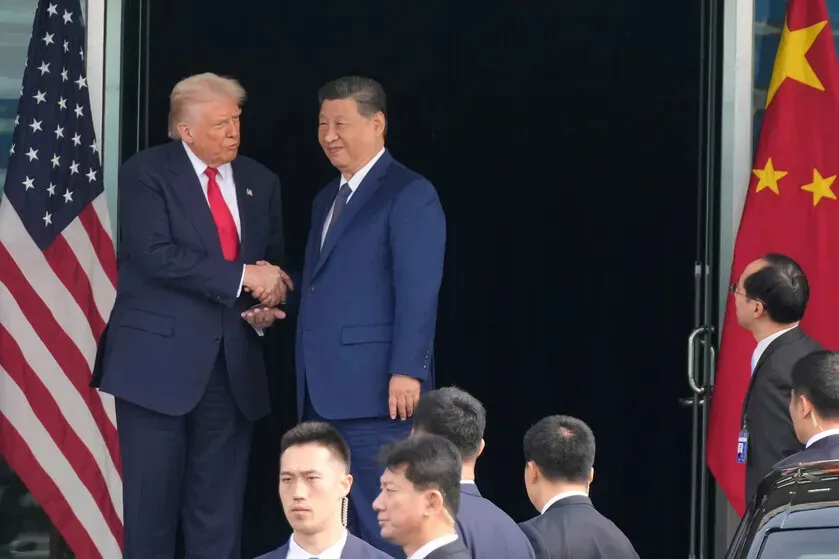
US President Donald Trump boasted that his summit with China’s Xi Jinping in Busan on Oct. 30 was a “12 out of 10.” To be clear, it would be correct to state that the winner of those points was not the US, but China.
China got Trump to roll back the tariffs and export restrictions he had indiscriminately imposed since retaking office. After China retaliated by imposing restrictions on rare earth exports and suspending US soybean imports, Washington abandoned its plan to expand the list of Chinese companies subject to advanced technology export controls.
This marked the first time the US has ditched export curbs imposed on national security grounds during trade negotiations. A desperate Trump even attempted to allow China to import Nvidia’s cutting-edge Blackwell semiconductor chips, but that plan was ultimately scrapped due to opposition from his aides.
During the South Korea-US summit, which took place a day earlier, the two parties reached an agreement to allow South Korea to build nuclear-powered submarines and have the US provide nuclear fuel for them. Previously, in 2021, the US granted the privilege of support for building nuclear submarines exclusively to Australia as part of the AUKUS alliance with the UK.
South Korea announced this provocative decision ahead of its bilateral summit with China, with South Korean President Lee Jae Myung explaining, “Diesel submarines have limited submergence capacities, which hinder our tracking of North Korea or Chinese submarines.”
During the South Korea-China summit on Nov. 1, Lee explained that this push for nuclear-powered submarines was a matter of self-reliant defense and was not being pursued to target any particular country. Xi reiterated China’s position on the matter, stressing adherence to non-proliferation obligations. In the past, this argument would not even have been considered by the US and would’ve aggravated China to no end.
The current situation is best explained by the flipside of Trump’s “America First” policy: offshore balancing. “America First” puts the burden of defense costs on its allies and forces allies to invest by raising tariffs. As such, it cannot help but entail an offshore balancing strategy in which the US refrains from direct intervention in regional issues while enhancing the roles of allies to create a balance of power in those regions.
A prime example of such a strategy is the UK’s practice of “splendid isolation” from the European continent in the 18th-19th century. While it ensured that no single power dominated the continent by maintaining a balance of power, the UK intervened at decisive moments that threatened that very balance.
John Mearsheimer and other realist theoreticians point out that the instability of the liberal international order, one in which the US intervenes in problems across all the regions in the world, will also lead to a decline in the US’ national power. They argue that the US ought to instead focus on offshore balancing, with Mearsheimer stressing that the US ought to pivot to strengthening its power within the American continent by prioritizing the Western hemisphere.
Trump’s vulgar pursuit of US isolationism is headed down that road. Following his inauguration, Trump has declared that the US will gain control over Greenland, Canada and the Panama Canal. More recently, he has deployed the US Navy to the Caribbean, threatening to attack Venezuela. The 2025 National Defense Strategy, which the Trump administration will soon release, is slated to prioritize defense of the US homeland and neighboring territories instead of focusing on its conflict with China.
Nvidia CEO Jensen Huang has commented that in the next 10 years, China will emerge triumphant in the global AI race, basing that opinion on the fact that while China has 1 million laborers in that industry, the US has a mere 20,000. Huang has also stated that Huawei’s AI chips deliver 90% of the efficiency of an Nvidia chip and forecast that China’s AI computing powers would surpass the capabilities of every other country by 2027.
Huang has further argued that US controls on chips to China have given Chinese companies “the spirit, the energy and the government support to accelerate their development,” and that the US should understand it’s “handing them the trophy” by keeping controls in place.
In terms of shipbuilding capabilities, which is an indicator of maritime supremacy — a must for any country that wishes to be a hegemonic power — China’s capabilities are 233 times those of the US.
Trump is losing ground to China in the economic conflict he started during his first stint in office, and America is clearly in retreat since his return. It’s precisely at this moment that we’ve seen the emergence of the “Make American Shipbuilding Great Again” project that entrusts US shipbuilding to Korea and the demands from Washington for Seoul to invest US$350 billion, which then gave way to South Korea’s pursuit of nuclear-powered submarines. In short, South Korea is being exploited by the US, and nuclear-powered submarines will do less for national security and more to trigger another arms race.
However, the US has no choice but to allow South Korea to pursue nuclear-powered submarines, and China is now reconsidering the role of South Korea in East Asia as the US starts to back away from the region. South Korea can no longer be satisfied with simply being a subordinate of the US. The greater our responsibilities grow, the more imperative it is that South Korea refrain from meddling in conflicts in East Asia and instead focus on ensuring that the various powers remain in balance. This is at once a crisis and an opportunity for South Korea.
Please direct questions or comments to [english@hani.co.kr]

Editorial・opinion
![[Editorial] Head of USFK continues to cross the line with inappropriate political remarks](https://flexible.img.hani.co.kr/flexible/normal/500/300/imgdb/original/2026/0528/4817799568931091.jpg "[Editorial] Head of USFK continues to cross the line with inappropriate political remarks") [Editorial] Head of USFK continues to cross the line with inappropriate political remarks
[Editorial] Head of USFK continues to cross the line with inappropriate political remarks![[Editorial] A disgraced former president like Park Geun-hye has no place on the campaign trail](https://flexible.img.hani.co.kr/flexible/normal/500/300/imgdb/original/2026/0526/2117797859381587.jpg "[Editorial] A disgraced former president like Park Geun-hye has no place on the campaign trail") [Editorial] A disgraced former president like Park Geun-hye has no place on the campaign trail
[Editorial] A disgraced former president like Park Geun-hye has no place on the campaign trail- [Editorial] Korea’s online hate problem calls for platform regulation and anti-discrimination law
- [Reporter’s notebook] Trump’s primary purge of ‘traitors’ won’t win him anything
- [Guest essay] Moscow-Pyongyang ties are rewriting security in NE Asia
- [Reporter’s notebook] Trump’s primary purge of ‘traitors’ won’t win him anything
- [Column] An incompetent ally is worse than no ally at all
- [Editorial] Samsung’s tentative bonus deal highlights need for profit-sharing rules
- [Editorial] Crisis averted at Samsung, but society must continue chip profit-sharing debate
- [Editorial] Seoul and Tokyo should focus on pragmatic cooperation, not countering China
Most viewed articles
- 1K-pop wins big at AMAs, with BTS taking home artist of the year
- 2[Editorial] Head of USFK continues to cross the line with inappropriate political remarks
- 3KFTC eyes criminal proceedings against Coupang founder over alleged false filings
- 4[Editorial] Samsung’s tentative bonus deal highlights need for profit-sharing rules
- 5[Editorial] Crisis averted at Samsung, but society must continue chip profit-sharing debate
- 6[Reporter’s notebook] Trump’s primary purge of ‘traitors’ won’t win him anything
- 7Ambassador denies Iranian involvement after Korea concludes ship was hit by Iran-linked missiles
- 8Lee pulls off pragmatic diplomacy balancing act between strongmen Trump and Xi
- 9Seoul stops short of naming Iran as attacker in strike on ship in Hormuz
- 10[Guest essay] Moscow-Pyongyang ties are rewriting security in NE Asia