hankyoreh
Links to other country sites 다른 나라 사이트 링크
[Column] Misconceptions about America’s war with Iran

By Yu Dal-seung, professor of Persian and Iranian studies at Hankuk University of Foreign Studies
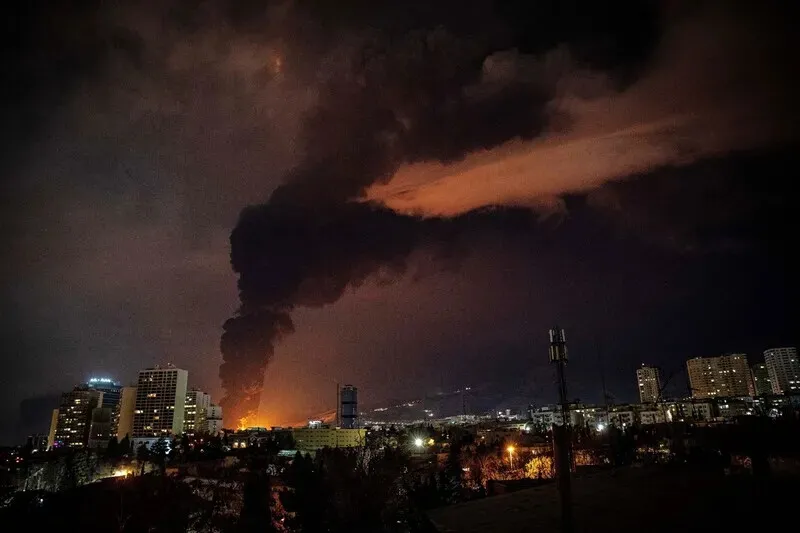
The war in Iran that was initiated by surprise preemptive strikes by the US and Israel appears to be turning into a protracted conflict as Iran employs asymmetric strategies as it wages a war of attrition.
A complex mix of factors contributed to the outbreak of this war. First among them are the political calculations of US President Donald Trump and Israeli Prime Minister Benjamin Netanyahu, who are attempting to use external security issues to dig their way out of political crises at home. Another one discussed by observers is the US’ strategic vision of redefining the Middle Eastern order around Israel.
One point that shouldn’t be forgotten is that the US attack on Iran is closely tied to issues of the global energy order, the hegemony of the dollar, and a reorganization of the world order.
The petrodollar system is a framework that has existed since the mid-1970s, where international petroleum transactions are determined by the dollar. It has been a key element shoring up the dollar’s status as the world’s primary reserve currency.
But since 2000, the petrodollar has faced challenges, namely, in the forms of Iraq, Iran, Libya and Venezuela.
In 2003, the US launched the Iraq War, which brought down the regime of Saddam Hussein. In 2011, it toppled the Muammar Gaddafi regime in Libya. Earlier this year, it carried out an operation to arrest Venezuelan President Nicolás Maduro.
The only one of the four left is Iran.
The strategic impact of the war could also reach Middle Eastern petroleum producers that are friendly with the US. That, in turn, could end up curbing China’s access to energy and check its growing influence in the Middle East.
In that sense, the war’s significance extends beyond the level of a regional conflict and relates to changes in the global power structure. In particular, it could represent an opportunity for the US to reinforce its hegemonic status at a time when the US-centered global order that has existed since the 1991 Gulf War has undergone recalibration within the so-called “Core 5” framework of competition with major powers such as China, Russia, India and Japan. This means it has the potential to serve as a historic turning point in determining the direction of the future global order.
What remains unclear is whether Washington’s strategic vision will actually come to pass.
The US and Israel view Iran as facing the biggest crisis since the establishment of its Islamic republic in 1979, and appear to be using this as an opportunity to attempt a regime change. But the history of Iran has been a process of maintaining national identity through ongoing resistance and struggle even when faced with invasions and domination by numerous foreign powers.
The only times in Iran’s history when it was controlled by Persian dynasties came during the Achaemenid Empire (550-330 BCE) and Sasanian Empire (224-651 CE) and under the Pahlavi dynasty (1925-1979). The rest of the time, power was held by groups from different ethnic backgrounds. Even then, those regimes all governed within the framework of Iranian political and cultural identity.
That means that even Iranians who are unhappy with the current regime are likely to rally behind it in a situation where national sovereignty and security are threatened. If Washington’s aim with the war is to establish a pro-US regime in Tehran, that will be no easy feat. A comparative realistic strategy would be if the aim were to achieve a symbolic relationship that involves maintaining some level of antagonism and tensions with Iran.
Yet another misconception relates to interpretations of the selection of Mojtaba Khamenei to serve as the third supreme leader in Iran’s history following the assassination of his father, Ali Khamenei, in a US-Israeli air strike. While many read the hereditary succession as a signal that Iran will adopt a no-compromise ultra-hard-line policy, we need to look at its deeper significance.
If Iran were not at war, many people would raise questions about the younger Khamenei’s accession to power, but the US’ assassination of his father has made his rise part of a larger symbolic narrative of resistance and martyrdom. That made him the only person with the political legitimacy to declare a halt or an end to the war. Considering that all the hard-liners in Iran would have no choice but to heed him if he were to indicate inclination to a ceasefire, Mojtaba Khamenei’s rise can be seen as part of a potential exit strategy for the war.
Finally, I would be remiss if I didn’t use this column to pay homage to the indomitable spirit of the Iranians living through this war. Each year on March 21, our department hosts an event for Nowruz, a spring festival that marks the Iranian New Year. In light of the war, however, we considered cancelling this year’s festivities, until one of our professors, an Iranian scholar herself, strongly objected.
No matter how trying the times may be, she said, Iranians come together to celebrate the arrival of spring as a reminder of life and renewal, of the values of friendship and togetherness. Such celebration must serve to remind us that while the haze of war may hinder our view, life goes on in Iran.
Please direct questions or comments to [english@hani.co.kr]

Editorial・opinion
![[Column] Trump has no idea how to fight a war](https://flexible.img.hani.co.kr/flexible/normal/500/300/imgdb/original/2026/0426/5817771660237765.jpg "[Column] Trump has no idea how to fight a war") [Column] Trump has no idea how to fight a war
[Column] Trump has no idea how to fight a war![[Editorial] Seoul must make an effort to move up OPCON transfer](https://flexible.img.hani.co.kr/flexible/normal/500/300/imgdb/original/2026/0424/7917770261235.jpg "[Editorial] Seoul must make an effort to move up OPCON transfer") [Editorial] Seoul must make an effort to move up OPCON transfer
[Editorial] Seoul must make an effort to move up OPCON transfer- [Editorial] US has no business telling Korea whether it can arrest Coupang founder
- [Editorial] Korea must protect its interests while sorting out US intel leak dispute
- [Column] America is a wounded giant running amok
- [Editorial] PPP leader’s trip to US is a stunt without substance
- [Editorial] Remembering Sewol tragedy is how we prevent another
- [Editorial] Close communication with incoming US ambassador will be key for alliance
- [Editorial] World must stand against any and all tolls in Strait of Hormuz
- [Correspondent’s column] Trump’s real red line isn’t Iran’s nuclear program
Most viewed articles
- 1[Column] Trump has no idea how to fight a war
- 2With a click, 220,000+ member Telegram room generates illegal deepfake porn
- 3US’ real gripe with Seoul isn’t an intel leak or Coupang – it’s the delayed investment rollout
- 4[Editorial] Seoul must make an effort to move up OPCON transfer
- 5Korean A-bomb victims head to UN to tell their stories and seek accountability
- 6Trump extends ceasefire with Iran indefinitely, US blockade remains sticking point in talks
- 7[Cartoon] Bulletproof Bang and Bom
- 8[Column] “Hoesik” as ritual of hierarchical obedience
- 9BTS' use of sign language in "Permission to Dance" music video draws international praise
- 10Young Korean women are more educated, less employed than men, OECD finds