hankyoreh
Links to other country sites 다른 나라 사이트 링크
[Column] What the debate over Atlas and robots in factories missed
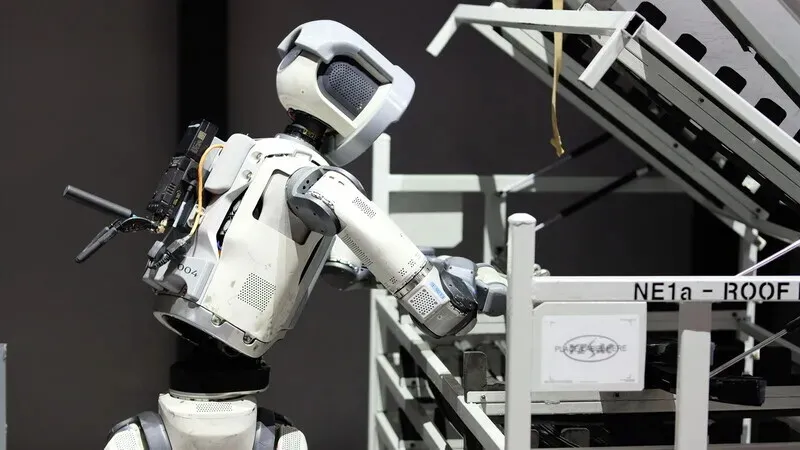

By Ha Jong-gang, dean of the Sungkonghoe University Labor Academy
This January, Boston Dynamics, a US-based robotics company under the Hyundai Motor Group, unveiled its humanoid robot “Atlas” at the Consumer Electronics Show 2026 held in Las Vegas. Its movements were so precise and its joint flexibility so remarkable that it could have been immediately deployed on an automotive assembly line. Hyundai Motor’s stock price soared, and the response was so positive that it felt like a beacon of hope to those who had been anxious that South Korea, once an IT powerhouse, was lagging far behind in the fields of artificial intelligence and robotics.
Subsequently, the media reported the Hyundai Motor union had declared an “all-out war” to block the introduction of robots, stating, “Not a single robot can enter the factory floor.” Public opinion has been overwhelmingly critical of the union. Around this time, in Q&A sessions after my lectures, participants would often pose biting questions about how I could defend the union’s anachronistic position.
However, there is an aspect that the media has failed to properly note. The fact is that the Hyundai Motor union’s claim was preceded by the condition, “without an agreement between labor and management.” In other words, the union was proposing that the company introduce robots after consultation between labor and management to minimize any adverse effects.
For many readers who did not read the articles carefully but only saw headlines along the lines of “Hyundai Motor Union Declares All-Out War on Robots,” the union’s proposal inevitably appeared to be a Luddite-esque backlash.
Robots have been a part of automobile production for years already. There is probably not a single Hyundai Motor worker who believes it is possible to prevent a robot from entering the factory. While expressions used by the union in its newsletters — such as “Not a single robot can enter the assembly line without labor-management agreement” — may seem radical, it is only when the labor union expresses such firm resolve that companies and the government will make even the smallest efforts to minimize the adverse effects of robot adoption.
Long ago, when the government attempted to privatize the Korea National Railway, the railway union went on strike, demanding the privatization scheme be completely withdrawn. The media criticized this as “opposition without offering an alternative.” However, because the union opposed the privatization with a “fight-to-the-death” attitude, the direction shifted from privatization to transforming the railway into a public corporation, resulting in the creation of a government-owned corporation. This is the same principle as demanding a salary raise of 15% at the beginning of negotiations to ultimately agree on a 5% increase.
Solutions to minimize the adverse side effects of introducing robots and artificial intelligence into production sites already exist, and the direction is relatively straightforward. Even if jobs are lost due to the introduction of robots and AI, productivity increases dramatically, so the volume of goods produced becomes much larger. We simply need to devise a way to distribute those goods equitably — including to those who are unemployed.
When astrophysicist Dr. Stephen Hawking passed away in 2018, a response he gave to a question on technological unemployment through Reddit’s “Ask Me Anything” event was widely circulated, as if these might be his final words.
The question posed was as follows: “Have you thought about the possibility of technological unemployment, where we develop automated processes that ultimately cause large unemployment by performing jobs faster and/or cheaper than people can perform them? Some compare this thought to the thoughts of the Luddites, whose revolt was caused in part by perceived technological unemployment over 100 years ago. In particular, do you foresee a world where people work less because so much work is automated? Do you think people will always either find work or manufacture more work to be done?”
To this, Hawking responded, “If machines produce everything we need, the outcome will depend on how things are distributed. Everyone can enjoy a life of luxurious leisure if the machine-produced wealth is shared, or most people can end up miserably poor if the machine-owners successfully lobby against wealth redistribution.”
As his final line, he wrote, “So far, the trend seems to be toward the second option, with technology driving ever-increasing inequality.”
Whether his prediction is right or wrong, the fact remains that all of us should be trying to make the first option even possible.
On Jan. 29, during a meeting with senior advisers, President Lee Jae Myung commented on the Hyundai Motor union debate.
“I think the labor union declared that they wouldn’t allow any robots into their worksites,” he said. “There’s no escaping this juggernaut.” No sooner had he spoken those words than did various media outlets send out reports that made it seem like he’d done some epic takedown of Hyundai’s union.
But there’s something that those media outlets buried in their reports. The fact is that Lee said of the union’s claims that they were “probably a bargaining tactic more than a real threat.”
Ultimately, the Hyundai Motor union, Stephen Hawking, and Lee Jae Myung were all basically saying the same thing. Considering that Lee said that “the side that owns the means of production will accumulate inordinate wealth, while it will get harder for the vast majority to find jobs, and we need to be prepared and respond to that,” his intentions become all the clearer.
Please direct questions or comments to [english@hani.co.kr]

Editorial・opinion
![[Editorial] Head of USFK continues to cross the line with inappropriate political remarks](https://flexible.img.hani.co.kr/flexible/normal/500/300/imgdb/original/2026/0528/4817799568931091.jpg "[Editorial] Head of USFK continues to cross the line with inappropriate political remarks") [Editorial] Head of USFK continues to cross the line with inappropriate political remarks
[Editorial] Head of USFK continues to cross the line with inappropriate political remarks![[Editorial] A disgraced former president like Park Geun-hye has no place on the campaign trail](https://flexible.img.hani.co.kr/flexible/normal/500/300/imgdb/original/2026/0526/2117797859381587.jpg "[Editorial] A disgraced former president like Park Geun-hye has no place on the campaign trail") [Editorial] A disgraced former president like Park Geun-hye has no place on the campaign trail
[Editorial] A disgraced former president like Park Geun-hye has no place on the campaign trail- [Editorial] Korea’s online hate problem calls for platform regulation and anti-discrimination law
- [Reporter’s notebook] Trump’s primary purge of ‘traitors’ won’t win him anything
- [Guest essay] Moscow-Pyongyang ties are rewriting security in NE Asia
- [Reporter’s notebook] Trump’s primary purge of ‘traitors’ won’t win him anything
- [Column] An incompetent ally is worse than no ally at all
- [Editorial] Samsung’s tentative bonus deal highlights need for profit-sharing rules
- [Editorial] Crisis averted at Samsung, but society must continue chip profit-sharing debate
- [Editorial] Seoul and Tokyo should focus on pragmatic cooperation, not countering China
Most viewed articles
- 1K-pop wins big at AMAs, with BTS taking home artist of the year
- 2[Editorial] Head of USFK continues to cross the line with inappropriate political remarks
- 3KFTC eyes criminal proceedings against Coupang founder over alleged false filings
- 4[Editorial] Samsung’s tentative bonus deal highlights need for profit-sharing rules
- 5[Editorial] Crisis averted at Samsung, but society must continue chip profit-sharing debate
- 6[Reporter’s notebook] Trump’s primary purge of ‘traitors’ won’t win him anything
- 7Ambassador denies Iranian involvement after Korea concludes ship was hit by Iran-linked missiles
- 8Lee pulls off pragmatic diplomacy balancing act between strongmen Trump and Xi
- 9Seoul stops short of naming Iran as attacker in strike on ship in Hormuz
- 10[Guest essay] Moscow-Pyongyang ties are rewriting security in NE Asia