hankyoreh
Links to other country sites 다른 나라 사이트 링크
[Editorial] USFK quickly needs to return all of Yongsan Garrison and cover cleanup costs
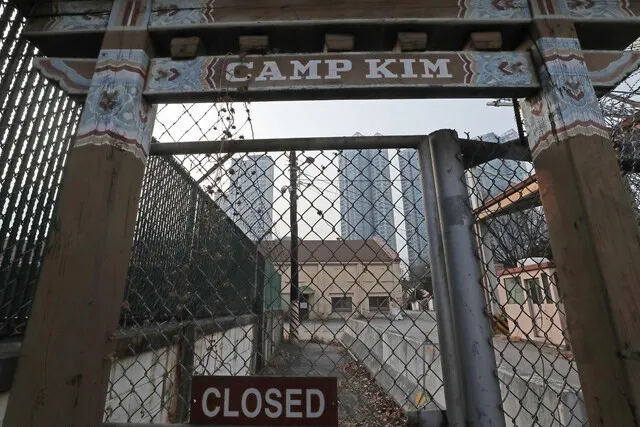
US Forces Korea (USFK) is returning control of 12 more bases in South Korea to the local authorities. That list includes two athletic facilities at the Yongsan Garrison in central Seoul. The move is significant, since it’s the first time that even a portion of the Yongsan Garrison has been returned to Korea since 2002, when the two sides began working on the handover of 80 bases in use by USFK.
But the two athletic facilities in question only occupy an area of 53,418 square meters, just 2.6% of the total area of the Yongsan Garrison. So this is just the first step, and we still have a long way to go.
Furthermore, Korea and the US didn’t make any progress in deliberations on the cost of cleaning up environmental pollution on the USFK bases. Korea needs an aggressive yet strategic approach that can persuade the US to quickly return the bases while shouldering the cleanup costs.
The Korean government announced on Dec. 11 that an agreement was reached in a meeting of the 201st US-ROK Joint Committee of the Status of Forces Agreement (SOFA) to return control of two sections of the Yongsan Garrison and 11 other American bases located in areas including Seoul; Gyeonggi Province; Daegu; Pohang, North Gyeongsang Province; and Taebaek, Gangwon Province.
That leaves 12 of the 80 bases that the US agreed to return to South Korea in 2002, a figure that, by itself, would suggest that a lot of progress has been made on the handover. But in fact, the handover of the Yongsan Garrison, the most important base of all, has been going slowly.
The timeframe for relocating the ROK-US Combined Forces Command, a key facility at the garrison, to Pyeongtaek is still up in the air. On top of that, the US wants some components of the CFC to remain where they are. It’s likely that it will take quite a bit of time — and require clearing a number of hurdles — before the handover of the Yongsan Garrison can be completed.
The government’s plan is for the current site of the Yongsan Garrison to be turned into a national park once the handover is complete. We hope the government will take a more proactive stance in the negotiations so that this park can be made available to Koreans as soon as possible.
Once again, the government punted the question of responsibility for cleaning up environmental pollution until another round of deliberations. If deliberations on this question drag out, the government explained, the handover of the bases itself might be delayed. The government’s position is that the bases should be returned now and the cleanup bill be presented later, so as to transfer as many of the bases as possible before President Moon Jae-in leaves office.
But the US military has never taken responsibility for pollution by paying for a cleanup after returning a base to local control. That raises suspicions that Seoul is just trying to buy some more time, without any viable way to persuade the US to pick up the tab.
“The government has failed to get any concessions from the Americans in regard to covering the cost of [cleaning up] pollution, improving environmental management and revising SOFA,” environmental group Green Korea said in a critical statement.
Common sense says that the party that has severely polluted land over decades of use ought to take responsibility for cleaning up its own mess. It’s time for the Korean government to show some moxie.
Please direct comments or questions to [english@hani.co.kr]

Editorial・opinion
![[Correspondent’s column] Coupang’s game in Washington follows familiar pattern](https://flexible.img.hani.co.kr/flexible/normal/500/300/imgdb/original/2025/1226/8217667391873536.jpg "[Correspondent’s column] Coupang’s game in Washington follows familiar pattern") [Correspondent’s column] Coupang’s game in Washington follows familiar pattern
[Correspondent’s column] Coupang’s game in Washington follows familiar pattern![[Editorial] Coupang’s attempt to hide behind US won’t win back Korean consumers](https://flexible.img.hani.co.kr/flexible/normal/500/300/imgdb/original/2025/1226/1817667387971465.jpg "[Editorial] Coupang’s attempt to hide behind US won’t win back Korean consumers") [Editorial] Coupang’s attempt to hide behind US won’t win back Korean consumers
[Editorial] Coupang’s attempt to hide behind US won’t win back Korean consumers- Coupang under fire for possible obstruction of investigation into its customer data leak
- [Editorial] Coupang founder’s contempt for workers, customer security knows no bounds
- [Column] Confessions of a Coupang-holic
- [Editorial] Kim Bom-suk’s arrogance on full display in boycott of Coupang leak hearing
- [Editorial] The facts of Yoon’s insurrection are clear — justice cannot be further delayed
- [Column] Trump destroys government
- [Column] A post-Western world approaches
- [Column] Offshore balancing, or carving out spheres of influence?
Most viewed articles
- 1Korea to trial next-gen train capable of sub-2-hour Seoul-Busan trip starting 2030
- 2Kim Jong-un’s hidden motive in criticizing South Korea’s nuclear submarine push
- 3[Editorial] Coupang’s attempt to hide behind US won’t win back Korean consumers
- 4Coupang under fire for possible obstruction of investigation into its customer data leak
- 5[Correspondent’s column] Coupang’s game in Washington follows familiar pattern
- 6Real-life heroes of “A Taxi Driver” pass away without having reunited
- 7Moon Jae-in renews call for end-of-war declaration, peace treaty on Korean Peninsula
- 8Chang Chun-ha’s family hopes to know truth of his death after 37 years
- 9Chinese money flooding into South Korean companies
- 10Russian architect personally witnessed Empress Myeongseong’s assassination by Japanese ronin, accoun