hankyoreh
Links to other country sites 다른 나라 사이트 링크
[Guest essay] Seoul’s emergency alert fiasco and the dangers of elite panic
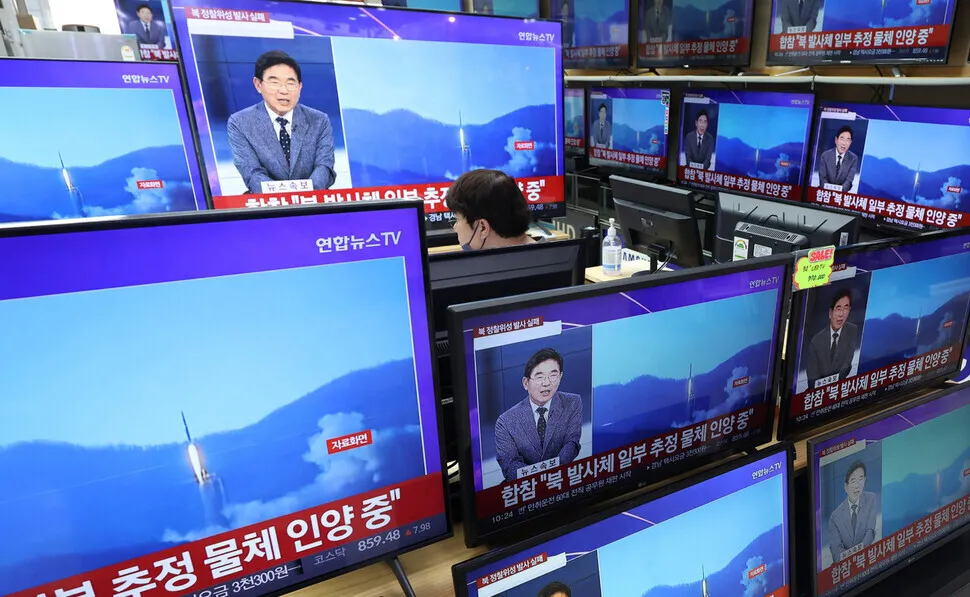

South Korean citizens have long since gained steel nerves worthy of special forces, which make them stoic in the face of most North Korean threats.
Threats from a neighboring hostile power with nuclear weapons and missiles would’ve caused any other country’s citizens to feel woozy and faint, but South Koreans dismiss such things as slight inconveniences, such as scattered showers on the weather forecast.
People of Seoul probably feel more inconvenienced by the bimonthly closure of supermarkets than by North Korean nuclear missile tests.
Citizens remain unfazed, but the South Korean elite are gripped by confusion and fear. They assume in advance that citizens will panic over the North Korean threat and worry in advance about the calls for accountability that they will be subject to.
They do not have the ability to face grave threats to the country and act with prudence and precision to prevent chaos. They overreact with unnecessary measures, try to restrict the behavior of citizens and their freedom of expression, and fight over who controls any situation.
Activist and writer Rebecca Solnit has called such behavior, mostly seen in disaster situations, “elite panic.”
The alert issued in Seoul on Wednesday morning was a classic case of elite panic. North Korea had launched a reconnaissance satellite into the waters off the western coast, but the Army’s Capital Defense Command was not officially part of the response.
The unit, which had not been notified of the drone\'s presence by the I Corps in December 2022, when North Korean drones were circling over Seoul, has a history of failing to live up to its responsibility to defend the city. Did this past failure prompt the overreaction?
In the aftermath of the emergency disaster warning message, the city of Seoul issued a statement to the media saying that the alert was issued at the request of the Ministry of National Defense.
The Ministry of the Interior and Safety (MOIS) sent a vague directive that “areas that did not receive the alert should issue their own alerts.”
This ambiguity was the beginning of more information pollution. Seoul, which has not been immune to controversy over its failed response to the Itaewon tragedy of October 2022, was alarmed by the message and issued a warning to Seoul residents to “prioritize the evacuation of children and the elderly.”
The message turned a North Korean rocket launch into an emergency, even though it was not an emergency for the city. The MOIS, alarmed by the city’s sudden actions that disrupted the mornings of 9.4 million people, hastily sent out a message to Seoul residents saying that the alert was a mistake. This is a classic case of elite panic, where the response to a disaster by the country’s elite creates another disaster.
As terrestrial broadcasters did not broadcast special reports, citizens who were curious about the situation rushed to access the Internet, and the portal site Naver crashed. When KakaoTalk went down in October 2022, President Yoon Suk-yeol called it a “national security incident” and ordered the formation of a pan-governmental cybersecurity task force. However, the fact that Naver crashed so easily shows that calls for new cybersecurity measures were merely sweet nothings to appease citizens.
The National Security Council has also failed to demonstrate its strength as a control tower to fix the chaos in government agencies. Last year alone, Yoon was taking pictures with his dog in his office when a North Korean drone flew over Yongsan, he was unaware of the misfire of South Korean Hyunmoo missile in Gangneung, and was unable to leave his premises during the heavy summer rains.
In regard to the tragic crowd crush in Itaewon, he gave impunity to the incompetence and irresponsibility of the state elite and pinned the blame on the frontline fire departments and police districts.
In its efforts to control information about the victims’ identities, destroy civic solidarity, and build the government\'s prestige, the government, with the view that the responsibility for disasters lie with citizens, not the elite, imposed a deep sense of shame on the weak.
Unable to face up to the nature of the problem and afraid of a president who snaps at them at every turn, the rigid bureaucracy overreacts to protect the president’s feelings, which fails to make anything better. They fight the blame game itself, not any threat to the country.
What could these elites do for the safety of their citizens and the stability of the country if a national crisis were to become a reality? The shame they inflicted on us on the morning of the last day of May, and the blame game they engaged in afterward, foreshadows the tragic end of the real crisis that may come one day.
It is not North Korea’s nuclear weapons that I fear, but the incompetent and irresponsible elites of this country. There is little they can do for us.
Please direct questions or comments to [english@hani.co.kr]

Editorial・opinion
 [Column] What it will take to make a US-North Korea summit happen
 [Editorial] Seoul must be ready for anything with North Korea
- [Column] Is this America’s last Red Scare?
- [Column] Becoming stupid: Kindness videos, Blinkist and duanju
- [Editorial] USFK commander must retract, apologize for denying Korea’s territorial sovereignty
- [Editorial] US is in no position to lecture Korea about ‘fair treatment’
- [Column] The era of weaponizing intelligence to bring allies to heel
- [Correspondent’s column] US midterms: A contest of money vs. public sentiment
- [Column] Life’s too short to search for meaning in Trump’s bullshit
- [Reporter’s notebook] Why Korea can’t seem to get rid of sexual exploitation sites
Most viewed articles
- 1Lee’s posting spree is legitimizing anti-migrant sentiment in Korea, experts say
- 2In Korea, migrant children are caught between languages and left behind in both
- 3147 days of Olympic Park protests: From ballot shortage outrage to far-right rallying point
- 4North Korea answers South’s proposal for military talks by firing off ballistic missiles
- 5Four years after disaster, Itaewon families ask the world to remember their loved ones
- 6Blue House doubles down on Lee’s plan to review ‘special treatment’ for multicultural families
- 7[Guest essay] A general who talks too much, an ally who wants too much
- 8Special counsel demands death penalty for Yoon in appeals trial on insurrection charges
- 9Kim Jong-un may have used Dandong trip to relay stance on US talks to Beijing, says NIS
- 10US declines to clarify visa problems faced by Korean politicians