hankyoreh
Links to other country sites 다른 나라 사이트 링크
[Guest essay] A general who talks too much, an ally who wants too much
By Ko Seung-woo, director of the Conference of Journalists of the May 1980 Democratic Struggle
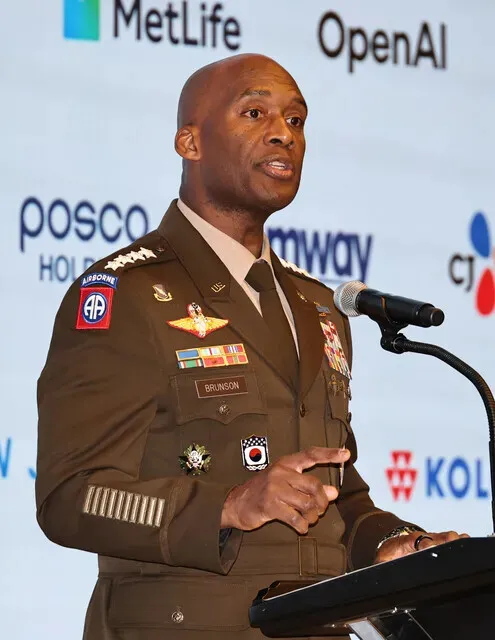
US Forces Korea Commander Gen. Xavier Brunson wears three hats: commander of USFK, commander of the UN Command and commander of the ROK-US Combined Forces Command.
It is nothing if not perplexing that the current system allows one person to have authority over three military systems that have vastly different goals and are based on distinct legal grounds.
The man atop this command system in which an individual wears three hats — a case rarely seen in all of global military history — takes his orders from Washington, giving him considerable and growing influence.
When Brunson makes a statement, he is not speaking as a mere soldier. He relays the words of US President Donald Trump and acts as a channel for comments that have been ordered to be disseminated by the White House.
On wartime operational control (OPCON), he has taken a strategically flexible stance, shifting the goalposts on the conditions for South Korea to regain control. When discussing the country’s sovereign territory, he has pointed to the DMZ’s southern boundary fence.
By daring to declare that South Korea begins at the “southern fence line” in the DMZ, Brunson expressed contempt for South Korea’s Constitution, which stipulates in Article 3 that the territory of South Korea consists of the Korean Peninsula and its adjacent islands.
Only a commander of colonial forces would make such radical remarks.
It is not difficult to infer that, given Trump’s authoritarian leadership, Brunson is being ordered to make these comments by the White House.
The framework Brunson has outlined for restructuring the US alliance with Korea makes clear the strategic advantages Washington seeks to secure.
By signaling that Korea ought not to rush into regaining OPCON, implementing moves that further elevate the role of the UN Command, and using strategic flexibility to extend US military operations beyond the Korean Peninsula into the surrounding region, he is advancing Washington’s vision of multidomain operations.
Brunson has stated that stationing a US multi-domain task force on the Korean Peninsula would allow the US to survey not only North Korea in the realms of space, cyberspace, and electronic warfare, but also China and Russia. He has also stated that Korea would become a regional sustainment hub and a strategic base in Northeast Asia.
These three statements combined outline the framework for the US’ future strategies. OPCON will either be belatedly returned to Korea or not returned at all; the UN Command and USFK will expand their influence beyond the Korean Peninsula; and Korea will have no choice but to shoulder the expenses and risks from that outcome.
Brunson was joined in his efforts to take center stage in the South Korea-US alliance by Lt Gen. Joe Hilbert, the commander of the US Eighth Army, which is stationed in Korea under the USFK.
Hilbert stated that it was irresponsible for the USFK to only focus myopically on threats on the Korean Peninsula and that the Eighth Army should be ready to be deployed during emergencies in the Asia-Pacific region while also being used to keep China in check.
There is no doubt that Trump approved those comments beforehand, and that Hilbert made those statements as a politicized general.
If the USFK officially adopts a policy of being strategically flexible, Korea may find itself in the thick of war simply for hosting US military bases. Much like how Iran’s shellfire turned Saudi Arabia and Kuwait — which also house US military bases — into seas of flames, tensions and conflicts in the Taiwan Strait or West Sea may spread to Gunsan, Osan and Pyeongtaek.
Is this not the fate of the “invincible-class aircraft carrier” that Brunson expects our beautiful land to become?
Trump is attempting to draw Korea even deeper into the front lines of the Indo-Pacific containment strategy against China while pretending to be open to the OPCON transfer. Strategic flexibility would give USFK greater operational agility, broaden its mission and expand South Korea-US military cooperation across the wider region.
However, this also opens up a terrifying possibility — South Korea could be expected to participate in an unwanted war. How can we say that our security is being prioritized if our people have to pay for the consequences of operations that we had no control over with their blood and assets? How will it help our national security if South Korea is attacked because of its US military bases and the Korea-US alliance makes us the target of retaliation?
The fact that US military bases in Kuwait and Saudi Arabia are being attacked by the Iranian military during the US war with Iran demonstrates how military bases are double-edged swords — while strategic assets, they can also just as easily become targets of aggression.
The strategic interests of the US and South Korea do not always align. Those disparities cannot be erased simply by saying that the alliance is strong, which is why Korea needs to take a firmer stance when confirming facts.
South Korea must secure an agreement requiring its consent before its territory or US military bases on the peninsula can be used for military operations beyond the Korean Peninsula.
The South Korean government must be able to exercise substantive influence over decisions that put the lives of our citizens at risk.
Trump’s demands, voiced through Brunson, know no bounds. They range from affairs involving military sovereignty to territorial issues. Guided by the White House’s directives, Brunson is faithfully carrying out his role as the on-the-ground architect of the restructuring of the ROK-US alliance, wielding the authority vested in him as commander of the ROK-US Combined Forces Command, the UN Command and USFK.
The problem is whether the South Korean government, politicians, the media, and academics are perceiving this restructuring and responding as they should. The Lee Jae Myung administration must not repeat the same mistakes made by past progressive administrations.
The administrations of both Roh Moo-hyun and Moon Jae-in loudly championed self-reliance, but failed to change the fundamentally unequal framework of the Korea-US alliance. A small group of politicians and bureaucrats sought only to strike tactical deals with the US and agreed to accommodate the USFK’s strategic flexibility, which led to the expansion of the Pyeongtaek base into the largest US base in the world, deployment of troops to Iraq, and the purchase of cutting-edge US-manufactured weapons at astronomical costs.
As a result, Korea found itself on the front lines of the US-China hegemonic rivalry while being drawn deeper and deeper into the US’ strategic plans.
Do we not remember how promises of peace and steady handshakes between the leaders of North and South Korea were erased in vain by the unequal structure of the Korea-US alliance and the US’ regional strategy?
Will regaining OPCON be the be-all, end-all? On the contrary, it will mark a new beginning. We must review the meaning and the operation of Article 4 of the Mutual Defense Treaty, establish and agree upon rules on the strategic flexibility of the USFK and its offshore operations, and base the normalization of the UN Command’s scope of influence in general and over the Armistice Agreement on international law and South Korea’s Constitution.
We must examine the command structure of the ROK-US Combined Forces Command, rectify the unequal elements of the Status of Forces Agreement between Korea and the US, and establish mutual respect regarding the use and operation of US bases, as well as environmental and legal responsibilities. If necessary, amendments or the termination of the treaty must be brought to the negotiation table.
The Lee administration must pioneer a new era of true self-reliance together with civil society, the force that brought about the Revolution of Light by quashing the 2024 insurrection. Instead of only focusing on regaining OPCON, it must face the issues surrounding the inequality behind Article 4 of the Mutual Defense Treaty to secure a substantive veto over the extraterritorial operations of the USFK, and, in the name of a sovereign nation, normalize the authority of the UN Command, which is reigning like a colonial overlord.
Brunson’s words are Trump’s words. If we cannot read between the lines and identify the plan to restructure the Korea-US alliance, we may once again find ourselves in a conundrum — the moment we are, on paper, self-reliant, we might subject ourselves to an even more insidious system of subordination.
An alliance cannot replace sovereignty, national security cannot silence democracy, and self-determination is not a right to be granted, but a national principle that should be built and defended by the people.
No alliance can become an absolute power that reigns above our Constitution.
Please direct questions or comments to [english@hani.co.kr]

Editorial・opinion
 [Column] What it will take to make a US-North Korea summit happen
 [Editorial] Seoul must be ready for anything with North Korea
- [Column] Is this America’s last Red Scare?
- [Column] Becoming stupid: Kindness videos, Blinkist and duanju
- [Editorial] USFK commander must retract, apologize for denying Korea’s territorial sovereignty
- [Editorial] US is in no position to lecture Korea about ‘fair treatment’
- [Column] The era of weaponizing intelligence to bring allies to heel
- [Correspondent’s column] US midterms: A contest of money vs. public sentiment
- [Column] Life’s too short to search for meaning in Trump’s bullshit
- [Reporter’s notebook] Why Korea can’t seem to get rid of sexual exploitation sites
Most viewed articles
- 1Blue House doubles down on Lee’s plan to review ‘special treatment’ for multicultural families
- 2Lee under fire for saying foreign workers ‘don’t do much’ for Korea’s economy
- 3[Guest essay] A general who talks too much, an ally who wants too much
- 4[Editorial] To become a leading nation, Korea must build self-reliance
- 5In a multiplex world, Korea must reduce US dependence, pursue pragmatism, says Acharya
- 64 years after losing loved ones, Itaewon families continue to fight lies and hate online
- 7US denies visa to another senior Korean lawmaker from ruling Democratic Party
- 8SK Hynix tops 100 tril. won in quarterly revenue, says memory shortage will last through 2030
- 9Samsung’s semiconductor business breaks 100 trillion won in profit in Q3, a new record
- 10[Column] What it will take to make a US-North Korea summit happen