hankyoreh
Links to other country sites 다른 나라 사이트 링크
In a multiplex world, Korea must reduce US dependence, pursue pragmatism, says Acharya
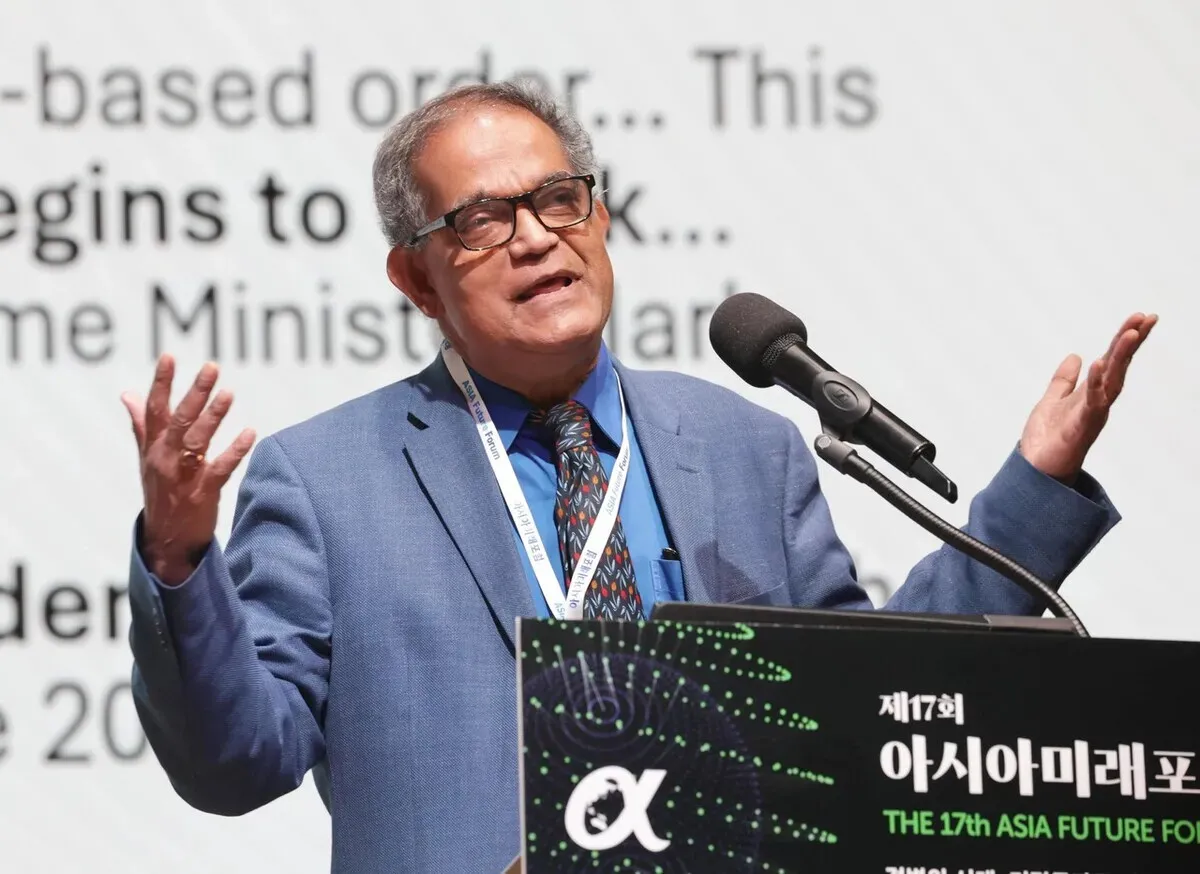
A leading global authority on international relations has argued that as the great powers lose their dominance and the world moves toward a “multiplex” order, Korea needs to maintain its alliance with major powers while seeking new opportunities through cooperation with middle powers.
Amitav Acharya, a distinguished professor at American University, said in a keynote address on Wednesday that rather than making a binary choice, Korea needs to respond to the rapidly changing world order through a multipronged approach to diplomacy that involves partnering with different countries for different issues.
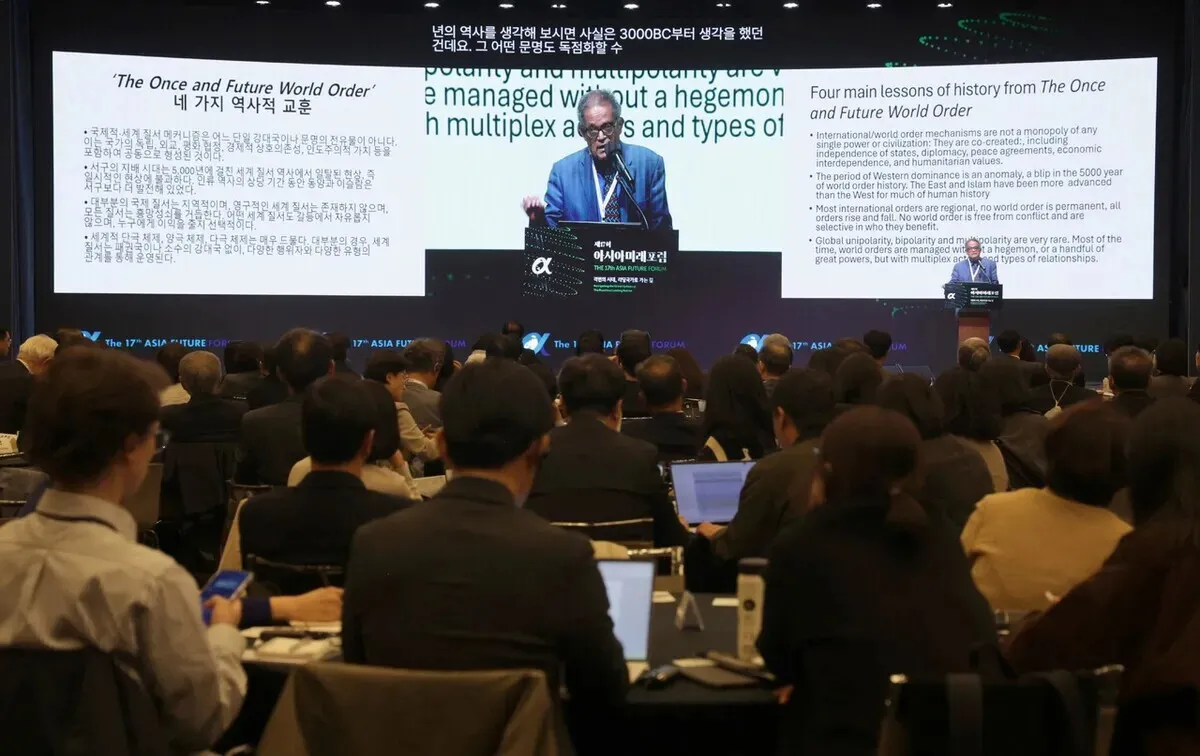
Acharya delivered his address at the 17th Asia Future Forum, which was organized by the Hankyoreh and held at the Korea Chamber of Commerce and Industry in downtown Seoul. Born in India, he was the first non-Western scholar to serve as president of the International Studies Association (2014-2015), which is the biggest academic organization in its field.
In his address, Acharya said that we are living in a time of change and predicted a shift to what he describes as a “multiplex world.”
The multiplex world, he explained, can be likened to a multiplex cinema, in which a variety of films are watched on separate screens. In our pluralistic world, a variety of actors — including not only the great powers but also middle powers, smaller countries, international organizations, corporations and NGOs — all share leadership and responsibility on such issues as security, the economy, climate and technology.
Acharya believes that what we are witnessing unfold is neither a unipolar world led by the US or China nor a multipolar world dominated by a few great powers.
But this shift, he said, is not so unfamiliar. “World order mechanisms are not a monopoly of any single power or civilization,” he noted.
Since “diplomacy, peace agreements, economic interdependence and humanitarian values” have developed through the interaction between multiple civilizations, the decline of the Western-dominated liberal order — which was sustained by military and economic superiority — need not be seen purely as a crisis.
With a broader range of actors to shape the world order together, various kinds of global cooperation have grown in importance as well, Acharya said.
Notably, the scholar advised Korea to adopt a “flexible, issue-driven foreign policy,” warning that overdependence on American security and the American market could make Korea vulnerable to American pressure in the areas of tariffs and defense burden sharing.
The scholar said that while US President Donald Trump is clearly less interested in sharing the burden than in shifting it to American allies, it would be dangerous for Korea to jettison its alliance with the US. Instead, Seoul ought to adopt a pragmatic line that reduces dependence on Washington.
Acharya’s prescriptions are to maintain the US alliance, manage conflict and continue engagement with middle powers and cooperation within Northeast Asia and other regions. Korea also needs to continue new partnerships with China and Russia, he said.
He also foresees Korea having a major role to play with AI.
The governance structure for discussing AI, he argued, cannot be led by the US, which is beholden to its own tech companies, and thus requires input both from China and middle powers. Countries like Korea, he said, should lead the way by serving as a bridge between the great powers.
By Song Ho-jin, Hankyoreh Economy and Society Research Institute staff writer
Please direct questions or comments to [english@hani.co.kr]

Editorial・opinion
 [Column] What it will take to make a US-North Korea summit happen
 [Editorial] Seoul must be ready for anything with North Korea
- [Column] Is this America’s last Red Scare?
- [Column] Becoming stupid: Kindness videos, Blinkist and duanju
- [Editorial] USFK commander must retract, apologize for denying Korea’s territorial sovereignty
- [Editorial] US is in no position to lecture Korea about ‘fair treatment’
- [Column] The era of weaponizing intelligence to bring allies to heel
- [Correspondent’s column] US midterms: A contest of money vs. public sentiment
- [Column] Life’s too short to search for meaning in Trump’s bullshit
- [Reporter’s notebook] Why Korea can’t seem to get rid of sexual exploitation sites
Most viewed articles
- 1Blue House doubles down on Lee’s plan to review ‘special treatment’ for multicultural families
- 2Lee under fire for saying foreign workers ‘don’t do much’ for Korea’s economy
- 3[Guest essay] A general who talks too much, an ally who wants too much
- 4[Editorial] To become a leading nation, Korea must build self-reliance
- 5In a multiplex world, Korea must reduce US dependence, pursue pragmatism, says Acharya
- 64 years after losing loved ones, Itaewon families continue to fight lies and hate online
- 7US denies visa to another senior Korean lawmaker from ruling Democratic Party
- 8SK Hynix tops 100 tril. won in quarterly revenue, says memory shortage will last through 2030
- 9Samsung’s semiconductor business breaks 100 trillion won in profit in Q3, a new record
- 10[Column] What it will take to make a US-North Korea summit happen