hankyoreh
Links to other country sites 다른 나라 사이트 링크
US denies visa to another senior Korean lawmaker from ruling Democratic Party
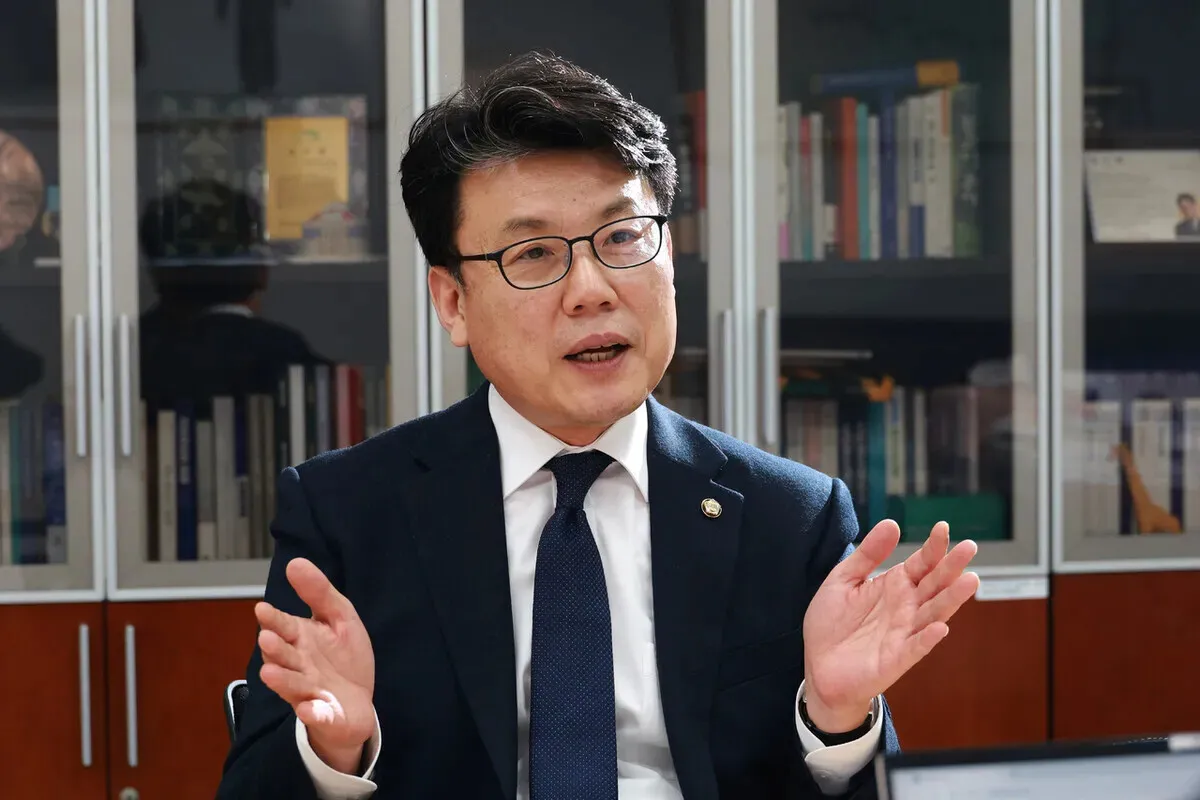
Rep. Jin Sung-joon of the ruling Democratic Party said Wednesday that the US had denied him an entry visa as he arranged a visit by a National Assembly National Defense Committee delegation to the US Pacific Command in Hawaii.
On the heels of a similar rejection last month for Democratic Rep. Jung Chung-rae, a former leader of the party, speculation is rising that the tension between Seoul and Washington over intelligence and trade issues might have played a role in the handling of Jin’s visa application.
A news release from Jin and a Facebook post said the committee had planned to send a four-member delegation to the command from Nov. 1-5. The group would have comprised Jin as chairperson of the committee, vice chairs from the ruling and opposition camps — Rep. Kim Byung-joo of the Democratic Party and Rep. Lim Jong-deuk of the main opposition People Power Party — and Rep. Chun Ha-ram of the minor Reform Party.
The finalized schedule of meetings with key Pentagon leaders included talks with the commanders of the US Pacific Command, Pacific Fleet and Pacific Air Forces as well as the deputy commanding general of the US Army Pacific and deputy commander of the US Space Forces - Indo-Pacific. The rejection of Jin's visa application brought the planned trip to a halt.
“The US refusal to issue a visa to the committee chair wasn't just a mere restriction on one individual's entry into the country, but an obstruction of the official legislative activities of the National Assembly, which represents the Korean people,” Jin said. “I find this decision even more puzzling since I visited the US Pacific Command in March 2014 as a committee member under the 19th National Assembly.”
“We express strong regret toward the US for not just restricting the sovereign activities of our National Assembly but also limiting our legislative efforts to advance the bilateral alliance, and urge that proactive measures be taken,” he said.
Earlier, on Sept. 27, Jung, a member of the National Assembly's Foreign Affairs and Unification Committee, was unable to attend a parliamentary audit of diplomatic missions in the Americas due to delayed approval of his US visa.
Speculation is mounting that the denial of visas to key members of the ruling party reflects American dissatisfaction stemming from recent tensions with Korea.
“Singling out politicians from the progressive camp to deny them visas constitutes an emotional expression of US dissatisfaction over bilateral relations with Korea,” said Lee Byong-chul, a professor at the Institute for Far Eastern Studies at Kyungnam University, adding that the practice seems like “a form of bringing them to heel.”
By Park Kang-su, staff reporter; Jang Ye-ji, staff reporter
Please direct questions or comments to [english@hani.co.kr]

Editorial・opinion
 [Column] What it will take to make a US-North Korea summit happen
 [Editorial] Seoul must be ready for anything with North Korea
- [Column] Is this America’s last Red Scare?
- [Column] Becoming stupid: Kindness videos, Blinkist and duanju
- [Editorial] USFK commander must retract, apologize for denying Korea’s territorial sovereignty
- [Editorial] US is in no position to lecture Korea about ‘fair treatment’
- [Column] The era of weaponizing intelligence to bring allies to heel
- [Correspondent’s column] US midterms: A contest of money vs. public sentiment
- [Column] Life’s too short to search for meaning in Trump’s bullshit
- [Reporter’s notebook] Why Korea can’t seem to get rid of sexual exploitation sites
Most viewed articles
- 1Blue House doubles down on Lee’s plan to review ‘special treatment’ for multicultural families
- 2Lee under fire for saying foreign workers ‘don’t do much’ for Korea’s economy
- 3[Guest essay] A general who talks too much, an ally who wants too much
- 4[Editorial] To become a leading nation, Korea must build self-reliance
- 5In a multiplex world, Korea must reduce US dependence, pursue pragmatism, says Acharya
- 64 years after losing loved ones, Itaewon families continue to fight lies and hate online
- 7US denies visa to another senior Korean lawmaker from ruling Democratic Party
- 8SK Hynix tops 100 tril. won in quarterly revenue, says memory shortage will last through 2030
- 9Samsung’s semiconductor business breaks 100 trillion won in profit in Q3, a new record
- 10[Column] What it will take to make a US-North Korea summit happen