hankyoreh
Links to other country sites 다른 나라 사이트 링크
SK Hynix tops 100 tril. won in quarterly revenue, says memory shortage will last through 2030
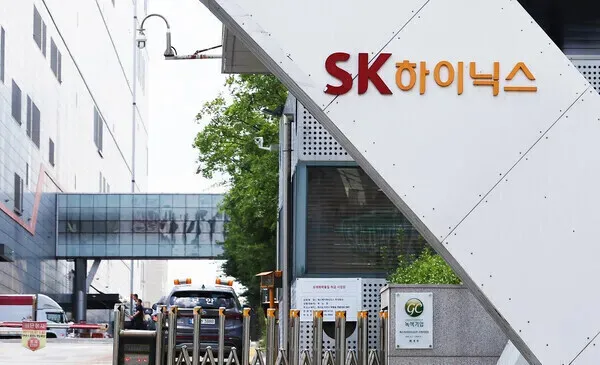
SK Hynix set a new all-time high of 100 trillion won in quarterly sales as the artificial intelligence boom fueled demand for memory chips.
The company has announced plans to increase its capital investment in South Korea and abroad and to return around 100 trillion won to its shareholders this year.
The company also stated that memory supplies would not meet demand through 2030, countering recent claims among some quarters that semiconductors have already reached their peak. The KOSPI index rose by more than 6% in response.
Revenue tops 100 trillion won; shortage seen lasting to 2030
SK Hynix reported consolidated third-quarter revenue of 104.62 trillion won and operating profit of 83.33 trillion won in a regulatory filing Wednesday. Revenue rose 32% from the previous quarter and operating profit 38%. This is the first time the company’s quarterly revenue has exceeded 100 trillion won.
Operating profit beat the average brokerage forecast of 76.96 trillion won compiled by financial data provider FnGuide. The operating margin reached 79.7%, meaning the company kept nearly US$80 in operating profit for every US$100 of memory it sold. Growing demand for server DRAM and enterprise solid-state drives (eSSDs) drove the results, as did continued increases in memory prices.
The company forecast that demand will continue to outstrip supply through 2030. “Given the complexities involved in implementing leading-edge processes and the lead times required to construct new production facilities, a situation where supply cannot keep up with demand is expected to persist for some time, a constraint projected to continue through 2030,” Chief Financial Officer Kim Woo-hyun said during Wednesday’s earnings call.
SK Hynix said it has signed long-term agreements with 14 customers, including major global cloud service providers. When demand currently under discussion with customers is factored in, its DRAM and high-bandwidth memory (HBM) output is effectively sold out through 2029, the company said.
A widening base for AI investment
The market has worried that returns on AI infrastructure spending have been slow to materialize.
In response, the company said, “The investment base is rapidly broadening as demand becomes multilayered, extending beyond cloud providers to companies building their own AI infrastructure and to sovereign AI investment.” In other words, AI spending is no longer driven only by a handful of Big Tech firms. Companies in other sectors and national governments are increasingly investing as well.
SK Hynix expressed confidence about the competition from Chinese memory makers, saying what matters is real mass-production capability. ChangXin Memory Technologies (CXMT) recently announced that it would release server DRAM built on the next-generation 4F² cell structure by the end of the year.
Park Joon-deok, SK Hynix’s head of DRAM marketing, downplayed the announcement. “Achieving a technology and actually commercializing it are two separate things,” Park said.
Brokerage analysts were upbeat.
“As Anthropic’s IPO takes concrete shape and hyperscalers report their earnings, doubts about end-market demand are likely to gradually fade,” said Son In-jun, an analyst at Eugene Investment & Securities.
Ryu Hyung-keun, an analyst at Daishin Securities, said, “We expect quarterly operating profit to top 100 trillion won for the first time ever in the fourth quarter of this year.”
Breaking down the 100 trillion won payout
Investors were focused squarely on shareholder returns. The company put its total shareholder returns for this fiscal year at about 100 trillion won. It plans to spend more than 60 trillion won on share buybacks and cancellations and more than 30 trillion won on cash dividends.
About 64 trillion won of that has been finalized so far. The company has finished the 40 trillion won buyback approved in August and will soon cancel those shares. Of the 20 trillion won in new buybacks its board approved Wednesday, it will cancel 10 trillion won worth of shares. The other 10 trillion won will go toward compensation for executives and employees and is not counted toward the return total.
The third-quarter dividend was set at 20,000 won per share, totaling 14 trillion won. That includes a regular dividend of 10,000 won reflecting earnings and a special dividend of 10,000 won sharing gains from the company’s investment in Japan’s Kioxia. Simple arithmetic leaves roughly 35 trillion to 36 trillion won in additional returns for the fourth quarter.
“We will continue to acquire shares each quarter. The size of quarterly share acquisition will be determined through board resolutions that consider share price, market conditions, and cash flow,” Kim said. SK Hynix had previously pledged to spend at least 50% of its cumulative free cash flow from 2025 to 2027 on shareholder returns.
This is the first return plan SK Hynix has announced since it dropped its review of a listing for Solidigm, its US NAND flash subsidiary. Plans to list Solidigm on the US stock market drew fierce criticism that they would erode shareholder value at SK Hynix. Regulators also voiced concerns.
During parliamentary audits, Financial Supervisory Service Governor Lee Chan-jin and Financial Services Commission Chairman Lee Eog-weon stressed the duties of SK Hynix’s board as the parent company. On Friday, SK Hynix officially announced that it had halted its review of the listing.
Because the plan came after that backlash, paying out the Kioxia gains as a special dividend looks like an effort to win back shareholders. However, the gains come from an investment made in 2018. They are a one-time windfall, not a return that can be repeated every year.
SK Hynix shares closed regular trading Wednesday up 10.89% at 1.49 million won after the earnings and shareholder return announcements. Samsung Electronics rose 9.01% to 242,000 won. With money pouring into the country’s two chip giants, the KOSPI closed up 6.63% at 6,012.44, back above the 6,000 mark for the first time in two weeks.
By Bae Ji-hyun, staff reporter; Seo Hye-mi, staff reporter
Please direct questions or comments to [english@hani.co.kr]

Editorial・opinion
 [Column] What it will take to make a US-North Korea summit happen
 [Editorial] Seoul must be ready for anything with North Korea
- [Column] Is this America’s last Red Scare?
- [Column] Becoming stupid: Kindness videos, Blinkist and duanju
- [Editorial] USFK commander must retract, apologize for denying Korea’s territorial sovereignty
- [Editorial] US is in no position to lecture Korea about ‘fair treatment’
- [Column] The era of weaponizing intelligence to bring allies to heel
- [Correspondent’s column] US midterms: A contest of money vs. public sentiment
- [Column] Life’s too short to search for meaning in Trump’s bullshit
- [Reporter’s notebook] Why Korea can’t seem to get rid of sexual exploitation sites
Most viewed articles
- 1Blue House doubles down on Lee’s plan to review ‘special treatment’ for multicultural families
- 2Lee under fire for saying foreign workers ‘don’t do much’ for Korea’s economy
- 3[Guest essay] A general who talks too much, an ally who wants too much
- 4[Editorial] To become a leading nation, Korea must build self-reliance
- 5In a multiplex world, Korea must reduce US dependence, pursue pragmatism, says Acharya
- 64 years after losing loved ones, Itaewon families continue to fight lies and hate online
- 7US denies visa to another senior Korean lawmaker from ruling Democratic Party
- 8SK Hynix tops 100 tril. won in quarterly revenue, says memory shortage will last through 2030
- 9Samsung’s semiconductor business breaks 100 trillion won in profit in Q3, a new record
- 10[Column] What it will take to make a US-North Korea summit happen