hankyoreh
Links to other country sites 다른 나라 사이트 링크
S. Korea pushes Japan to join “unconditional dialogue” between export regulators on both sides
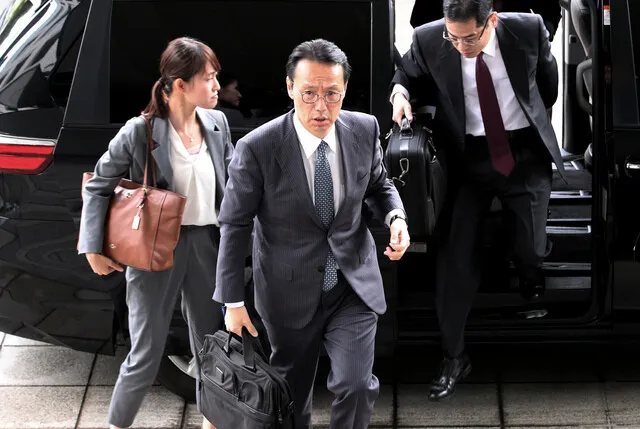
Director-generals from South Korea and Japan’s foreign ministries held talks in Seoul on Aug. 29, just one day after Japan took the step of removing South Korea from its white list of countries that enjoy streamlined screening on the exports of strategic materials.
Kim Jung-han, director-general for Asian and Pacific Affairs at the South Korean Ministry of Foreign Affairs, and Kenji Kanasugi, director-general of the Japanese Foreign Ministry‘s Asian and Oceanian Affairs Bureau, discussed the issue of forced labor during a meeting at the Seoul office of the South Korean Foreign Ministry on the afternoon of Aug. 29, the Foreign Ministry said. Kenji was on a trip to South Korea to attend the meeting.
During his meeting with Kenji, Kim expressed strong regret for the Japanese government’s removal of South Korea from its white list the previous day and protested that measure, while once again calling for its swift retraction. Kim also stressed that, in order to resolve that issue, unconditional and sincere dialogue needs to be quickly held between officials from the two countries who are responsible for managing exports. Kim also said that Japan needs to constantly provide South Korea with concrete and accurate information about its alleged plan to dump water contaminated with radioactivity from its Fukushima nuclear plant into the ocean.
An official from the South Korean Foreign Ministry said that the meeting, which lasted for about an hour and 10 minutes, “didn’t produce any meaningful progress because the gap between the two sides’ positions remains too wide.”
Sources say that the two officials also discussed a range of possible solutions to the South Korean Supreme Court’s ruling about providing compensation for victims of forced labor during the Japanese colonial period. Here too, the two sides reportedly remained at loggerheads. Kim called for the two sides to find a solution through deliberations based on the “one plus one” proposal (in which South Korean and Japanese companies would voluntarily pay compensation to the victims) that the South Korean government make back in June, while Kenji repeated Japan’s demand that the South Korean Supreme Court’s ruling was a “violation of international law” and must therefore be amended.
Kenji reportedly expressed Japan’s wish for South Korea to reconsider its decision to terminate its intelligence-sharing agreement with Japan (the General Security of Military Information Agreement, or GSOMIA), but Kim emphasized that Japan must withdraw its export controls before that can happen.
By Park Min-hee, senior staff writer
Please direct comments or questions to [english@hani.co.kr]

Editorial・opinion
 [Column] What it will take to make a US-North Korea summit happen
 [Editorial] Seoul must be ready for anything with North Korea
- [Column] Is this America’s last Red Scare?
- [Column] Becoming stupid: Kindness videos, Blinkist and duanju
- [Editorial] USFK commander must retract, apologize for denying Korea’s territorial sovereignty
- [Editorial] US is in no position to lecture Korea about ‘fair treatment’
- [Column] The era of weaponizing intelligence to bring allies to heel
- [Correspondent’s column] US midterms: A contest of money vs. public sentiment
- [Column] Life’s too short to search for meaning in Trump’s bullshit
- [Reporter’s notebook] Why Korea can’t seem to get rid of sexual exploitation sites
Most viewed articles
- 1Lee’s posting spree is legitimizing anti-migrant sentiment in Korea, experts say
- 2In Korea, migrant children are caught between languages and left behind in both
- 3147 days of Olympic Park protests: From ballot shortage outrage to far-right rallying point
- 4North Korea answers South’s proposal for military talks by firing off ballistic missiles
- 5Four years after disaster, Itaewon families ask the world to remember their loved ones
- 6Blue House doubles down on Lee’s plan to review ‘special treatment’ for multicultural families
- 7[Guest essay] A general who talks too much, an ally who wants too much
- 8Special counsel demands death penalty for Yoon in appeals trial on insurrection charges
- 9Kim Jong-un may have used Dandong trip to relay stance on US talks to Beijing, says NIS
- 10US declines to clarify visa problems faced by Korean politicians