hankyoreh
Links to other country sites 다른 나라 사이트 링크
Belatedly, Korea seeks to catch up in seed industry
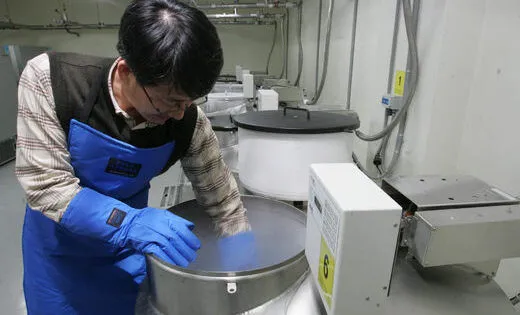
When Jo Eun-gi, an senior official of the Rural Development Administration, heard about a Japanese botany professor visiting Korea and asking around for a guide to accompany him to the mountains, he suspected that hiking was not the only order of business. Jo investigated further, and indeed found out that the Japanese professor, together with a plant specimen gatherer, had secretly collected legume seeds from Korea. Though the professor had visited Korea on the pretext of a joint research project, he had also evidently come on a "seed hunt."
In the first half of this year, South Korean retailers and cultivators paid royalties of 6 billion won (US$6.5 million) to Japan for the rights to deal in Japanese strawberries. Japanese breeds of strawberries dominate a full 85 percent of the Korean strawberry market, with Korean breeds occupying but 10 percent of the domestic market in 2005.
Last year, Korosa, the Korean branch of the German rose breeding company W. Kordes Sohne, sued the Korea Agro-Fisheries Trade Corporation for 100 million won and won its case in November 2005. The grounds of the lawsuit was that the Korean Trade Corporation had illegally bred and raised W. Kordes Soehne roses before selling and exhibiting them on the flower market. Currently, the annual royalty payments made by South Korea to overseas companies for seed usage totals 20 billion won.
This war is hidden but fierce. As seeds for prime plants can equal big money, nations often commit acts of seed piracy for economic gain.
The U.S. and European nations have already passed the stage of seed technology development that involves gathering seed stocks and developing them for vegetable and fruit lines. Now, these countries use top-of-the-line biotechnologies to develop new medicines and other substances from plant extracts. Specialists anticipate that the global annual market for genetically modified plants and microorganisms could top 9 quadrillion won.
Late to join the race, South Korea is trying to catch up. But that is not to say there is no hope.
Malaysia was once a nation that primarily sold gum. Since then, palm oil has become an important export product there, as well. In the mid-1970s, Malaysian scientists modified palm oil samples they had gathered in Africa and developed a class of coconuts that were smaller yet rich in oil. This industry alone now brings the Southeast Asian nation 10 trillion won a year in profits, and a nature park developed with related technology earns an additional 3 trillion won through tourism.
If not for palm oil, Malaysia would merely be a gum-producing nation. Dr. Jeong Hyeok, who returned this month from negotiations with Malaysia over an exchange of genetic materials, stated that "though [Malaysia] is economically underdeveloped, it is enlightened in this field."
On a trip in 2000 to a biogenetic firm in Oregon, Jo could not believe his eyes. There, he found a whole hectare filled with hazel trees native to the glens of Korea, each labeled with its seed's place of origin, "Bonghwa, Pyongyang, Jinan..." The seed gathering had been done some 40-50 years prior. They were taken from Korea to be stored and cultivated for development into a bioenergy oil crop.
"[Korea] has yet to take interest in developing such crops," lamented Jo "and I am embarrassed to see how organized the Americans are."
Though America is lacking in seed diversity, the researchers there have gathered some 465,000 genetic plant specimens from around the world.
The Korean Rural Development Administration is in negotiations with China to exchange legume seeds for research. It is widely accepted that the beans that dominate the market are the product of a U.S. crossbreed of Chinese and Korean legumes.
With 25,000 types of legumes, China agreed to an exchange. Yet the swap is limited to 10 legume species a year. In other words, China could just as well have turned the deal down. It is due to such restraints, said Dr. An Wan-sik, former president of the Korea Academy of Native Species, that "seed collection techniques come straight out of spy thrillers."
One high official at the Ministry of Agriculture and Forestry divulged, "We too have our own unofficial ways of gathering," refusing to elaborate further.
Success in the seed industry is a product of time and capital. In order to breed a line of fruit trees, 20 years of research and 3,000 cross-germinations are necessary. Such requirements explain why the top 10 seed developers in the world, such as U.S.-based DuPont and Swiss-based Syngenta, are currently developing their size and value through a series of mergers and acquisitions. Once the second-largest seed development company in the world, multinational firm Monsanto acquired Switzerland's Seminis to become the largest.
The competition between these companies is no less fierce than that between semiconductor producers. Monsanto, Dupont, and Syngenta are all conducting research at Canada's Saskatoon University. With competition for human resources fierce, the government and universities have experienced difficulty in the maintenance and security of genetic projects. Seminis alone has made agreements with 100 research institutes and universities around the world, including Seoul National University.
South Korea maintains 150,000 genetic plant specimens, making it the owner of the sixth-largest seed stockpile in the world. However, the necessary component analysis of this supply is only 10 to 15 percent complete. This is due to the failure until recently to recognize the importance of the seed enterprise.
After the 1997 financial crisis, multinational firms acquired four of South Korea's five major seed companies. The seeds gathered and breeding techniques developed by these firms were then transferred en masse to the multinational firms, with the resulting economic damage done to Korea beyond measure.
The limitation of South Korean agricultural firms in business today is that they mainly focus only on traditional domestic crops, including the cabbage, red pepper, and radish. Of the 53 companies comprising the Korean Seed Association, only three or four operate breeding research centers; none of these deals with flowering plants, for instance.
Just as in the lesson of Tongil rice - a strain developed by South Korea in the 1960s and '70s to boost rice production, but which failed due to its poor flavor - efforts to develop non-food-related genetic crops have been either failures or slow to take root. The movement began in South Korea less than 20 years ago. Of the seeds owned by South Korea, only 25 percent are non-food related.
"The aid given by the Japanese and Dutch governments to South Korean chrysanthemum companies is larger than that given by South Korea to its own firms," said Dr. Kim Hyeon-seok of Gyeongsangbuk Do Agricultural Research & Extension Services, who successfully exported a strain of newly developed chrysanthemums to Japan in October. "It is not easy for our government, with its 15 years of experience, to compete with countries that have been in the business of plant breeding for 80 to 100 years. In fact, Korea-produced roses occupy but 1 percent of the 112.5 billion won domestic market, which means the remaining 99 percent is subject to royalty fees.
In September, the government announced plans to invest 1.33 trillion won in its seed industries. Of this, 274 billion won will be devoted to preparation for the liberalization of the industry and the resulting higher level of imports. An additional 40 billion won will be spent on horticulture.
"Having temperate, subtropical, and continental climates and four distinct seasons, our nation's biological diversity is about three to four times higher than an average country of similar size," said Chairman Jo.
"We started late, but our environment and technology are both up to par. With supportive government policies, we will surpass Japan within 10 years."
Written by Im In-taek, and translated by Daniel Rakove
Please direct questions or comments to [englishhani@hani.co.kr]
Editorial・opinion
 [Column] What it will take to make a US-North Korea summit happen
 [Editorial] Seoul must be ready for anything with North Korea
- [Column] Is this America’s last Red Scare?
- [Column] Becoming stupid: Kindness videos, Blinkist and duanju
- [Editorial] USFK commander must retract, apologize for denying Korea’s territorial sovereignty
- [Editorial] US is in no position to lecture Korea about ‘fair treatment’
- [Column] The era of weaponizing intelligence to bring allies to heel
- [Correspondent’s column] US midterms: A contest of money vs. public sentiment
- [Column] Life’s too short to search for meaning in Trump’s bullshit
- [Reporter’s notebook] Why Korea can’t seem to get rid of sexual exploitation sites
Most viewed articles
- 1Lee’s posting spree is legitimizing anti-migrant sentiment in Korea, experts say
- 2In Korea, migrant children are caught between languages and left behind in both
- 3147 days of Olympic Park protests: From ballot shortage outrage to far-right rallying point
- 4North Korea answers South’s proposal for military talks by firing off ballistic missiles
- 5Four years after disaster, Itaewon families ask the world to remember their loved ones
- 6Blue House doubles down on Lee’s plan to review ‘special treatment’ for multicultural families
- 7[Guest essay] A general who talks too much, an ally who wants too much
- 8Special counsel demands death penalty for Yoon in appeals trial on insurrection charges
- 9Kim Jong-un may have used Dandong trip to relay stance on US talks to Beijing, says NIS
- 10US declines to clarify visa problems faced by Korean politicians