hankyoreh
Links to other country sites 다른 나라 사이트 링크
Joint Chiefs chairman’s remarks provoke N. Korea
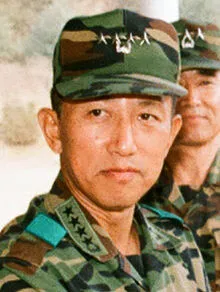
The recently appointed chairman of South Korea’s Joint Chiefs of Staff has caused a wave of controversy when remarks he made on March 26 were interpreted by North Korea to mean that the South would launch a pre-emptive strike against the North’s nuclear stockpile. Though North Korea has lambasted the remark, and Kim has denied that the remark was made specifically about North Korea, the incident has reawakened a debate about what nuclear deterrence measures, if any, should be taken by the South.
At the time, the new chairman Gen. Kim Tae-young answered in a parliamentary hearing that, “The most important thing is to strike a site that the enemy could be using to stock nuclear bombs, after confirming the location of the site, before the enemy uses them. The next thing would be to not let them be used against us.” The remark was made in response to a question from Rep. Kim Hak-song of the Grand National Party, who asked, “If we assume that North Korea has nuclear weapons, what countermeasures do we have?”
Gen. Kim and the Joint Chiefs of Staff have vigorously denied that the remark was about a “pre-emptive strike,” as North Korea insists. In a statement on March 27, the Joint Chiefs of Staff said the remark was made to describe a “general military plan for nuclear deterrence under the worst-case scenario. No mention was made about a pre-emptive strike against North Korea’s nuclear weapons.’”
On March 28, Kim said, “At the time, the remark wasn’t about a pre-emptive strike (before an outbreak of war), I was talking about it in the context of the worst case of war.”
Despite such explanations, Kim’s remarks were seen as unusual because South Korean military officials have often raised the issue of launching a pre-emptive strike on North Korean nuclear facilities since the North’s nuclear test on October 9, 2006. Immediately following the nuclear test, William Arkin, a U.S. military columnist, wrote an article for the Washington Post in which he claimed that “South Korea and the U.S. agreed to revise and expand CONPLAN 5029 to carry out a pre-emptive military operation,” referring to a contingency plan for dealing with the collapse of North Korea.
On November 9, 2006, Flight Colonel Kwon Jae-sang and Lieutenant Colonel Park Bong-gyu, two professors at South Korea’s AirForce Academy, publicly proposed a plan to “launch a pre-emptive air attack on North Korea’s nuclear weapons in the interim between North Korea’s decision to use nuclear weapons and its implementation.” Speaking at an international academic conference, the two professors urged South Korea to lay out a plan for a pre-emptive strike in advance of a possible nuclear attack by North Korea, saying, “As North Korea possesses nuclear weapons, the current strategy of ‘defense-first, attack-second’ is meaningless.” Such arguments are in line with the recent remarks made by Kim, the new JCS chairman.
In order to launch a pre-emptive attack North Korea’s nuclear weapons, South Korea could fire a cruise missile from land, drop a precision-guided bomb like the JDAM from an airplane or launch a cruise missile from an Aegis-equipped ship, experts say. The prerequisite for this would be to have perfect monitoring and surveillance capabilities in order to detect the location of the nuclear weapons, they say.
A military official said, “The U.S. is the only nation in the world pushing for a pre-emptive nuclear strike. We cannot be too careful because the matter could lead to the collapse of the Korean Peninsula,” the official said.
Please direct questions or comments to [englishhani@hani.co.kr]
Editorial・opinion
 [Column] What it will take to make a US-North Korea summit happen
 [Editorial] Seoul must be ready for anything with North Korea
- [Column] Is this America’s last Red Scare?
- [Column] Becoming stupid: Kindness videos, Blinkist and duanju
- [Editorial] USFK commander must retract, apologize for denying Korea’s territorial sovereignty
- [Editorial] US is in no position to lecture Korea about ‘fair treatment’
- [Column] The era of weaponizing intelligence to bring allies to heel
- [Correspondent’s column] US midterms: A contest of money vs. public sentiment
- [Column] Life’s too short to search for meaning in Trump’s bullshit
- [Reporter’s notebook] Why Korea can’t seem to get rid of sexual exploitation sites
Most viewed articles
- 1Lee’s posting spree is legitimizing anti-migrant sentiment in Korea, experts say
- 2In Korea, migrant children are caught between languages and left behind in both
- 3147 days of Olympic Park protests: From ballot shortage outrage to far-right rallying point
- 4North Korea answers South’s proposal for military talks by firing off ballistic missiles
- 5Four years after disaster, Itaewon families ask the world to remember their loved ones
- 6Blue House doubles down on Lee’s plan to review ‘special treatment’ for multicultural families
- 7[Guest essay] A general who talks too much, an ally who wants too much
- 8Special counsel demands death penalty for Yoon in appeals trial on insurrection charges
- 9Kim Jong-un may have used Dandong trip to relay stance on US talks to Beijing, says NIS
- 10US declines to clarify visa problems faced by Korean politicians