hankyoreh
Links to other country sites 다른 나라 사이트 링크
Kim Jong-un reconfirmed as National Defense Commission chairman
By Choi Hyun-june, staff reporter
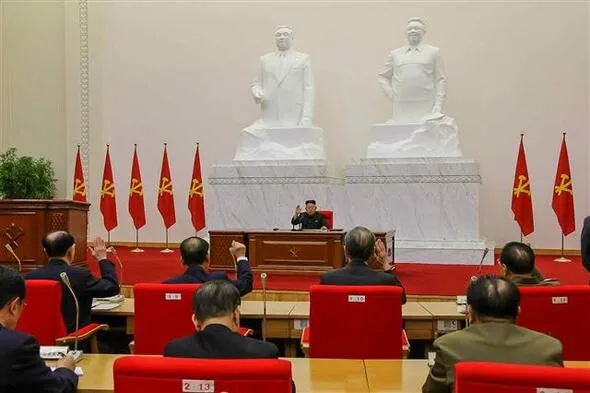
The 13th Supreme People’s Assembly of North Korea - whose members were recently elected for the first time since Kim Jong-un came to power - held its first meeting on Apr. 9. Kim Jong-un, the first secretary of the Korea Workers’ Party (KWP), was reconfirmed as the first chairman of the National Defense Commission, a position he has held since Apr. 2012, and changes were made in the members of the commission and other major state institutions such as the cabinet.
Choi Ryong-hae was elected as vice chairman of the National Defense Commission, a position that was previously held by Jang Song-thaek, former head of the KWP Administrative Department. Choi has therefore effectively taken the number two position in North Korea’s power structure. The moves could be intended to tie up loose ends after Jang’s execution and to consolidate Kim Jong-un’s power. Jang Jong-nam was appointed as a National Defense Commission member.
North Korea often decides its main policies at the first session of the Supreme People’s Assembly, whose members are elected every five years. It was at the first session of the 10th Supreme People’s Assembly in Sep. 1998 that Kim Jong-il officially inaugurated his rule, abolishing the presidential system through a constitutional amendment and having himself appointed as chairman of the National Defense Commission. In 2003, the Supreme People’s Assembly was the site of a political charade publicizing the launch of the second phase of Kim Jong-il’s regime to observers at home and abroad.
During the first session of the 12th Supreme People’s Assembly, which was held in April 2009, Kim Jong-il increased the seats on the National Defense Commission from the previous four to eight and positioned key figures in the organizations controlling the party, the government, and the military. This was when Jang Song-thaek attracted attention for his appointment to the National Defense Commission.
On Apr. 8, the members of the Political Bureau of the KWP Central Committee convened to discuss major issues including the organization of the party. While the specific items discussed in the meeting were not disclosed, the state-run Korea Central News Agency (KCNA) reported that members “discussed organizational issues and the question of how to boost agencies in order to improve the leadership role and function of the Party.” The report indicated that institutions and staff were being strengthened to support the Kim Jong-un regime in the future.
It is likely that the KWP Administrative Department, which had been led by Jang Sung-thaek, was eliminated and replaced by a new department or committee. There may also have been a reshuffle of the standing members, members, and candidate members of the KWP politburo. The members of the politburo were appointed during the 4th meeting of KWP deputies in Apr. 2012, and shifts in the power struggle in North Korea since then have resulted in quite a few vacancies. One former member of the politburo was Jang Song-thaek, who was executed in Dec. 2013. Two others were Hyon Chol-hae, former first vice-minister of the People’s Armed Forces, and Ri Myong-su, former head of the Ministry of People’s Security, both of whose names were not included on the list of deputies elected to the Supreme People’s Assembly on Mar. 9.
Among 44 cabinet ministries, only the Foreign, Forestry and Commerce Ministries had leadership changes. Ri Su-yong, former ambassador to Switzerland, was named Foreign Minister. Ri is believed to have taken care of Kim Jong-un when he was studying in Switzerland.
The KCNA reported that Kim Jong-un had “proposed the essential task of taking steps to strengthen the party as an invincible revolutionary institution, firmly defending the dignity and autonomy of the country, and vigorously aiding the improvement of the people’s livelihoods and the construction of a rich and powerful country,” but it did not provide any detailed information.
“It appears that North Korea used yesterday’s meeting of the politburo and today’s session of the People’s Supreme Assembly to wrap up the follow-up measures to the purge of Jang Song-thaek and to take preparations to reinforce the monolithic system and undertake a variety of tasks in the agricultural and construction sectors that Kim Jong-un mentioned in his New Year’s address,” said Chang Yong-seok, senior analyst at the Institute for Peace and Unification Studies at Seoul National University.
Please direct questions or comments to [english@hani.co.kr]

Editorial・opinion
 [Column] What it will take to make a US-North Korea summit happen
 [Editorial] Seoul must be ready for anything with North Korea
- [Column] Is this America’s last Red Scare?
- [Column] Becoming stupid: Kindness videos, Blinkist and duanju
- [Editorial] USFK commander must retract, apologize for denying Korea’s territorial sovereignty
- [Editorial] US is in no position to lecture Korea about ‘fair treatment’
- [Column] The era of weaponizing intelligence to bring allies to heel
- [Correspondent’s column] US midterms: A contest of money vs. public sentiment
- [Column] Life’s too short to search for meaning in Trump’s bullshit
- [Reporter’s notebook] Why Korea can’t seem to get rid of sexual exploitation sites
Most viewed articles
- 1Lee’s posting spree is legitimizing anti-migrant sentiment in Korea, experts say
- 2In Korea, migrant children are caught between languages and left behind in both
- 3North Korea answers South’s proposal for military talks by firing off ballistic missiles
- 4147 days of Olympic Park protests: From ballot shortage outrage to far-right rallying point
- 5Four years after disaster, Itaewon families ask the world to remember their loved ones
- 6[Guest essay] A general who talks too much, an ally who wants too much
- 7Special counsel demands death penalty for Yoon in appeals trial on insurrection charges
- 8Blue House doubles down on Lee’s plan to review ‘special treatment’ for multicultural families
- 9US declines to clarify visa problems faced by Korean politicians
- 10‘I’ve made peace with it’: Upward income mobility for young Koreans hits record low