hankyoreh
Links to other country sites 다른 나라 사이트 링크
85% of major Korean firms say political uncertainty could fuel exchange rate woes
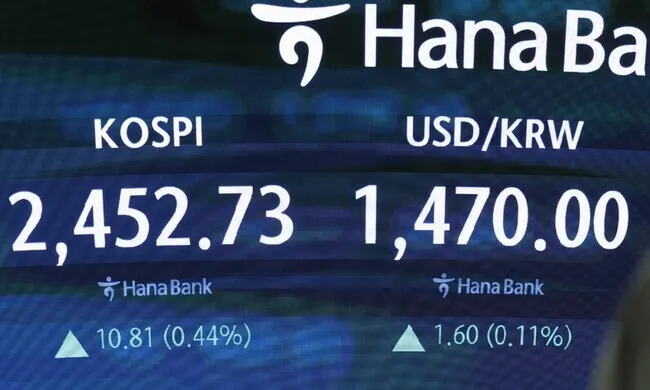
Barely 10% of Korean companies had expected the won-to-dollar exchange rate to be so high when drawing up their business plans for the year, a recent survey found.
The implication is that most major Korean companies are struggling with increased costs resulting from the unexpected spike in exchange rates. Most companies in the survey identified domestic political uncertainty as one of the risk factors behind exchange rate volatility.
These were among the results of a survey of Korea’s 50 largest conglomerates (in terms of assets) published on Thursday by the Korea Chamber of Commerce and Industry. The surveyed companies included Samsung, SK, Hyundai Motor Company, LG and POSCO. The survey elicited responses from 31 affiliates of the 50 groups, many of which are in the manufacturing sector.
Among firms that responded to the survey, 33.3% said that they expected a won-dollar exchange rate somewhere between 1,350 and 1,400 won; while 29.6% expected 1,300-1,350 won and 18.5% expected 1,400-1,450 won. This implies that over 80% of major corporations expected the won-dollar exchange rate this year to be below 1,400 won.
Only 11.1% of respondents expected the current exchange rate, between 1,450 and 1,500 won, meaning that the overwhelming majority of major firms will have to revise their business plans and come up with measures for dealing with the exchange rate.
In the Seoul forex market, the won-dollar rate (based on closing weekly rate) rose from 1,402.90 won on Dec. 3, 2023, right before the martial law declaration, to 1,455 won on Jan. 8.
Firms cited increases in costs for procuring raw materials and parts as the biggest hurdle presented by the climbing exchange rate. Additional obstacles included increases in financial expenditures on foreign investments, losses incurred by price hikes between purchase and settlement due to exchange-rate fluctuations, and the increased cost of paying off loans taken out in foreign currency.
Among respondents, 44.4% expected the won-dollar exchange rate to remain in the range of 1,450 to 1,500 won during the first half of 2025. This is a forecast of consistently high exchange rates for half a year. Firms that expected exchange rates over 1,500 won amounted to 18.5% of respondents.
Particularly notable was that the majority of respondents, 85.2% (multiple answers allowed), cited “continued domestic political uncertainty” as a potential factor that could fuel anxieties over exchange rates. As additional risk factors, firms cited the Trump administration’s new trade policies (74.1%); delays to the US lowering its policy interest rate, and fewer rate cuts overall (44.4%); imbalances in domestic management of foreign currency (22.2%); and a downgrade in South Korea’s sovereign credit rating (22.2%).
In terms of policy responses to unstable exchange rates, firms called for expanded subsidies in foreign currency liquidity and emergency measures to stabilize the foreign exchange market.
By Park Jong-o, staff reporter
Please direct questions or comments to [english@hani.co.kr]

Editorial・opinion
![[Editorial] North Korea’s rejection of unification doesn’t rule out coexistence](https://flexible.img.hani.co.kr/flexible/normal/500/300/imgdb/original/2026/0507/2517781427975787.jpg "[Editorial] North Korea’s rejection of unification doesn’t rule out coexistence") [Editorial] North Korea’s rejection of unification doesn’t rule out coexistence
[Editorial] North Korea’s rejection of unification doesn’t rule out coexistence![[Editorial] Coupang’s Kim must respect Korean law to earn Koreans’ trust](https://flexible.img.hani.co.kr/flexible/normal/500/300/imgdb/original/2026/0430/5717775362813378.jpg "[Editorial] Coupang’s Kim must respect Korean law to earn Koreans’ trust") [Editorial] Coupang’s Kim must respect Korean law to earn Koreans’ trust
[Editorial] Coupang’s Kim must respect Korean law to earn Koreans’ trust- [Editorial] USFK commander’s ‘kill web’ idea is dangerous and unworkable
- [Editorial] Appeal ruling rectifies lower court’s lenience on ex-first lady Kim Keon-hee’s corruption
- [Column] US shows China its limits in Iran war
- [Editorial] South Korea must turn to multifaceted diplomacy as North Korea-Russia military ties deepen
- [Column] Don’t shoot the messenger
- [Column] People do not live on bread alone
- [Editorial] Another act of political violence, another red flag for America’s democracy
- [Column] Trump has no idea how to fight a war
Most viewed articles
- 1Judge who convicted Korea’s ex-first lady last month found dead
- 2The 3 factors driving KOSPI’s unstoppable run
- 3As military might fails to secure victory over Iran, Trump makes rare turn to diplomacy
- 4‘Operation Fauxios’: Iran’s top negotiator denies report that US and Iran are nearing deal
- 5[Editorial] North Korea’s rejection of unification doesn’t rule out coexistence
- 6500 femicides: The epidemic of violence against women in Korea
- 7North Korea enshrines ‘two states’ doctrine in constitution, removes references to reunification
- 8New US counterterrorism strategy signals increased burden for allies like Korea
- 9Korean appeals court lowers ex-PM’s sentence to 15 years in insurrection trial
- 10With a click, 220,000+ member Telegram room generates illegal deepfake porn