hankyoreh
Links to other country sites 다른 나라 사이트 링크
Stocks beat out real estate for Koreans’ most-preferred investment option
As of July of this year, the top choice for Koreans looking to invest was stocks. Since Gallup Korea first started asking Koreans their favored form of investing in 2000, this was the first time stocks beat real estate to rise to the top spot.
A Gallup Korea survey of 1,000 Koreans aged 18 and above found that 31% of respondents picked “stocks” in response to a question about the “most beneficial form of investing.”
Stocks were followed by real estate (23%; 14% chose apartments and houses; 9% chose land), installment savings accounts (20%), and bitcoin and other virtual assets (9%).
Private equity and mutual funds, US dollars and gold, and bonds comprised 2%, 2% and 1% of responses, respectively, while 13% of respondents deferred making a choice.
The survey findings were published on July 17 after polling respondents from July 15 to 17.
In the last survey conducted on investor preferences, conducted in July 2023, 14% of respondents chose stocks as their top option, representing an increase of 17 percentage points in two years. Preference for virtual assets also increased from 2% to 9%.
Preference for real estate dropped significantly from 39% to 23%. Preference for apartments and houses dropped 7 percentage points (from 21%) in the last two years to 14%; while preferences for land purchases dropped 9 percentage points to 9%.
The change reflects a chill in the real estate market that has been ongoing for years. Preference for installment savings accounts also decreased by nine percentage points. Back in 2000, investor preference for installment savings accounts was as high as 74%.
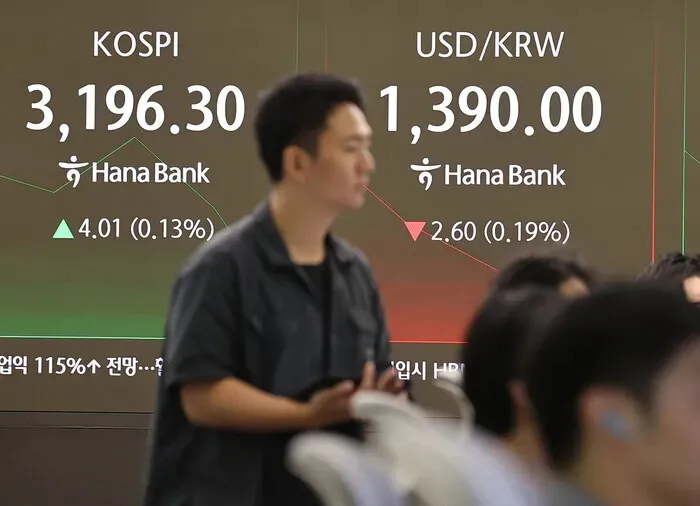
Preference for stocks remained below 10% until 2019. In 2021, when the KOSPI index rose above 3,000, it exceeded 20%. The stock market grew sluggish in the following year, and investor preference dropped to just above 10%.
“In the 14 surveys we’ve conducted since 2000, this was the first time stocks surpassed real estate,” Gallup Korea stated.
Since 2006, real estate has remained a top choice for investors (following installment savings accounts) looking to make their money work for them, but stocks have taken that top spot. Gallup Korea pointed to the current administration’s policy initiative of getting stocks to replace real estate as a priority investment strategy as a key factor behind the change.
Throughout his campaign and his term, South Korean President Lee Jae-myung has said that he is “in the same boat as 14 million retail investors” and that he will “make the stock market into an investment tool that rivals real estate, one that gives investors interim dividends and allows people to make a living through stocks.”
The amendment to the Commercial Act recently passed by the National Assembly dictates that company board members need to faithfully protect the rights of retail investors. It also mandates that board members sell their treasury stock holdings while levying a separate tax on dividend income. The Democratic Party has argued that the legislation will help raise the KOSPI and KOSDAQ indices. The party continues to pursue similar legislation.
The KOSPI fell below 2,500 in May but rebounded to 3,216 during trading on July 11. When he was a presidential candidate, Lee appeared on a YouTube livestream and said, “I invested 20 million won in the country’s top KOSPI ETF and 40 million won in the KOSDAQ ETF [likely on May 28]. For the past five years, I’ve invested a total of 60 million won in an installment ETF, with monthly investments of 1 million won.”
Lee showed his purchase records during the broadcast.
The proportion of the population of Korean adults who invest in the stock market has steadily increased from 18% in 1990. From 2000-2006 it was around 10%. In 2014, it was 15%, which rose to 21% in August 2020 and to 29% in January 2021. In 2022, it rose again to 38%.
Aside from the Lee Jae-myung administration, a factor that has contributed to stocks rising as the top preference for investors is the proliferation of mobile technology that has made investing in stocks, both domestic and overseas, more convenient. Moreover, for young people residing in Seoul, where an apartment costs millions of dollars, stocks present a much lower barrier to entry than real estate.
In the aftermath of the COVID-19 pandemic, investors across all demographics in Korea turned to US stocks. New technologies such as AI and innovations in semiconductors, EVs, and rechargeable batteries have resulted in exponential growth in emerging industries. Such growth has also contributed to investors turning to stocks.
Moreover, ETFs have experienced a major boom recently, as funds tied to the KOSPI, the KOSDAQ, the S&P 500 and the Nasdaq present a relatively lower investment risk than individual stocks. The presence of such funds adds to the allure of stocks as in investment strategy for the average consumer.
When examining generational cohorts, investors in their 40s and 50s represent the largest category that prefers stocks over other investment options. People in their 60s and 70s prefer installment savings accounts, while people in their 30s prefer real estate. Investors in their 20s (ages 18-29) choose virtual assets.
The survey had a response rate of 12.8%, with a confidence level of 95% and a margin of error of plus or minus 3.1 percentage points.
By Cho Kye-wan, senior staff writer
Please direct questions or comments to [english@hani.co.kr]

Editorial・opinion
![[Editorial] PPP leader’s trip to US is a stunt without substance](https://flexible.img.hani.co.kr/flexible/normal/500/300/imgdb/original/2026/0417/4317764157621763.jpg "[Editorial] PPP leader’s trip to US is a stunt without substance") [Editorial] PPP leader’s trip to US is a stunt without substance
[Editorial] PPP leader’s trip to US is a stunt without substance![[Editorial] Remembering Sewol tragedy is how we prevent another](https://flexible.img.hani.co.kr/flexible/normal/500/300/imgdb/original/2026/0416/6617763295917051.jpg "[Editorial] Remembering Sewol tragedy is how we prevent another") [Editorial] Remembering Sewol tragedy is how we prevent another
[Editorial] Remembering Sewol tragedy is how we prevent another- [Editorial] Close communication with incoming US ambassador will be key for alliance
- [Editorial] World must stand against any and all tolls in Strait of Hormuz
- [Correspondent’s column] Trump’s real red line isn’t Iran’s nuclear program
- [Column] Who’s calling whom a rogue state?
- [Column] Xi Jinping exploits growing rift in Transatlantic alliance
- [Column] Trump’s war boomerangs on US hegemony and alliances
- [Column] Negotiating with bombs
- [Column] What the debate over Atlas and robots in factories missed
Most viewed articles
- 1Korean A-bomb victims head to UN to tell their stories and seek accountability
- 2[Interview] Key to stewardship code is sustainable value, not box-ticking, says expert
- 3South Korea positions itself for greater influence after end of Iran war
- 4Trump hints at renewed talks with Iran, but nuclear enrichment remains a sticking point
- 5World is ‘being ravaged by a handful of tyrants ’ pope says in dig at Trump
- 6Pushed into a corner, Sewol memorial fights to keep memory alive
- 7Trump hints second round of talks with Iran could take place over weekend
- 8Lee becomes first sitting president to attend Sewol memorial ceremony
- 9Sewol survivors say their mistake was making it off the ferry alive
- 10[Editorial] PPP leader’s trip to US is a stunt without substance