hankyoreh
Links to other country sites 다른 나라 사이트 링크
To invest or not to invest: The happy dilemma that could make or break Korea’s chip industry
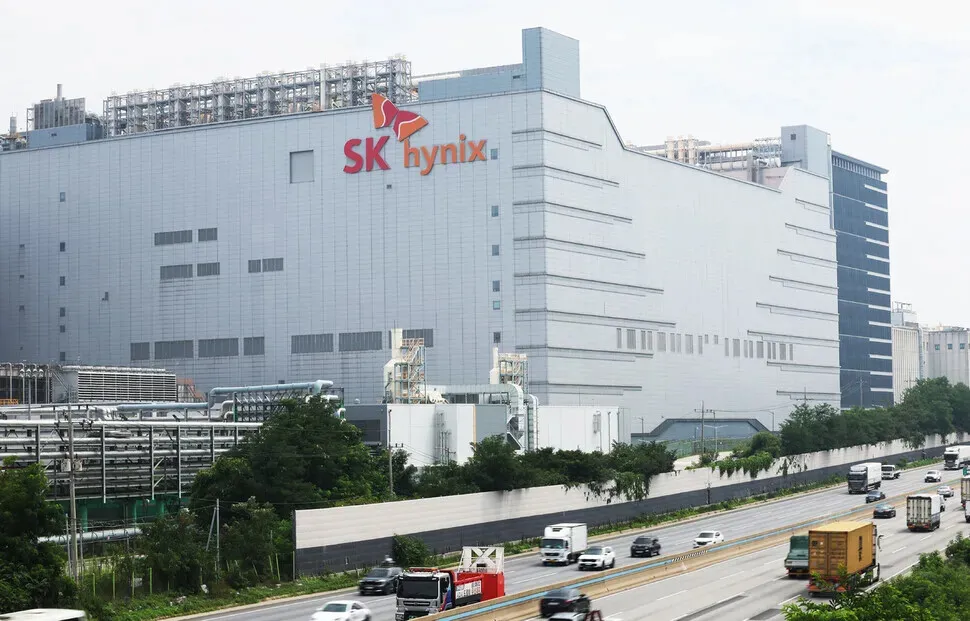
Semiconductors haven’t succumbed to the winter everyone expected. Far from frosty, the sector is as sizzling as midsummer. Morgan Stanley, the investment bank whose pessimistic predictions about chipmakers have driven volatility in the Korean stock market, has quietly changed its outlook.
Morgan Stanley had predicted a chill for semiconductors in reports last year titled “Memory – Winter Always Laughs Last” and “Winter Looms.”
But recently, the bank published a report titled “Memory Supercycle – Rising AI Tide Lifting All Boats.” The bank retracted its forecast of a DRAM price correction through the end of 2025 and predicted that prices may rise through 2027.
For a mea culpa, that comes a little late. The average fixed price of DRAM (DDR4 8GB) already began to rebound in April 2025. The price rose steadily each month, more than quadrupling from US$1.35 in March 2025 to US$6.30 as of early October.
The confounding factor for semiconductor price predictions is artificial intelligence. As components in every electronic device, chips are an integral part of the modern economy.
To make their price forecasts, semiconductor experts have generally made use of the manufacturing PMI (standing for “purchasing managers’ index”), an index tracked by the Institute for Supply Management. When the economy is strong, chip prices rise; when the economy is poor, they fall.
Undersupply persists despite poor economy
The PMI has only been above 50 in three months over the past three years. Given past trends, chip prices ought to fall. But global Big Tech firms determined to set future trends have poured huge sums of money into AI regardless of the current economic climate.
A large chunk of that money has been used to buy chips. That has produced an undersupply in ordinary DRAM, high-bandwidth memory (HBM), solid-state drives (SSD) for servers and even good old-fashioned hard disk drives (HDD).
This undersupply is due to underproduction, which itself is due to forecast failures. That is, the chipmakers would have made more chips if they’d known the chips would sell.
Deciding how much to produce is no easy task. In an off-the-record conversation that left a big impression on me, a senior manager at SK Hynix once remarked, “At the advent of the mobile era, we made a big investment based on our prediction that a massive market was opening up. Supply shortages only last two or three years. But it’s impossible to predict how far the AI era will go. And that’s true for both buyers and sellers.”
SK Hynix is basically the sole supplier of HBM chips to Nvidia, which has been a runaway success in the AI ecosystem.
It’s difficult to define the parameters of the AI industry. One could call the successful chatbots put out by Big Tech, such as ChatGPT and Gemini, AI. People use them for translation, document organization, and various inquiries. The more recently revealed reasoning models perform the same tasks but require more computing power. Instead of just spitting out an answer, it questions and evaluates its answer before offering a response. Creating presentation materials, drawing pictures, making videos and programs — all of these tasks are now in AI’s domain. AI can be put to use almost anywhere; the only limit is a lack of creativity.
Nvidia CEO Jensen Huang views the evolution of AI as following a course that goes from perception to reasoning to agentic AI to physical AI, and argues that each phase of this evolution requires a geometric progression of computing power.
An AI could communicate with other AI (A2A) to solve problems while making hotel and restaurant reservations or purchasing products. Self-driving cars may reign over the roads, and robots do the work for humans. It doesn’t take a very active imagination to think of the kind of human work that AI robots will soon do. Not only will they do everything a human can — from housework to manufacturing — they will do things that humans can’t.
All of these projects require memory chips. Memory chip producers like Samsung Electronics and SK Hynix cannot build plants in anticipation of situations that mimic science-fiction scenarios set in the far future. Yet they also cannot ignore demands for products. The numerical figures representing such demand are already beyond imagination.
During OpenAI CEO Sam Altman’s recent visit to South Korea, he announced plans to build AI data centers with Samsung in Pohang and SK Hynix in South Jeolla. Altman met with Samsung Electronics Chairman Lee Jae-yong and SK Group Chairman Chey Tae-won and announced his intentions to place orders for DRAM chips to the tune of 900,000 wafers a month until 2029.
Samsung is currently the world’s top producer of memory chips. Yet Samsung’s current manufacturing capacity for DRAM chips is 600,000 to 650,000 per month. SK Hynix’s monthly capacity is around 500,000 chips. These two firms comprise around 70% of the global DRAM market, yet Altman said he’s willing to buy more chips per month than either company can produce. But how serious is he, really?

Orders piling up
A few days after reports of Altman’s pledge, American chipmaker AMD announced that it will supply OpenAI with 6 gigawatts (GW) of GPUs, starting in the second half of 2026.
OpenAI plans to build a data center requiring 1 GW of power using the MI450 GPUs that AMD expects to launch in 2026. People expect AMD to generate tens of billions of dollars in annual revenue. It goes without saying that AMD’s AI semiconductors also require memory chips.
In September, Nvidia announced that it would invest US$100 billion in OpenAI. Nvidia announced its “letter of intent for a landmark strategic partnership to deploy at least 10 gigawatts of NVIDIA systems for OpenAI’s next-generation AI infrastructure to train and run its next generation of models on the path to deploying superintelligence.”
To start off, Nvidia will invest US$10 billion in the second half of 2026 to build infrastructure that employs Nvidia’s next-generation AI chip platform, Vera Rubin. Huang told CNBC that the 10-gigawatt project with OpenAI is equivalent to between 4 million and 5 million graphics processing units, around the total number of units Nvidia is expected to ship in 2025 and “twice as much as last year.”
In short, the additional orders are equivalent to an entire year of orders fulfilled by the largest AI chip firm in the world.
That’s not all. Bloomberg has reported that Nvidia will invest US$2 billion in Elon Musk’s xAI. Nvidia’s investment is part of the US$20 billion funding round that xAI is pursuing. xAI is building Colossus, the world’s largest supercomputer, in Tennessee. The project is expected to be equipped with 100,000 GPU units. The project is planning on boosting that up to 200,000 units when additional investments come in.
These recently announced investments in AI infrastructure will produce the equivalent of all AI infrastructure currently available. OpenAI has no cash. Its plan is to extend its lifespan through investments from Nvidia and AMD.
Suspicions of an AI bubble and cross trading have been raised. These suspicions question the feasibility of taking money received from Nvidia to purchase Nvidia chips, and of using money raised from AMD to purchase AMD semiconductors.
Regarding these qualms, Huang said that the firms don’t have any money, so they must “raise that money through, first of all, their revenues, which is growing exponentially, equity or debt.”
“When we invested in OpenAI, early on, my only regret is that we didn’t invest more,” Huang has said.
In other words, they have potential but no money, so I’m investing in them.
Unlike OpenAI, which has been really loud about its investment plans, firms with money are securing investments without making a ruckus.
Google announced back in July that it would invest US$85 billion in AI in 2025. This was up US$10 billion from initial plans. Microsoft pledged US$80 billion, and Meta US$72 billion.
“What’s going on in the world versus what happened in 2000 is just dramatically different. Back then, there were pets.com, hospitals.com. All of the internet companies combined were, what, US$30-$40 billion in size,” said Huang.
“If you look at the hyperscalers now, that’s where the first tranche of AI infrastructure is building. That’s about US$2.5 trillion of business that’s already operating today. That business, that US$2.5 trillion business, and the capex that goes underneath that is about, call it, US$500 billion,” Huang said.
Technology paradigm shift game
As demand for memory chips exceeded expectations, prices shot up accordingly. Production needs to be increased. Yet firms can’t be expected to double or triple current production based on figures in an announcement. If they overreach in their investments while demand doesn’t meet expectations, the result would be utter disaster. This sudden influx of demand has resulted in something of a happy dilemma for Korean chip firms.
Happy dilemmas, however, don’t always result in happy endings. If firms under-invest, they may be surpassed by Chinese firms and other competitors or lose their opportunity. If they over-invest, they may be the ones left in the rubble when the AI bubble bursts.
In the AI era, the chip industry is no longer about business cycles. It’s now a paradigm shift game. This happy dilemma will determine the future of South Korea’s semiconductor industry.
By Kwon Soon-woo, editor at 3ProTV
Please direct questions or comments to [english@hani.co.kr]

Editorial・opinion
![[Editorial] Head of USFK continues to cross the line with inappropriate political remarks](https://flexible.img.hani.co.kr/flexible/normal/500/300/imgdb/original/2026/0528/4817799568931091.jpg "[Editorial] Head of USFK continues to cross the line with inappropriate political remarks") [Editorial] Head of USFK continues to cross the line with inappropriate political remarks
[Editorial] Head of USFK continues to cross the line with inappropriate political remarks![[Editorial] A disgraced former president like Park Geun-hye has no place on the campaign trail](https://flexible.img.hani.co.kr/flexible/normal/500/300/imgdb/original/2026/0526/2117797859381587.jpg "[Editorial] A disgraced former president like Park Geun-hye has no place on the campaign trail") [Editorial] A disgraced former president like Park Geun-hye has no place on the campaign trail
[Editorial] A disgraced former president like Park Geun-hye has no place on the campaign trail- [Editorial] Korea’s online hate problem calls for platform regulation and anti-discrimination law
- [Reporter’s notebook] Trump’s primary purge of ‘traitors’ won’t win him anything
- [Guest essay] Moscow-Pyongyang ties are rewriting security in NE Asia
- [Reporter’s notebook] Trump’s primary purge of ‘traitors’ won’t win him anything
- [Column] An incompetent ally is worse than no ally at all
- [Editorial] Samsung’s tentative bonus deal highlights need for profit-sharing rules
- [Editorial] Crisis averted at Samsung, but society must continue chip profit-sharing debate
- [Editorial] Seoul and Tokyo should focus on pragmatic cooperation, not countering China
Most viewed articles
- 1K-pop wins big at AMAs, with BTS taking home artist of the year
- 2[Editorial] Head of USFK continues to cross the line with inappropriate political remarks
- 3KFTC eyes criminal proceedings against Coupang founder over alleged false filings
- 4[Editorial] Samsung’s tentative bonus deal highlights need for profit-sharing rules
- 5[Editorial] Crisis averted at Samsung, but society must continue chip profit-sharing debate
- 6[Reporter’s notebook] Trump’s primary purge of ‘traitors’ won’t win him anything
- 7Ambassador denies Iranian involvement after Korea concludes ship was hit by Iran-linked missiles
- 8Lee pulls off pragmatic diplomacy balancing act between strongmen Trump and Xi
- 9Seoul stops short of naming Iran as attacker in strike on ship in Hormuz
- 10[Guest essay] Moscow-Pyongyang ties are rewriting security in NE Asia